Richard F. Kosich: Who’s really behind the recent ‘No Kings’ protests around the Philadelphia region?
Thousands demonstrated in the streets across the Philadelphia region during the latest “No Kings” protest on Saturday, March 28 in solidarity with protests nationwide that largely denounced President Trump and his policies, especially those involving his “mass deportation” agenda.
It was the third national “No Kings” protest in roughly nine months, with more to undoubtedly follow. Activist members of radical groups are taking credit for these national protests, including Indivisible, MoveOn, and the 50501 Movement.
Locally, demonstrations took place from Center City, to Ardmore, to Camden, NJ, with organizers estimating about 40,000 attendees at the main Center City rally alone (i.e. City Hall to Benjamin Franklin Parkway).
Indivisible Philadelphia, along with other groups affiliated with Indivisible, played an essential role in organizing these local demonstrations.
Given that their parent organization, Indivisible national (and its affiliates), has received millions of dollars from the Left’s premier foundations and dark money networks, it raises serious questions regarding where Indivisible Philadelphia receives its financial support from, and, more importantly, what their political agenda is.
Who is Indivisible Philadelphia?
Indivisible Philadelphia was founded in 2017 to “resist Trump’s corrupt, authoritarian agenda” per the group’s Facebook page.
Their main website provides additional context: “Indivisible Philadelphia is a grassroots organization of volunteers determined to advance a progressive agenda…our aim is to educate, engage, and mobilize members to take political actions.”
Like most left-wing organizations today, they seem excessively fixated on racism in America. But fortunately their main website provides numerous “resources for anti-racism,” which, of course, no self-respecting “la Résistance” organization would be without.
Their “Anti-Racism 101 Mandatory Reading” list, for example, contains a plethora of far-left publications like “Me and White Supremacy” by Layla F. Saad, which “teaches listeners how to dismantle the privilege within themselves so that they can stop (often unconsciously) inflicting damage on people of color.”
And, of course, no anti-racism reading list would be complete without notable contributions from race hucksters like Ibram X. Kendi (“How To Be An Antiracist”, “Stamped From the Beginning: The Definitive History of Racist Ideas in America”) and Robin DiAngelo (“White Fragility and the Rules of Engagement”, “Anti-Racist Checklist for Whites”).
Regarding their values and progressive agenda, they include a long list of protester grievances, such as the “illegal” war in Iran, the rollback of transgender rights and the environment, to name just a few.
Indeed, the general script of their elected official contact information form reflects this la cause du jour approach to activism so popular amongst the anti-Trump “resistance” today:
“I’m calling [REP/SEN NAME] because I’m outraged about [insert topic here]. I ask that [REP/SEN NAME] speak out against these [insert topic here] and demand accountability before [name impact here].”
Their main conniption, however, appears to be the President’s immigration enforcement push, as many of their most recent demonstrations and webinars have targeted Immigration and Customs Enforcement (ICE) in particular.
Their January 10 “ICE OUT FOR GOOD” rally and march, for example, featured protesters carrying signs containing incendiary, anti-ICE language such as “Making safe places dangerous again. F–K ICE,” while their January 26 “Eyes on ICE: Document and Record” webinar referred to ICE as an “occupying force” and claimed that “Masked people continue to bring terror to our neighbors.”
And although their recent No Kings protest in Philadelphia was largely peaceful, similar protests in both Los Angeles and Portland, OR that same day escalated into property damage, violent clashes with law enforcement, and mass arrests after protesters in LA threw rocks, bottles and broken concrete blocks at federal officers.
Cole Allen, the California man indicted as the prime suspect in the White House Correspondents’ Dinner assassination attempt, reportedly attended at least one “No Kings” protest over the past year, according to law enforcement officials, while his “manifesto” contained similar language that groups rallying for the recent May Day protests have leveled against President Trump, calling him a “rapist,” “pedophile,” and “traitor” among other unproven allegations.
Who funds Indivisible Philadelphia and the Indivisible Project?
Indivisible Philadelphia is primarily funded through donations from its members to cover operational expenses, such as meeting space rentals, supplies for events (e.g., protest signs, post carding etc.), and equipment rentals for protests.
Indivisible Philadelphia is also eligible to receive grants from the national Indivisible organization for specific projects and materials, which can also provide direct financial support for Indivisible groups’ collaborative and capacity-building projects.
Indivisible national further offers direct reimbursements for major movement moments, such as the most recent No Kings protests, facilitated by local chapters such as Indivisible Philadelphia.
One important difference between the two, however, is that while the local chapter is mainly grassroots funded, the national Indivisible organization (Indivisible Project) receives funding from a variety of sources, including major contributions from foundations and wealthy individuals.
For example, Indivisible Project — classified as a left-of-center 501(c)(4) tax-exempt organization — has received over $7.6 million since 2017 from George Soros’s Open Society Foundations and its sister organizations.
In the past, officials with Indivisible have said that they “would ‘gladly’ accept a check from Mr. [George] Soros or his foundation”, and have accused anyone critical of that funding as being antisemitic.
Indivisible Project, in turn, gave $2.5 million to Indivisible Action during the 2024 campaign cycle according to Open Secrets, one of the nation’s premier research groups tracking money in U.S. politics and its effect on elections and public policy.
As a “Carey committee,” also known as a “hybrid PAC/super PAC,” Indivisible Action can collect unlimited contributions from almost any source for its independent expenditure account.
And since 2018, Indivisible Action PAC has given $507.6K in collected contributions to federal Democratic candidates exclusively.
This helps underscore how money from organizations like Open Society Foundations can be filtered through “pass-through,” tax-exempt 501(c)(4)s like Indivisible Project, then to ideological and highly influential super PACs, all perfectly legal according to federal campaign laws and regulations.
Socialist links and communist affiliations
The Indivisible Project was created in late 2016 by left-of-center activists Ezra Levin and Leah Greenberg in response to the election of President Donald Trump, and provided Democratic voters a practical guide for “Resisting the Trump Agenda.” The movement has since evolved into an effort to disrupt civil discourse and “sustain a powerful progressive movement.”
Sarah Dohl, Indivisible’s chief communications officer, has said, “It’s not a secret that we would like to move the Democratic Party further to the left.”
But just how far to the left? Well, it’s also no secret that Indivisible and certain socialist organizations in the United States, such as the Democratic Socialists of America (DSA) and the Working Families Party (WFP), share common goals in opposing right-wing policies and promoting progressive agendas. This often results in overlapping activities at the local level by creating a space for more radical, leftist, and socialist organizations to operate.
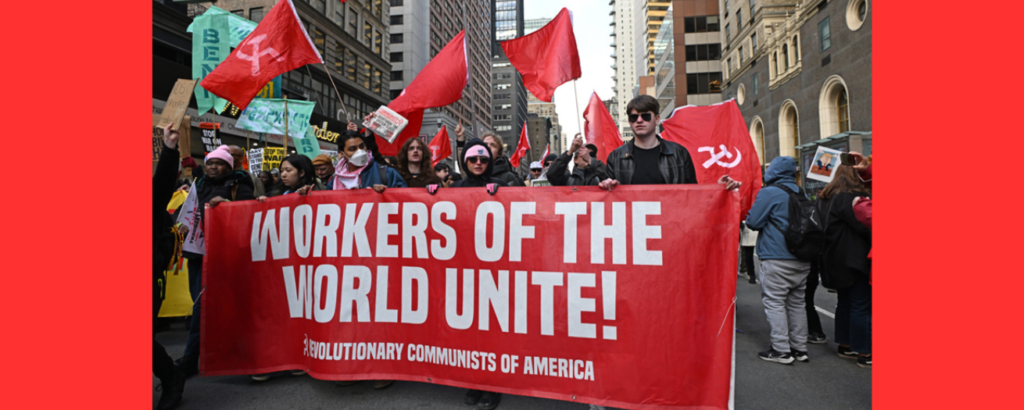
For example, the Communist Party USA (CPUSA), the Party for Socialism and Liberation (PSL), and the Revolutionary Communists of America (RCA) all marched alongside more mainstream Democrats during the March 28 No Kings protest in NYC, where they waved red banners emblazoned with the traditional Soviet hammer and sickle while chanting “There is only one solution — communist revolution!”
And when Ezra Levin was questioned by Katie Pavlich of NewsNation during a March 27 interview about letting certain communist-aligned groups into the No Kings III protests, he deferred by bringing up the same old tropes about January 6 (what else?) and hid behind the First Amendment in response.
A similar inquiry for this article sent to Vicki Miller, Group Leader of Indivisible Philadelphia, asking if communist-aligned groups like the CPUSA, PSL and/or RCA would be permitted in their next demonstration went unanswered.
Why this matters
Indivisible and national socialist groups (like the DSA) are experiencing surges in membership and are part of the broader anti-Trump “resistance,” as they both align on a wide range of “progressive” issues while adopting similar tactics.
Local Indivisible chapters also often collaborate with a wide array of liberal and left organizations, including socialist ones, to organize protests and community events. Activists involved in these socialist movements may also participate in local Indivisible groups, like Indivisible Philadelphia, and vice-versa.
And as the No Kings demonstration in NYC has shown, Indivisible provides a “big tent” space that connects more revolutionary Marxist-Leninist organizations (PSL, RCA, etc.) with conventional progressive efforts, thus allowing communist activists to operate within a larger, more mainstream resistance movement.
The demonstrations Indivisible Philadelphia and other local Indivisible chapters have helped organize so far have been largely peaceful, but as LA and Portland, OR have shown, they have the potential to quickly dissolve into acts of violence by those intent on the “revolutionary overturn” of capitalism (including “smashing” police, prisons, courts, etc.) to help usher in a Marxist “utopia,” which should concern all of us, or at least those who aren’t fans of Mao’s little red book.
Richard F. Kosich is a writer, community organizer, Chair of the Conshohocken Borough Republican Committee (CBRC), and vice-Chair of the Colonial Republicans. Opinions are his own.