Felice Fein: Pennsylvania’s budget — balanced or bazinga?
When Dr. Sheldon Cooper from “The Big Bang Theory” would pull a prank on someone, rather than “gotcha” he would say “bazinga!” Who knew the term might be appropriate when discussing the Pennsylvania budget?
Pennsylvanians suffered while legislators and the Governor’s Office argued/negotiated the details of the current fiscal year budget, which was delayed by four months. What was the center of the impasse? Spending levels. The Governor wanted to spend more and the Republican-led Senate tried to limit increases. Eventually, there was compromise.
A mere three months after signing the 2025-2026 Pennsylvania budget into law, Governor Josh Shapiro released his proposed budget for the 2026-2027 fiscal year on February 3, 2026. He must have enjoyed the negotiations last year because this budget is sure to meet as much resistance or more than the previous one.
On April 16, 2026, the PA House passed HB 2400 that appropriates funds by department for Governor Shapiro’s 2026-2027 Budget. The $53.3 billion budget increases spending by 5.4 percent, while using almost 60 percent of the “Rainy Day Fund” to balance. Some legislators are already gearing up for the fight and trying to mitigate the impact on citizens.
Spending
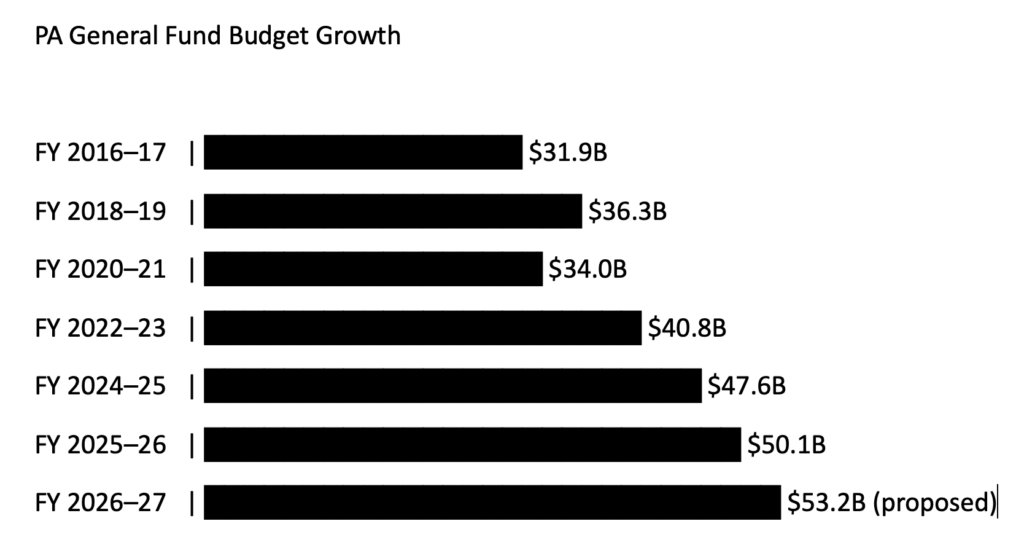
Over the last ten years, the General Fund expenses have increased 67 percent or $22.3 billion. The last four years have seen the sharpest rise in spending in the decade with a 30 percent increase. There are two primary drivers of the growing expenses in the state budget: Department of Human Services (DHS)/Medicaid and Education.
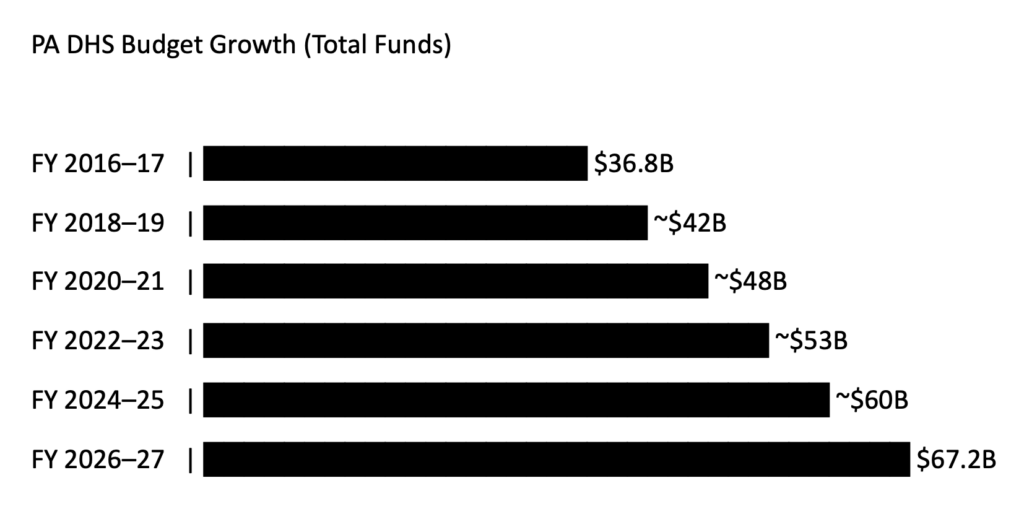
DHS includes Medicaid applicants, Long Term Care, and disability programs among others. This is the fastest growing area of the budget due to increased medical expenses and an aging population. Over $10 billion in Medicaid funding is supplied by the federal government in this proposed budget. Additional funding allows programs to expand services and increase payroll. Once programs are expanded, they never contract. In fact, this department’s budget has increased over 80 percent in the last decade.
Education spending is the largest purely state driven category of expenditures in the budget. The biggest reason for the increased education spending over the last few years stems from a landmark 2023 Commonwealth Court decision. In it the court ruled that Pennsylvania’s executive and legislative branches must reform the school funding system to provide a high quality public education to all students no matter their economic background. It appears the term “reform” simply means “spend more money” to this administration. There are large targeted “block grants” going to underprivileged school districts. An analysis needs to be done to see if more money improves test scores for those districts. From what we’ve seen, it has not.
Revenue
Good news! The proposed budget does not include a broad-based increase of the personal or sales tax. How is the increase in expenditures funded?
- Legalization & taxation of recreational marijuana – this measure is expected to provide $729 million in revenue to the commonwealth.
- Regulation & taxation of skill games (as played in many bars and restaurants) – this measure is expected to provide $766 million in revenue.
- Budget Stabilization Reserve Fund (“Rainy Day Fund”) – $4.6 billion will be deducted from the Rainy Day Fund, leaving a balance of $3.3 billion.
Although this budget doesn’t increase taxes, it may be creating a structural deficit such that future tax increases are assured. Using 60 percent of the Rainy Day Fund to balance this budget is irresponsible. The fund was established in 1985 to set aside extra revenue in prosperous times to be used as a safety net during economic downturns.
In 2025, Governor Shapiro planned to use $1.6 billion of the Rainy Day Fund to balance the budget. Negotiations led to balancing the budget without withdrawing from the fund. Now, the governor wants to pull $4.6 billion from the fund for next year! The economy is not in recession, quite the opposite; it is expanding. Rather than use the Rainy Day Fund as intended, it appears Governor Shapiro wants to use it as a piggy bank to pay for already bloated programs.
Deadlines
The new fiscal year begins July 1, 2026. It stands to reason that a budget should be in place before the start of the new year. As such, the Pennsylvania Constitution requires the budget to be enacted no later than June 30. However, given the four-month delay in passing the 2025-2026 budget, the legislature is readying for an impasse over the governor’s proposed budget. As a result, two state representatives are calling for contingency planning.
Rep. Melissa Shusterman (D-Chester) plans to put forth a two-bill package which would:
1. Require the General Assembly to stay in session every weekday after June 30th if a budget is not passed;
2. Amend the PA Constitution to require the governor to call a special session if a general appropriations bill is not enacted.
Rep. Brian Rasel (R-Westmoreland) plans to put forth legislation to create the Temporary Budget Continuity Act when a budget impasse occurs. It would allow the government to continue to operate during budget negotiations by granting the state Treasurer the authority to pay operating expenses up to 85 percent of the prior year’s appropriations.
Pennsylvania’s budget has exploded over the last four years. The proposed budget spends $4.6 billion more than the state will receive in federal grants or taxpayer dollars. To balance the budget the governor believes it necessary to use money put in a reserve fund from prior years of good stewardship.
What happens next year when the depleted Rainy Day Fund doesn’t have enough to meet those additional expenses? What happens if the Commonwealth of Pennsylvania has a true emergency like a natural disaster or economic downturn? Is the proposed budget really balanced? No, it’s a joke. Bazinga!
Felice Fein is the Executive Director of Keystone Fair Business Partners, a 501c6 membership organization supporting the shared interests of its members as it educates southeastern Pennsylvania with facts about issues and policies that impact local businesses and families.