Terry Tracy: Stay and fight — Why John Fetterman should remain a Democrat
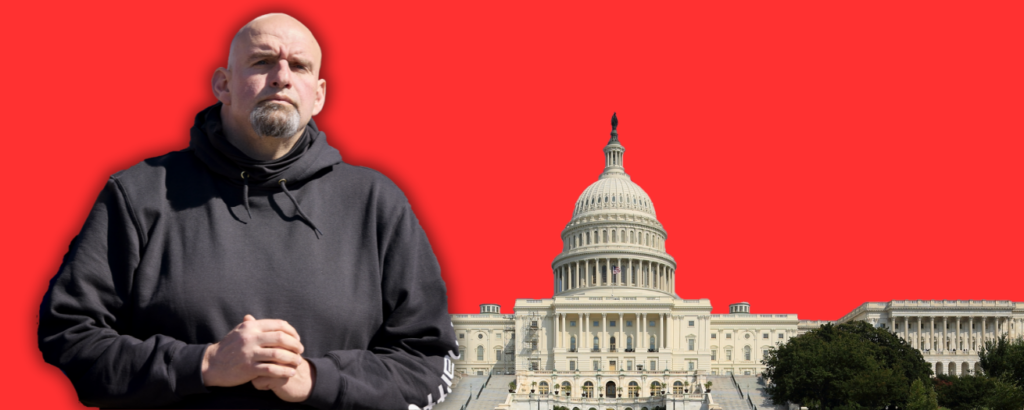
John Fetterman’s recent Washington Post essay was written in response to growing speculation that he may eventually leave the Democratic Party.
Fetterman was not merely defending his partisan affiliation. He was defending the very concept of dissent within a political coalition now deeply uncomfortable with internal dissent.
He argues that parts of the Democratic Party have drifted away from durable public sentiment on issues from border security to public order. More significantly, he suggested that too much of modern Democratic politics has become reflexively oppositional — less a governing philosophy than a permanent performance of resistance.
One need not agree with every conclusion he reaches to recognize the value of the argument.
Indeed, that value exists precisely because Fetterman remains a Democrat.
If he became a Republican tomorrow, much of the force behind his critique would evaporate instantly. It would become predictable. Another former Democrat attacking the left while safely outside the coalition rather than forcing uncomfortable introspection within it.
Pennsylvania has a long history of rewarding political heterodoxy — and punishing politicians who abandon it for institutional convenience.
Arlen Specter spent decades frustrating conservatives inside the Republican Party. That frustration was precisely what made him politically valuable. Specter forced the GOP to remain in conversation with constituencies that ideological purists would have happily abandoned.
Then he switched parties.
At the time, the move was presented as pragmatic sophistication. In retrospect, it looks more like institutional surrender. Specter stopped shaping the internal argument and simply relocated himself to a coalition where neither side fully trusted him.
He lost not only his seat, but his political purpose. Fetterman should avoid repeating that mistake.
What makes Fetterman politically significant is not merely that he occasionally breaks with Democrats. Plenty of politicians perform independence so long as it remains safely within the boundaries of elite approval.
What distinguishes him is his apparent willingness to absorb genuine hostility from within his own coalition — a rarity in modern American politics.
Today’s political culture rewards ideological conformity masked as moderation — carefully managed deviations from party orthodoxy calibrated to preserve the appearance of independence without threatening the coalition’s goals.
Too often, what passes for moderation in American politics is not independence at all, but ideological conformity delivered with superior media discipline. The feeling of moderation without any of the substance.
This is where the contrast with Josh Shapiro becomes especially revealing.
The long-running tension between Fetterman and Shapiro is sometimes treated as a matter of personality. Perhaps some of it is. But the more useful lesson is not personal — it is political.
Fetterman’s own account of their falling out, rooted in disputes over Pennsylvania’s Board of Pardons, suggests a deeper conflict between two governing instincts: one willing to risk institutional discomfort in pursuit of a moral judgment, the other more cautious, lawyerly, and attentive to political exposure.
That contrast runs through the broader argument.
Governor Shapiro is plainly intelligent, disciplined, and politically gifted. He has constructed a national image as a pragmatic Pennsylvania moderate capable of translating progressive governance into culturally acceptable terms for swing-state voters.
But that moderation is aesthetic rather than substantive — tonal rather than structural.
To be fair, Shapiro was right to condemn the antisemitic targeting of Goldie in Philadelphia and right to criticize the moral evasions surrounding antisemitism at the University of Pennsylvania during the unfortunate tenure of Liz Magill.
In those moments, Pennsylvanians glimpsed a version of Shapiro willing to confront activist excess directly rather than merely manage around it.
The obvious question is why that instinct disappears once the cameras are turned off in Philadelphia and actual governing begins in Harrisburg.
Because when progressive pressure collides with governing decisions, the independent moderate too often recedes and the political choreography resumes.
Shapiro’s rhetoric remains carefully calibrated toward Pennsylvania sensibilities. His governing posture, however, often bends back toward the gravitational pull of national Democratic politics — donors, consultants, activist organizations, institutional staff cultures, and the ideological expectations of elite progressive infrastructure.
That is not a problem only with Shapiro. It reflects the broader evolution of elite Democratic politics itself: a coalition that increasingly mistakes ideological uniformity for moral clarity.
Fetterman operates differently.
Whatever one thinks of him, he appears far less interested in managing elite consensus. In fact, much of the hostility directed toward him stems precisely from his unwillingness to reflexively genuflect to progressive orthodoxy.
He says things the coalition would prefer remain unsaid. He forces arguments the Democratic Party would prefer to postpone. And he often does so before permission structures exist inside national media or institutional Democratic culture.
Political courage is not saying controversial things once elite opinion shifts safely in your direction. Political courage is risking coalition disapproval before consultants approve the language and donor networks determine the political weather.
Pennsylvania voters still understand this intuitively.
Perhaps that is because Pennsylvania itself remains too culturally contradictory to be managed entirely through political marketing. It is economically populist yet institutionally cautious. Socially tolerant yet deeply skeptical of ideological coercion. A state where working-class ethnic Democrats, suburban professionals, organized labor, and small-town conservatives still uneasily coexist within the same civic terrain.
Pennsylvania voters possess an unusually refined instinct for distinguishing genuine conviction from political choreography.
They know when a politician actually believes something.
And they know when he is navigating.
Fetterman’s critique of his own party carries real political weight because it feels less like positioning and more like actual disagreement.
Shapiro, by contrast, too often appears more committed to navigating institutional expectations than confronting the underlying causes of political division directly.
That may serve his national ambitions. It may play well in future Democratic presidential politics where stylistic moderation is often rewarded more than substantive independence.
But it does very little to help Democrats reconnect with the culturally moderate and working-class voters they continue losing across Pennsylvania and throughout the industrial Midwest.
Which is precisely why Fetterman should stay where he is.
Because parties do not renew themselves through ideological purification. They renew themselves through internal challenge — through figures willing to argue with their own side before voters force the argument upon them electorally.
If Fetterman leaves the Democratic Party, his critique becomes partisan.
If he stays, it remains dangerous.
And danger — intellectual, political, institutional — is often the beginning of honesty in democratic life.
Terry Tracy is the publisher and CEO of the Fideri News Network.