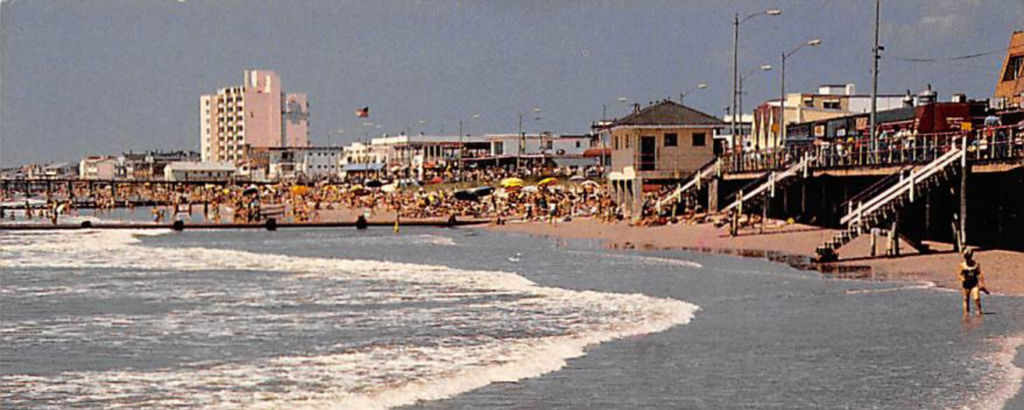
Gerard St. John: The shore, the church, and the Bagel
On March 15, 1958, the St. Joseph’s College basketball team played St. Bonaventure in the quarterfinal round of the National Invitation Tournament in New York City. In those days, the NIT was a major post-season basketball tournament; some people said that it was “the” major tournament.
It was held in the old Madison Square Garden on Eighth Avenue at 50th Street. The 18,000-seat “Garden” was a great sports venue. It was right out of Damon Runyon; and so were some of the regulars who inhabited the smoke-filled recesses of that hallowed site. Adding to the attraction in 1958 was the fact that the game was being played on Saturday night of the St. Patrick’s Day weekend. We took an early afternoon train to New York. When we boarded the train at 30th Street Station, Sadie Haughton was especially excited. He said that I would get to meet “the Bagel.” I had no idea what he was talking about.
After the train pulled into New York’s Penn Station, we walked several blocks to a small Irish pub. It was late in the afternoon – too early for the game. “He said to meet him here,” said Sadie. Near the front of the establishment, in a booth by himself, was a man in his early 30s (which, at the time, we considered to be middle age), wearing an old-time baseball jacket, the kind that had a woolen body and leather sleeves. He was holding a black cigar. It was Reverend Robert H. Breen, a recently ordained priest with the curious nickname “Bagel.”
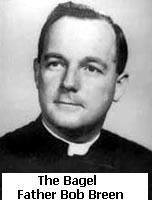
During the summers of his last few years in the seminary, Breen worked as a counselor at the Gwynedd Mercy Day Camp. Counselors were expected to reward successful campers with tokens of victory in the daily games. Some counselors awarded ribbons; others awarded medals or coins. The token was left to the discretion of the individual counselor.
No one told Bob Breen of that expectation until his first morning at the camp. Breen then scurried around the camp like a kid on a scavenger hunt, looking for some trinkets that he could use to recognize the victors in that morning’s events. There was nothing in sight. Then, he went into the kitchen, and there was a bag of bagels. Bagels became both his award and his life-long nickname.
At the Irish pub, Sadie introduced him to me as “Bagel.” I said, “That is all I have heard for the past two hours on the train.” He replied, “All I have heard for the past week is that I was going to meet the Saint.” We talked for about an hour or so and then walked over to the Garden where we went our separate ways. Bagel reminded me of the priest played by Bing Crosby in the popular movie, The Bells of St. Mary’s.
The following year, after graduation from St. Joe’s, I went into the Marines. From September 1959 through June 1960, I was stationed at Marine Corps Schools, Quantico, Virginia. During that stretch, I spent most of my spare time in Philadelphia and at the Jersey shore. I knew that in June I would probably be transferred to a distant Marine Corps base. Still, Sadie insisted that I join him and a group of friends in renting a house for the summer in Ocean City, New Jersey.
Obie O’Brien organized the group and named it “Chez Dix” (house of ten), even though there were twelve of us involved. Obie graduated from La Salle High a year or so behind me. Approximately half of the Chez Dix group was from St. Joe’s and the other half was from La Salle College. The La Salle people were about a year younger than the St. Joe contingent. That meant that most of them were too young to be served at the nearby drinking establishments, a fact that we knew would cause us problems. The oldest member of Chez Dix was our chaplain, Father Bob Breen – the Bagel.
I was right at home with the concept of a chaplain. Chaplains are a traditional part of the military, dating back to the English navy more than one thousand years ago. Typically, the chaplain is a priest who provides support for the spiritual and emotional needs of the crew. As chaplain of Chez Dix, Bagel had his work cut out for him.
It wasn’t long before Bagel’s practical skills came into play. One of the younger members of the house frequently found himself in the clutches of law enforcement officials of the neighboring town of Margate, New Jersey. The typical fine for underage drinking in Margate was about $100. That was a lot of money at that stage of our lives. We sympathized with our friend’s predicament, but most of us thought that he created the problem, and that he was the one who should resolve it. Bagel stepped into the breach.
Bagel was about ten years older than most of us. He graduated from La Salle High in the closing days of World War II. He attended classes at Pennsylvania Maritime Institute, which prepared him for a career in the merchant marine. During his second year at the Maritime Institute, he signed on with the merchant marines. To hear Bagel tell the story, you would think of John Wayne and the U.S. Marines on the Sands of Iwo Jima. In fact, he was the purser on a cruise ship.
Soon he heard the call to the priesthood and entered St. Charles Seminary. During his hitch in the merchant marines, he gained some practical experience in dealing with personnel problems. The ship’s crew stuck together. If money was lost or stolen, each member of the crew would throw $10 into a pot to help refinance the loser. The crew members would not miss the ten-spot, and although the amount collected would not be as great as the loss, the victim would be restored to solvency and would feel like a part of a cohesive team. It was a good remedy.
On the other hand, repeat offenders tend to generate a good bit of resentment. When we saw Obie on the beach in the morning going from person to person, we knew that Hank had done it again, and we began to grumble. I probably grumbled less than my cohorts. My allotted time on the East Coast was coming to an end. I was shipping out. My orders called for me to report to Camp Pendleton, California by the second week of August 1960.
My last two weeks at the Jersey Shore bore little resemblance to the festive “farewell tours” of present-day athletes, but it was a fun time. However, on my last day in Ocean City, when I pulled up to Chez Dix to pick up my gear, there was a noticeable chill in the air.
“What’s up?” I asked.
“Bagel’s leaving,” was the terse reply. “He’s upset because we let Nancy McGinn sleep on the porch last night when her girlfriends left Ocean City without her. She had no place to stay. Bagel’s upstairs packing his bags.”
I decided to take a walk upstairs.
Bagel was in the front room. A small suitcase lay open on the bed. Bagel’s eyes were fixed on an open dresser drawer. He did not look up as I entered the room.
“Father Breen (I rarely addressed him as ‘Bagel’), I thought that I was the one who was leaving.”
“I can’t stay here, Saint, not after last night. They let a girl stay in the house overnight. Everyone knows that I’m a priest. We set the rules at the start. No women were to stay in the house. I have to insist on that rule.”
“Well Father, I just heard about this a few minutes ago – but what I heard sounds a lot different.” I was tempted to say, “That was no girl; that was Joe’s sister.”
But I did not say that. I said, “Nancy always stops over here to talk to Joe and the rest of the guys. She is like family. She had no place to stay. It was late. What were they to do? Besides, it was not like they gave her one of the bedrooms; they let her stay on the front porch.”
Father Breen turned around and looked at me, but he did not say anything. He was thinking. I pushed it a bit farther. “It seems to me that you serve a real purpose here. Issues like this are going to come up whether you are here or not. This group is going to be a whole lot better off if they have your guidance. Isn’t that what being a chaplain is all about?”
At that point, I reminded the Bagel that I had to leave for Camp Pendleton. I bade my farewell and added, “I hope that you change your mind and stay.” I never did hear what transpired after I left, but I have the strong impression that the Chez Dix chaplain served his full tour of duty that summer.
Three years later, when I returned to the East Coast, things had changed. My Chez Dix T-shirt was long gone. It was shredded by the underbrush on the island of Okinawa. Most of the ten – or twelve – members of our 1960 seashore house were now married and pursuing their own lives. Chez Dix existed only in our memories.
On occasion, I would hear stories about Father Breen. He was a teacher at Cardinal Dougherty High School in Olney (at the time, the largest Catholic high school in the world); he was the golf coach at La Salle College; he was a parish priest at St. Anne’s in Port Richmond or a pastor in rural Riegelsville; he was the chaplain for the teams in Philadelphia’s Big-5 Basketball program – and at one point for the Philadelphia Eagles football team.
On rare occasion, we had passing contact. At the conclusion of Sadie Haughton’s funeral Mass, Father Breen glanced at the pallbearers and said, “It looks like the Chez Dix.” There were similar comments at the wedding of Jim Gavaghan’s daughter Maureen and Scott Arnold, a member of Breen’s La Salle golf team.
It did not occur to me at the time, but a chaplain’s social circle is often defined by the boundaries of his current crew. During the course of the chaplaincy, there is close contact between the crew and the chaplain. Members of the crew seek out the chaplain to officiate at their weddings, and to baptize their first born. When the chaplain moves on to another assignment, he slowly loses contact with the earlier group. A few years ago, when Father Breen reached retirement age, he was assigned to Villa St. Joseph, the priests’ retirement home in Darby. In retirement, Father Breen helped out with the weekend Masses at St. Andrew the Apostle Church in Drexel Hill – my parish. My contact with the chaplain had come full circle.
Bagel now added my name to the list of people he could call when he needed a ride. Rides became a frequent need when Bagel’s declining health made him give up his car. A retirement home is not a pleasant place for someone who is accustomed to a high level of social activity. Many of the retired priests are in poor physical or mental health, and they live in their own tightly circumscribed worlds. For active priests like Bagel, the urge to get away is overwhelming.
One of Bagel’s getaways is the weekly lunch of the Markward Club, the group that supports high school basketball in the Philadelphia area. Bagel is the unofficial chaplain of the club. Invariably, he is asked to say grace before meals. He jokes about the time that a lunch occurred on Ash Wednesday, and the club arranged for him to have an adjoining room where he distributed ashes to people who attended the luncheon.
Ash Wednesdays present Bagel with a different challenge. He is a picky eater. On the fifth day of creation, God did not create a single fish that Bagel believes is edible. Vegetables? Father Breen’s nephews insist that as a child he was attacked by a carrot and a bunch of broccoli. His penance on Ash Wednesdays is to have scrambled eggs for all three meals. The Markward Club also gave the aging chaplain a chance to re-connect with some of his former charges from years gone by: Billy Oakes, a St. Joe guard and NBA referee; Herb Magee, the hall-of-fame basketball coach; Joe Heyer, the sharpshooting guard from La Salle; Don DiJulia, St. Joe’s athletic director; Fran Dunphy who coached at La Salle, Penn and Temple; and a host of other people from the past.
In retrospect, Bagel could not have picked a worse time for his retirement. It coincided with a series of Philadelphia grand jury reports that accused many priests of sexual abuse crimes against juveniles dating back to the 1940s. That evil was compounded by the poor judgment of archdiocesan officials who failed to confront and deal forthrightly with the criminals. Sensationalized publicity gave the impression that all Catholic priests are hiding their own past acts of sexual abuse. These are trying times for an old chaplain who served his flock with distinction for more than 50 years, and always confronted his crew when it was going astray. Now, like many other Catholic priests, he is being viewed with suspicion by people who never had any contact with him.
In contrast, those of us who have known Bagel for many years recognize his contributions to our lives. He is a member of La Salle High’s hall of fame. The Cardinal Dougherty High School Alumni Association dedicates its annual golf tournament to Father Breen in recognition of his “56 years in the priesthood and for all he has done for both the Cardinal Dougherty Community and the church in the Delaware Valley.”
The archdiocese did not help this exemplary priest when they housed many of the abuser-priests in a “prayer and penance” program in Villa St. Joseph, thereby forcing Bagel to live side-by-side with the malefactors who disgraced him and all other priests. Moving out of the Villa to a private dwelling place is not an option because a priest’s retirement compensation is minimal and even that small sum is being reduced by an archdiocese that is trying to cut expenses in all areas.
On Thursday afternoons, Father Breen and I get together with a group that Bagel calls “The Old Geezers.” It is a group of about fifteen retired men, most of whom had some connection with high school athletics in the 1940s and 1950s. The youngest member was one of Father Breen’s students at Cardinal Dougherty High School in the 1960s. The topics of discussion vary widely. As befits a chaplain, Father Breen rarely criticizes any particular individual. Similarly, he rarely comments on the failings of the archdiocese or his fellow priests. Not long ago, he was asked point-blank what it was like to be a long-term priest living in the shadow of the sex abuse scandal where many members of the public wrongly assume that every priest is a sexual abuser. Bagel hesitated for a moment, and then summed up his thoughts in one short sentence:
“It is a different kind of martyrdom.”
Postscript: Reverend Robert H. Breen died on August 2, 2018, at the age of 91 years. His funeral Mass was celebrated at St. Andrew the Apostle Church in Drexel Hill. The church was packed with mourners.
Gerry St. John is a retired lawyer who lives in the suburbs of Philadelphia. He was graduated from St. Joseph’s College and Temple University School of Law. Between these educational endeavors, he spent nearly four years in the United States Marine Corps, most of it in Camp Pendleton, California, and in the Far East during the Cuban Missile Crisis. For more than 45 years was a civil trial lawyer, and for nine years a member of the adjunct faculty at Saint Joseph’s University.