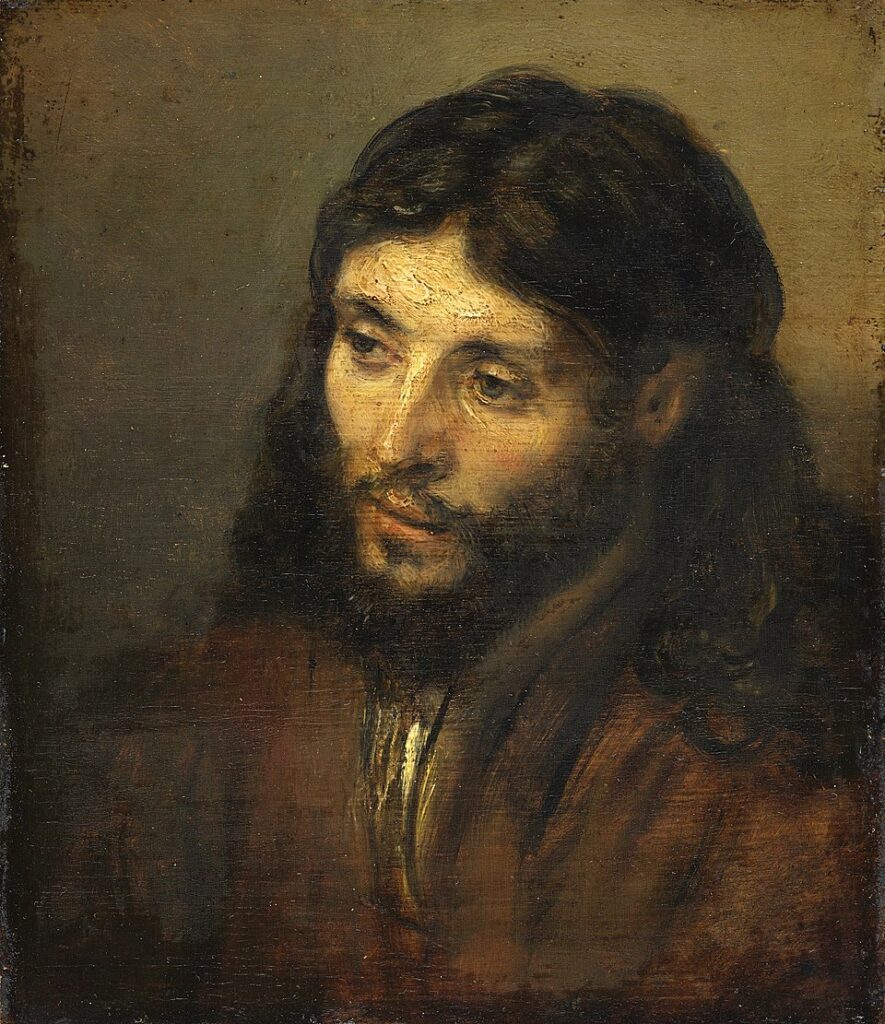
Thom Nickels: The changing face of Jesus
In August 2011, the Philadelphia Museum of Art, the Louvre, and the Detroit Institute of Arts, organized the Rembrandt and The Face of Jesus exhibit on the Parkway.
The exhibit allowed Philadelphians an opportunity to view “human friendly” images of Jesus. Prior to Rembrandt van Rijn, artists ignored their imaginations when it came to portraying Jesus but followed standard images based largely on Veronica’s Veil, (the imprint of the face of Jesus taken when Veronica offered Jesus a cloth to wipe his face on the way to Calvary) or the Holy Mandylion, a legendary imprint of the face of Christ in the Orthodox world that originated well before the crucifixion.
The Rembrandt exhibit came pretty close to capturing what Jesus may have actually looked like. For starters, Rembrandt used mostly Jewish models. But a Jewish Jesus in Rembrandt’s day was a revolutionary thing.
History tells us that immediately after the crucifixion Jesus was pictured as a clean shaven, Apollo-like deity. In the 4th century, most Jesus images had the close-cropped hair we see today on most Byzantine icons. (These images seem to jive with St. Paul’s famous admonition against men having long hair.) By the 6th century, the tide had turned and Jesus was being painted as someone with long hair and a beard. What helped this new view was the discovery of the Shroud of Turin in the city of Edessa (Mesopotamia) in 544.
What Jesus might have looked like has always been a subject for speculation.
With the exception of those who worshiped foreign idols such as Moloch, most Jews of ancient Israel remained faithful to the Mosaic edict against “graven images.” Jewish Law forbade the depiction of living people.
“This prohibition was even respected by King Herod, who reveled in pagan luxury himself,” wrote Jean-Pierre Isbouts in “Medium.”
“Throughout his reign, he made sure that his coins avoided the usual portrait of the Roman emperor or any other representation of humans (such as himself) that could offend the Jewish commandment against the representation of living beings.
This is the reason why no contemporary image of Jesus has survived. Jesus lived and ministered in a devoutly observant environment, where the precepts of the Torah were scrupulously adhered to.”
In my Irish-German Catholic childhood home, the Jesus images on the wall had an Irish troubadour look: Long soft dark hair and a tranquil-looking face without lines or blemishes. Rembrandt’s models, however, are certainly not Irish. Going back to the 2nd century, you can read how Church Fathers Justin Martyr and Origen thought that Jesus was unattractive. Both men held fast to the Isaiah 53 quote: “He has no form nor glory, nor beauty when we beheld him, but his appearance was without honor and inferior to that of the sons of men.”
Then there was St. Augustine, who said, “The physical face of the Lord is pictured with infinite variety by countless imaginations, though whatever it was like He certainly had only one.”
In the 20th century, psychic Edgar Cayce wrote that Christ had long red hair and steely blue eyes. Cayce goes on to explain that among Jews the birth of a red haired son was always a special event.
The famous Lentulus letter, allegedly written by a predecessor of Pontius Pilate, spells out Christ’s appearance:
“…Hair is the color of ripe hazelnut, parted on top and falling straight to the ears yet curling further below. His beard is large and full but not long and parted in the middle. His glance shows simplicity adorned with maturity, his eyes are clear and commanding. Never apt to laugh but sooner inclined to cry.”
The historic record also holds clues the issue of Jesus’ height. A Popular Mechanics article about what Jesus may have looked like — titled, “Advances in forensic science have revealed the most famous face in history” — tells us that from an analysis of skeletal remains, archeologists had firmly established that the average build of a Semite male at the time of Jesus was 5 ft. 1 in., with an average weight of about 110 pounds. Furthermore, since Jesus worked outdoors as a carpenter until he was about 30 years old, it is reasonable to assume he was more muscular and physically fit than those rather feminized westernized portraits suggest. His face was probably very weather-beaten, which would have made him appear older, as well.
The 2011 exhibition was a sort of gamble for PMA. Since it was highly religious in nature, it appeared to some that the museum was paying special homage to Jesus.
On Facebook at that time I recall someone offering to give away his two PMA members tickets to the exhibition because he was not into honoring “demi-gods.”
For some people, Jesus is controversial like that. At least this was the case in 2011, when the anti-Jesus folks associated the name with the tenets of conservative evangelical Protestantism and traditional Catholicism. In 2025, however, many churches have embraced a secularized Jesus: this Jesus blesses abortion, gender ideology, extreme feminism, same sex marriage as well as the DNC’s version of open borders. In this new world, trans pastors in rainbow stoles preach a liberal gospel to congregations that firmly believe Christianity should change with the times, and where the only sins are sins against climate change and inhospitably to illegal aliens.
Rembrandt’s haunting images of Jesus suggest otherwise.
In 2011, PMA President Gail Harrity told me that organizing The Faces of Jesus became an opportunity to reach out to Philadelphia’s faith community.
Many in the faith communities did, in fact, stream into PMA for a special two hour community reception. There were Protestant pastors and their wives; innumerable Rosemont College alums; nuns in secular dress as well as nuns who looked like nuns; clergymen in collars who appeared Catholic although they could have been Anglican or Lutheran. There were no bearded Orthodox priests although then Cardinal Rigali made a brief appearance.
Rembrandt, it should be noted, had a prickly individuality. He was not an academic type who did things to further his career but in fact he often did the opposite. He was criticized for hanging out with people of low estate and for not paying enough attention to the rich and powerful. He did not play the game but went his own way. He was no court portrait painter who painted kings, queens, and cardinals but stuck to the low and non-mighty, like beggars and lepers.
Thom Nickels is a Broad + Liberty’s Editor at Large for Arts and Culture and the 2005 recipient of the AIA Lewis Mumford Award for Architectural Journalism. He writes for City Journal, New York, and Frontpage Magazine. Thom Nickels is the author of fifteen books, including “Literary Philadelphia” and ”From Mother Divine to the Corner Swami: Religious Cults in Philadelphia.” His latest is “Death in Philadelphia: The Murder of Kimberly Ernest.” He is currently at work on “The Last Romanian Princess and Her World Legacy,” about the life of Princess Ileana of Romania.