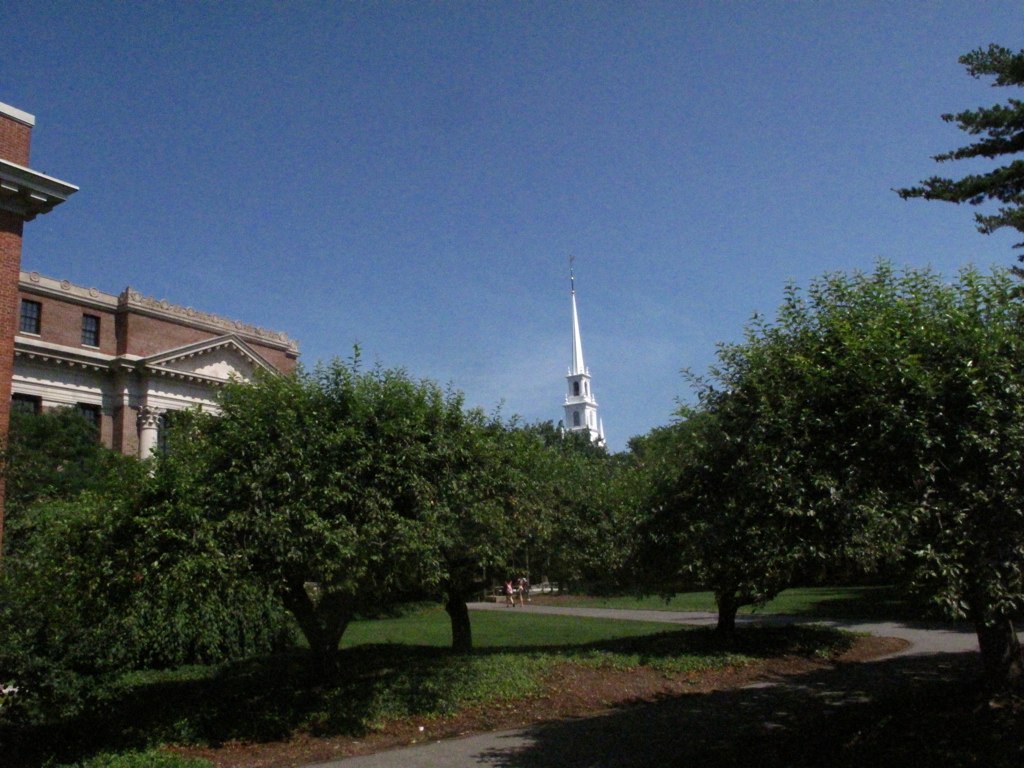
 Photo by Carlos Pacheco via Flickr
Thom Nickels: Harvard’s atheist chaplain
The current chief chaplain at Harvard University is an atheist who’s never seen the inside of a foxhole.
Greg Epstein, 47, author of “Good Without God: What a Billion Nonreligious People Do Believe,” a 2010 New York Times bestseller, has been the humanist chaplain at Harvard since 2005. Epstein, who describes himself as a humanist/atheist, was elected President of the University Chaplains’ Organization by more than 30 of his fellow chaplains. His election was met by cheers from woke religious communities, especially “reconfigured” Protestant Christian denominations that are now a shadow of their former orthodox selves.
The Harvard Catholic Chaplains released a statement emphasizing the “administrative nature of the presidency,” a coy way of suggesting that administrators have no real influence at all but are there merely to arrange meetings and give introductions at lectures.
The selection of Epstein as head university chaplain should not come as a shock. A Harvard Crimson survey of the class of 2019 found that more than sixteen percent identify as atheists and more than 21 percent as agnostic, while some identify as “spiritual” (a vague term can mean anything from a belief in cosmic grasshoppers to an intense love for humanity when high on weed). Students without a religious affiliation call themselves “nones,” or someone who puts their faith in human beings (politicians, world leaders and the local roofer) rather than a divine or supernatural being.
In 2023, The Crimson reported a fourteen percent decrease in Protestant-identifying students over the last ten years as well as a general rise in students identifying as atheist or agnostic over the past decade.
The word chaplain is derived from the word chapel or a place of worship, and yet it’s a title that Epstein embraces, proof that wokeness has eclipsed standardized English usage. This queer development would have Harvard’s founders, all Protestant religious men, scratching their heads in feverish consternation.
After Epstein’s election, The National Review observed that it isn’t so much that Epstein has rejected religion, “but rather chose political leftism as his new faith — which just so happens to be the dominant creed of Harvard and of many elite institutions.”
One clueless Notre Dame sociologist, Christian Smith (Catholic universities and organizations are increasingly coming under the spell of woke orthodoxy), offered his myopic view that the Humanism of ‘Nones’ has taken off because of “the growing alliance between the Republican Party and the Christian right, a decline of trust in institutions, growing skepticism of religion in the wake of the Sept. 11 terrorist attacks and a shift away from traditional family structures that centered on churchgoing.”
Smith’s comment is a stupid mouthful in need of mouthwash because the “threat” of the Christian Right hardly registers in 2025 when practically the whole of Protestant Christianity harmonizes with the radical social agenda put forward by progressive Democrats. Furthermore, the September 11 attacks have everything to do with fallible man and his misuse of free will, not God.
The former Catholic auxiliary bishop of Los Angeles, Bishop Baron, founder of Word on Fire Catholic media, weighed in on Epstein’s election: “If a professed atheist counts as a chaplain — which is to say, a leader of religious services in a chapel — then ‘religion’ has quite obviously come to mean nothing at all.”
Religion, of course, sinks into meaninglessness when it emerges with secular culture (think of certain mainline Protestant denominations) because when this occurs it is impossible to tell one from the other.
This doesn’t mean, however, that Epstein is an angry, intolerant atheist in the tradition of the infamous Madalyn Murray O’Hair (1919-1995). Critics admit to his being “extremely likeable” and charming. His chaplaincy web page shows a wide range of woke-related interests. The nearly always smiling Epstein loves “ethics in technology; meaning and purpose beyond religion; existentialism and humanism in literature and popular culture; developing healthy masculinity from a feminist perspective; secular humanistic atheistic Judaism; racial justice and healing; and the philosophy and practice of interfaith work.”
In many ways, Harvard’s chief chaplain sounds like a billion other educated, sophisticated left-leaning academics. He’s the boring norm.
Epstein’s public charisma can be observed in various online videos that show him speaking before groups like the Harvard Humanist Hub in Harvard Square.
(When I lived in Harvard Square in 1970 at the height of the counterculture, I only knew one Christian believer: an Armenian Orthodox guy who collected icons. Everybody else — professors, writers, lawyers like Dermot Meagher, the author of the book, ‘Judge Sentences’ — and regular 9-to-5-ers never talked about God or went to church. At 21, I looked at that Armenian Orthodox guy who lived in my apartment building as the queerest anomaly in Massachusetts.)
Epstein has a polished “evangelical” style that has him sounding like the Dr. Phil of atheistic humanism. He talks with his hands, makes appropriate eye contact with the audience, and goes out of his way not to offend “believers.” The humanist chaplain is also a bit of a ham, such as when he MC’d the Humanist Hub memorial service for Tom Ferrick in 2014.
Ferrick, an ex-Roman Catholic gay priest who fell from grace when he embraced humanist-atheism, founded the Harvard humanist chaplaincy in 1974. In his videos Epstein likes to refer to Ferrick as “the world’s first avowed atheist to become a university chaplain.” In an article about Ferrick in the Huffington Post, Epstein wrote more about his hero:
“In so many ways, Tom was ahead of his time. He bridged the chasm between religious and Humanist communities before most people even knew the latter existed. Now, a third of young Americans identify as nonreligious, and local communities for atheists are starting up like popcorn in the microwave, maybe even by the thousands, often calling themselves cheeky names like “Godless Congregations.”
Epstein took over Ferrick’s role in 2005 after the latter’s retirement. Epstein was assistant chaplain at the time and training for the rabbinate at the International Institute for Secular Humanistic Judaism. Epstein, like his predecessor, believes that Humanism is the natural outgrowth of religion that has not lost sight of science.
Tom Ferrick’s transformation from Jesuit priest-to-atheist began when he was the assistant Catholic chaplain at Dartmouth College and was questioned by the students he counseled there. Ferrick claims he had no answers to offer when the students asked him the big questions about life, death and suffering.
Ferrick, according to Epstein, lived on $7,000 a year while maintaining a monastic lifestyle. When he went public with his intentions to leave the priesthood (his reasons had nothing to do with his homosexuality) and the Church, Boston’s Cardinal Cushing called him in for an interview but failed to get him to change his mind. Ferrick stands in stark contrast to Daniel Berrigan, a priest of the same era who became an antiwar activist and a political radical but who stayed in the Church and who later alienated his leftist friends when he then went on to fight for pro-life causes.
Ferrick’s 2014 memorial service on YouTube opens (predictably enough) with a singing/ guitar rendition of John Lennon’s Imagine, after which Epstein introduces friends of the deceased. The service ends with Epstein singing solo as the accompanying guitarist pretends not to notice the chaplain’s multiple missed notes.
“We don’t look to a god for answers,” Mr. Epstein has been quoted as saying. “We are each other’s answers.”
This reminds me of Pope Francis’ infamous comment that all religions are like different languages that lead to the same God — “all” as in Scientology or Wicca. But if “we are each other’s answers,” what about that brickbat from Isaiah 2:22 that says, “Stop trusting in mere humans, who have but a breath in their nostrils. Why hold them in esteem?”
Thom Nickels is a Philadelphia-based journalist/columnist and the 2005 recipient of the AIA Lewis Mumford Award for Architectural Journalism. He writes for City Journal, New York, and Frontpage Magazine. Thom Nickels is the author of fifteen books, including “Literary Philadelphia” and ”From Mother Divine to the Corner Swami: Religious Cults in Philadelphia.” His latest is “Death in Philadelphia: The Murder of Kimberly Ernest.” He is currently at work on “The Last Romanian Princess and Her World Legacy,” about the life of Princess Ileana of Romania.