
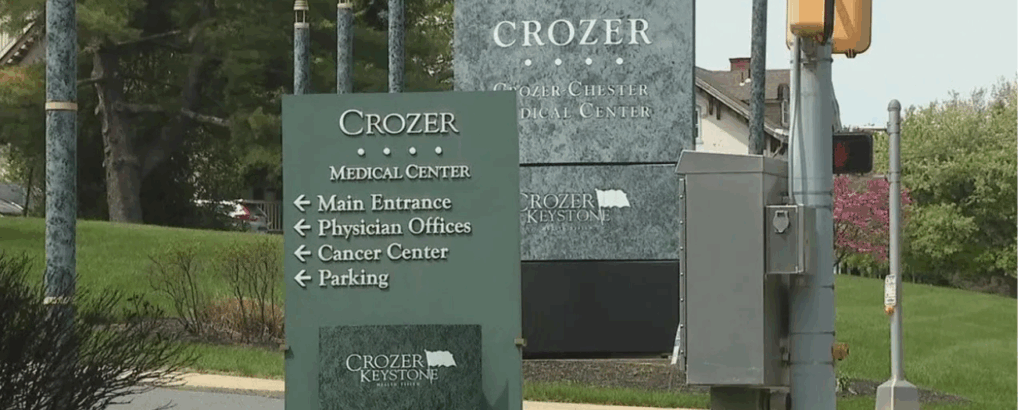
Predatory finance meets magical thinking at Crozer-Chester — and patients lose
A health care desert has emerged in Delaware County.
There are currently only two hospitals, Riddle and Mercy Fitzgerald, operating in a county of around 576,000 where there once had been six. The four additional hospitals of the Crozer Health System, Crozer-Chester, Taylor, Delaware County Memorial, and Springfield began closing in 2022 after their acquisition by Prospect Medical Holdings.
In 2016, Crozer Health was acquired by Prospect Medical Holdings (PMH). Prospect Medical Holdings was originally founded by a group of California physicians. In 2010, Leonard Green & Partners, (LGP) a private equity investment firm, acquired 61.3 percent position in Prospect Medical Holdings for $363 million. In 2018, Leonard Green & Partners, controlling Prospect, had the company take on debt of $1.31 billion. This cash infusion allowed Prospect to pay LGP dividends and management fees of $658.4 million.
On January 12, 2025, PMH filed for Chapter 11 bankruptcy. On January 13, 2025, the Philadelphia Inquirer reported the state health department cited Crozer for diverting heart attack patients because of nursing staff shortages and noting reports from staff of supply shortages.
At the time of its acquisition by Prospect in 2016, the not-for-profit Crozer Keystone Health System had debt on the order of $300 million with approximately $51 million funding The Foundation for Delaware County.
There seems to be a pattern. A private equity investment (PE) firm acquires an asset, a healthcare system, worth hundreds of millions. The PE then refinances the asset in the magnitude of billions allowing the PE to reward itself in order of hundreds of millions. The asset, the healthcare system, burdened by the debt and debt service and having burned through pension funding and other obligations such as unsecured creditors, files for bankruptcy.
Perhaps one might be skeptical of my description of events. If so, I offer the excellent Senate Budgetary Bipartisan Staff Report of January 2025, “Profits Over Patients: The Harmful Effects of Private Equity on the U S Health Care System”
What can we do?
First, we need to understand how we got there. Private equity may be a convenient bogeyman to blame, but there is more to the story.
Compensation by Medicare and Medicaid for care provided does not cover the cost of the care provided. To remain open, hospitals must have a payer mix with enough private insurance to cover the losses generated by Medicare and Medicaid.
Frequently private insurance payments. for a service are expressed as a per cent of Medicare payments such as 105 percent of Medicare. 113 percent of Medicare. A larger market presence of an institution usually results in a more favorable compensation rate by private insurance. A system with fifteen hospitals can usually negotiate better compensation than a two-hospital system. In healthcare, large systems survive, standalone hospitals disappear. And if your payer is predominantly self-pay and Medicaid, you will also disappear.
The Crozer-Chester Medical Center was a Level II Trauma Center, also providing a burn unit. Trauma and burn units consume resources and are usually money-losers, requiring the support of services with positive margins such as cauterization labs and imaging services. Combined with a service area for a substantial indigent population Crozer-Chester hemorrhaged money. To maintain such institutions will require exogenous financial support.
When I came of age in medicine, there was a hospital. Philadelphia General Hospital, whose origin was to provide care for the indigent. Society had recognized a duty to provide for the indigent, including healthcare.
The Board of PGH closed the hospital in 1977. Medicaid began in 1965. The expectation was private hospitals would provide care to the indigent now they were “insured.”
The closure and loss of Crozer-Chester, Taylor, Delaware County Memorial, and Springfield along with Brandywine in Chester County invites us to reflect on where this prediction has come true.
Predatory private equity is a symptom and scapegoat for creating a health care desert in Delaware County, not the cause.
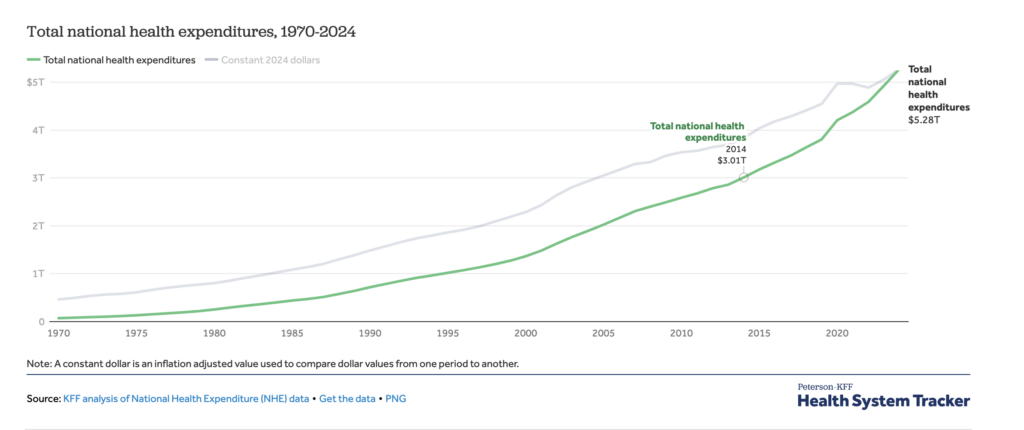
The cause lies with us. We have embraced magical thinking. We believe we can have ever increasing consumption of healthcare with minimally increasing expenditure.
One reason for the increasing expenditure on health care is the market basket of goods we call health care has changed.
In 1980, the care for a heart attack was oxygen, morphine, and monitoring. Today the standard of care is an interventional cardiac catheterization within 90 minutes of arrival.
Building, equipping, and staffing cardiac cath labs 24/7 is orders of magnitude more expensive.
In 1980, a patient with non-Hodgkins lymphoma could expect a three-to-five-year survival. Today I have a friend who is 20 years post-diagnosis and staging with no active lesions found. He was treated with rituximab, a monoclonal antibody introduced in 1997. Immunotherapy has revolutionized cancer care. For every drug we find effective, many never make it past phase 3 trials. Currently we have over 400,000 trials taking place.
Knowing Medicare and Medicaid does not cover the cost of the care provided, perhaps we must think the unthinkable. Perhaps government must pitch-in.
And why do we have a Pennsylvania Lottery … to “benefit older Pennsylvanians.” If Crozer-Chester remained open would older Pennsylvanians have been helped?
Frank Speidel, MD, is a retired emergency physician, US Navy Flight Surgeon and former hospital CEO. He was EMS Medical Director for the Commonwealth of Pennsylvania and Chester County. He is currently producer and host for The Doctor Is In on MLTV21.
Dr. Speidel’s excellent article explains that there’s more to this story than just the evil of private equity. Prospect Holdings was just the worms eating the corpse.
1-The 1980s merger of three middle class hospitals with the poverty hospital in Chester never made sense. That giant sucking sound was money flowing from Drexel Hill to Chester.
2-Democrats flooding Upper Darby with third world immigrants turned DCMH from the most profitable hospital in the system to … destitution. Kaboom!
3-For several decades, Crozer Keystone’s management adopted every half-assed fad proffered by its consultants.
4-Depose IBX leaders, old and new. Demand explanations why payments to Delco hospitals and doctors were substandard for so long. Use handcuffs if necessary.
Dr. Speidel,
You wrote a thoughtful article from a place of deep experience. It is true that the basket of goods we call healthcare is different, and costs have gone up since 1980s. And so have the medical bills, and especially gimmicks to fund profit in medical billing (e.g., price of aspirin during a hospital stay.)
Question(s): At the time of its acquisition by Prospect in 2016, was the not -for-profit Crozer Keystone Health System failing? Presumably, otherwise why did a not-for-profit sell? Yet… PMH was able to run it for years and extract big money from it. So was it all just a shell game and Crozer Keystone was doomed to die a slow death, or did PMH see an opportunity to crash it from California and to hell with the societal impact to the people on the East Coast?
Observation: Prospect Medical Holdings (PMH) owned 13 hospitals outside of Crozer Health at the time of its acquisition in July 2016 and purchased 3 more in CT in October 2016. All of those hospitals have either closed or are currently part of PMH’s ongoing Chapter 11 bankruptcy proceedings (filed in January 2025.) Leonard Green & Partners extracted approximately $658 million in dividends and fees from PMH between 2010 and 2019, amid patient care declines.
Very Impolite but seems accurate Observation: (and further evidence you can always find what you look for) Individuals associated with the firm Leonard Green & Partners (such as employees, owners, or family members) have contributed politically in ways that support pro-Israel interests, according to a simple AI search. Specifically, in the 2024 election cycle, these individuals donated $200,000 to the United Democracy Project, a bipartisan super PAC affiliated with AIPAC that focuses on electing pro-Israel candidates and defeating those perceived as anti-Israel. No other donations from the firm or its principals (such as John Danhakl, Jonathan Sokoloff, or Peter Nolan) to similar organizations, charities (e.g., Friends of the IDF), or pro-Israel lobbies like AIPAC were identified in federal election records, tax filings, or public reports. Historical political contributions from associated individuals total over $1.6 million across cycles since 1990, primarily to Democratic candidates and committees, but none were explicitly linked to pro-Israel causes beyond the 2024 UDP donation. Are these individuals actual US patriots and do they love their fellow citizens? Do they love the United States, or do they love Israel more? Why do we tolerate their selfish behavior? We need to call out these types of selfish people who hurt our society, specifically, and use legal means to change their hurtful behavior.
There certainly are more fathers to this illegitimate child than its failed investment model but across our economy writ large, private equity, venture capitalism, hedge funds, et al are wrecking havoc.
In many cases, it is not necessary to wait for the patient to be bled to death to proffer the cause of death. Almost immediately, the “invested in” firm becomes like an antelope in the clutches of a lion…no way out and bleating in fear.
Firms that lasted a century, that weathered Depression and world wars, find themselves under contracts that can never be paid off. It is legalized gambling and the “investors” are loan sharks.
PA might finally be aroused to act, to prevent future Croziers, but this is a far bigger issue. We cannot allow the “smartest guys in the room” to cannibalize our public and private institutions. Might doesn’t make right and neither does wealth.
It is one thing for a business to die. It is another for it to be murdered, taking jobs and its clients with it.
This has been a problem since the 1950s and we haven’t figured it out yet. I suggest anyone interested watch” Hospital” with George C. Scott and/or “Bringing Out The Dead” with Nicholas Cage. We are still railing against takeover equity entities. I remember the uproar caused by KKR and the hostile takeover movement. Hasn’t changed. I am at the point where wwe shoud be treated at home, if that can’t be done, sorry back to the 19th century.
George: Correct, “The Hospital” (1971, starring George C. Scott) and “Bringing Out the Dead” (1999, starring Nicolas Cage) both critique the American healthcare system.
HOWEVER, neither film addresses private equity’s role —which is a more recent phenomenon killing off hospitals, (and other societal institutions like youth sports leagues.) We aren’t talking about PEs buying up local HVAC companies, pretending they are independent still, and driving up local costs. We are talking about PEs destroying societal institutions, like hospitals.
The criticism of private equity’s involvement in hospitals is the internal partners of these PEs prioritize loading up on debt to pay themselves, enact reckless cost-cutting which impacts the local community and employees (while their principals live states away), create higher expenses for local patients, and ultimately force facility shutdowns and hide via bankruptcy laws.
Entirely different societal institution: Youth Sports.
Youth sports has long been dominated by local community associations. Local recreational and competitive leagues run by parents or community members, with the goal of engaging kids physically and socially.
Now, national brands backed by private equity firms are jumping into youth sports – aggressively. These firms are driving up price points and are lessening the quality of the child’s experience.
Btw, the low hanging fruit to your comment is “been a problem since the 1950s and we haven’t figured it out yet.” Incorrect; some of us have figured it out…actually. Society has just been trained that it is impolite and wrong to point out what happened and which group of people shifted our societal focus and ethics: from divorce to stores closed on Sundays to profit above all else. The 1950s is when “old-line” Protestant-controlled corporations, predominantly Protestant (Episcopalian or Presbyterian), started to shift leadership (and ethics) within their boardrooms. Subsequently, the United States of America started shipping off manufacturing and paying for everything on credit. Our currency is worth less, much less, now. And now the bill is coming due and our Country is hollowed out from the inside. Most of our leaders are dual citizens or controlled by them – these are not even debatable facts, though people will respond by saying they don’t actually matter (how can it not matter if your leader has competing dual loyalties?), but it is just impolite and socially prohibited to point out these actual facts of what has happened since the 1950s.
The bottom line still lays in Private Equity’s lap. Buying, then overburdening the system with a Billion dollar loan to pay off all the wealthy vultures is what killed this most desperately needed Health Care System. Don’t forget to add all the additional money given to these vultures with promises to keep the ER open, and the money the county also threw in which kept it open what? Another month?
It’s a game they play so well and have others already waiting in the wings! That initial ‘loan’ went straight into their greedy pockets and purposely made it so DCMH had to sell and then rent out thei own land, which of course was impossible.
GREEDY WEALTHY VULTURES are what killed the Delco Health Care systems. .PERIOD
Crozer was dead broke in 2016. Its remaining management desperately tried to sell to numerous regional hospital systems, even including Temple, but no hospital chain wanted their awful balance sheet.
Crozer’s leaders were explicit that they sold to private equity investors very reluctantly, but they had no alternative. They were close to bankruptcy, and nobody else would buy.
That’s when Crozer died. Prospect Holdings were just the worms eating the corpse.
Agreed. We see the spectacle of an elected officeholder publicly stating she is loyal to Guatemala first, then America. There are however many problems with hospital care beyond financial. Some of the problems are patient utilization ratios. socio-economic composition of the area they serve and medical hubris. Small non-profits are generally those whose clients cannot pay or can pay only a portion of the actual cost. Here they either have an endowment that can cover uncompensated expenses or government (taxpayer) makes up the difference. Private insurance is always in the wings but that can be problematic, particularly if most of the insurance is the very basic coverage found in “Affordable Care.” Medical hubris. This is what I call the “My CT scanner is bigger than your CT scanner.” Small non-profits serving areas of low economic stature still want the biggest bestist, mostist in medical hardware, not wanting to send patients to larger better equipped hospitals. A million dollar piece of equipment used by one patient in a year is not going to cover its cost. Corporate predators wait for these hospitals to fall into irreparable financial ruin, when that happens, they swoop in, pay the outstand bills that can’t be pushed off, load it up with debt, pay themselves a handsome fee and dividends and point the shell toward Chapter 11. BTW, I grew up during the late 40s, early 50s. I well remember Sunday closings, except I could not figure out why gas stations, movie theaters and restaurants were exempt from closure. Clubs (which also sold alcohol) could continue to do so where restaurants could not. I lived close to New Jersey so it was a matter of several miles to get to an open bar, the only quirk was you could only buy beer if they served it in wax milkshake cups, I never found out why there was such a crazy requirement. I think the beginning of the end was when “Two Guys from Harrison” (A Jersey based big box store sued PA over Sunday closing and won.
AI reports back – “Two Guys from Harrison” refers to a now-defunct discount department store chain founded in 1946 by brothers Herbert and Sidney Hubschman (it was almost certain they’d have an Eastern European culturally Jewish name) in Harrison, New Jersey. More anecdotal information seeming to continue to show an obvious pattern… and people have been noticing?
In December 1957, authorities arrested 76 Two Guys employees for violating the blue laws, with more arrests following in 1958. The company faced fines but continued operating on Sundays intermittently, even donating a portion of profits to charity in a show of good faith (though the donation was rejected). The case, Two Guys from Harrison-Allentown, Inc. v. McGinley, reached the U.S. Supreme Court in 1961. In an 8-1 decision, the Court upheld Pennsylvania’s blue laws, ruling they served a secular purpose of providing a uniform day of rest for workers, not just religious observance. The store was forced to close on Sundays temporarily. Two Guys is often credited with sparking the movement that “birthed” widespread Sunday shopping in Pennsylvania, even though they didn’t win their specific case.
Not every Catholic was an I.R.A. terrorist, but it seems every I.R.A. terrorist was culturally Catholic – yet if they truly feared the God perhaps their behavior would be different.
If one replaced “Jew” with “Catholic” and “I.R.A. terrorist” with “Zionist” in the preceding sentence there would be a wailing and gnashing of teeth. So, who are the people in the 1950s, 1960s, 1970s, and 1980s that pushed for atheism, divorce, and reliance on the state over family? They were Communists and Socialists… and they were mostly Zionists. They weren’t “Jews” (in the religious sense) but most of them were culturally Jewish.
Currently somehow the Epstein blackmail ring has been swept away. It is a sad situation and blatantly obvious Trump has been compromised by it all. Just like it is obvious that this PE firm destroyed these Del Co hospitals. And it is necessary to identify the people responsible in very specific ways and use their names, highlight their odious behavior, and to call it out publicly and loudly criticize them for it. I think the far-Left calls it Doxing; however, it is critical we use legal means to affect change. Step One: our elected leaders can’t be dual citizens. Step Two: identify the important institutions we want to protect from PE parasites and change the tax and bankruptcy laws to disincentivize them from trying to use and destroy them.
Not to add fuel to this inferno, but think about the politicians who want “Medicare for all.” Since it was enacted, every penny earned while you and I worked in this country was taxed 1.45%. This was matched dollar for dollar by our employers. Therefore 2.9% of every dollar of earned income went into the Medicare till. Then when we applied for Medicare at age 65, we had to pay a premium out of our Social Security checks as well. Then if you wanted to have good medical treatment and coverage you had better buy a supplemental plan. With all of that as background, they tell us that the Medicare trust fund, like the social security trust fund, is running out of money in the next 10 years. With that as a backdrop, many reimbursement rates for services under Medicare are insufficient to fully cover the costs, which results in many physician practices refusing to take new patients who are on Medicare. And the politicians want to provide “Medicare for all?” No thanks
Still doesn’t get to the underlying economics of hospital/medical care. Getting rid of equity capitalists still doesn’t make the hospital s/medical care systems break even or turn a profit. I follow reporting in the UK Telegraph and reading their coverage of the National Health Service in the UK, one sees overcrowding, shoddy, ersatz treatment facilities, substandard care and on and on AND surprise, surprise: the system is broke. Seems like a more or less universal problem with health care where the cost of care versus funds available to pay for it is perpetually out of balance. Short of hiring Druids to chant madrigals, there is no magic left for the health care system here and elsewhere.
Private Equity (PE) firms typically acquire hospitals through leveraged buyouts, loading them with significant debt while aiming to generate quick returns for investors, often within 3-7 years. This model prioritizes short-term profit extraction over long-term sustainability, leading to practices that degrade hospital operations, quality of care, and financial health. Here’s a breakdown of the key mechanisms:
A review of studies notes mixed quality effects, but the wealth extraction model often leaves hospitals financially weakened or bankrupt.
1. Asset Stripping and Debt Loading:
PE firms often sell off hospital real estate (land, buildings) to separate entities they control, then lease it back to the hospital at inflated rates. This generates immediate cash for investors but burdens the hospital with ongoing rental costs, eroding its balance sheet. For instance, in the case of Steward Health Care, a PE-backed chain, this led to the sale of assets, leaving hospitals unable to cover operational expenses and resulting in bankruptcy filings that devastated communities in Massachusetts.
2. Cost-Cutting Measures:
To service the debt and boost profits, PE firms reduce staffing levels, replace experienced nurses and doctors with cheaper, less-qualified personnel, and cut non-essential services. Studies show PE-owned hospitals have lower staff-to-patient ratios and rely more on unlicensed staff. This understaffing contributes to a 25% increase in hospital-acquired complications, such as falls and infections, for Medicare patients.
3. Shift in Care Delivery:
PE ownership often leads to higher charges for patients, a focus on high-margin procedures, and reduced investment in preventive or low-profit care. Research indicates a 27% income boost post-acquisition, but this comes at the expense of quality—patients experience more adverse events, including a 10% rise in mortality in some settings like nursing homes (with similar patterns in hospitals). Rural hospitals are hit hardest, as financial instability forces closures, undermining health equity.
4. Broader Systemic Effects:
PE’s involvement has been linked to higher healthcare spending (up to 11% in affected markets) due to negotiated price hikes with insurers. When hospitals fail, as seen with dozens “gutted” by PE per Senate reports, it leaves communities without access to care, increases emergency room burdens elsewhere, and shifts costs to taxpayers via public bailouts or Medicare.