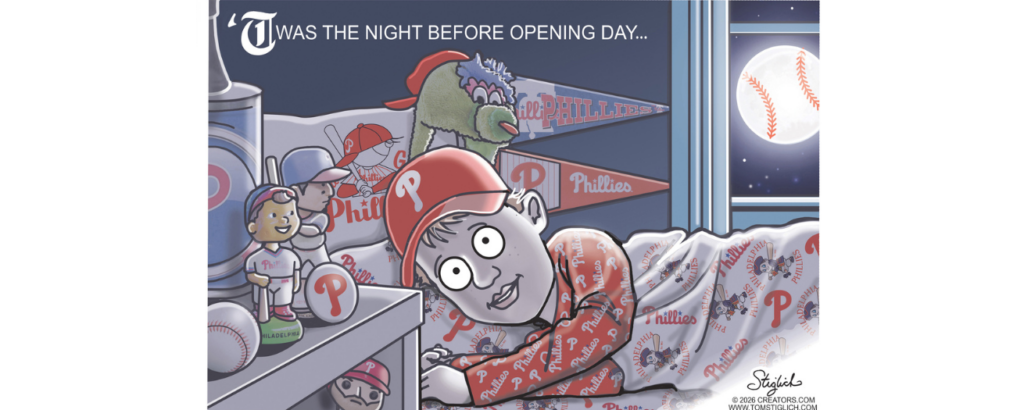
 Image by Tom Stiglich
John Rossi: Play ball! Baseball through the ages.
Professional baseball dates from the founding of the National League in 1876 so this season will mark the 189th consecutive campaign. Baseball has been called, ‘The American Game’ since the 1860s. But its roots are English. Best evidence indicates that baseball grew out of an English bat and ball game called Rounders in which an individual hit a rubber ball into a group of players — i.e., fielders — and ran around bases.
Like other things British it was adopted and modified in America. The most popular name in the colonies was ‘Old Cat’ or ‘Town ball.” It was played throughout the northeast with varying rules—home base could be square; bases could be sticks or rocks and the number of players could vary. But in all versions, a batter put a ball in play, thrown by a pitcher and then ran to a base before he was touched with the ball or he was “soaked,” the ball thrown by a fielder hit him before he reached his base.
Of all the versions of the game, the New York one gradually dominated, probably reflecting its rise as America’s dominant city. Between the 1840s and the beginning of the Civil War baseball took on its modern form: four bases, nine players, three outs to end an inning and a specified number of innings, nine, to constitute a game. One of its earliest proponents, a former cricket writer and America’s first baseball writer, Henry Chadwick created the box score that enables the fan, initially called a ‘crank,’ to follow the development of the game.
By the 1880s, baseball would be recognizable to any fan today. The bases were 90 feet apart, there were nine fielders, the pitcher and catcher were 50 feet apart — that would change to 60 feet 6 inches in 1893 — three strikes and the batter was out; four balls and he ‘walked,’ awarded first base.
The last significant change in the game of the late nineteenth century was the gradual introduction of the fielders’ glove which saw the quality of defensive play undergo a massive improvement. A shortstop in the first decade of the 20th century, for example, would make 60 errors a season. Today the figure would be closer to 15-20. The Phillies Larry Bowa once played an entire season and made just six errors. What in effect happened was that baseball became the nation’s first sport played at a professional level.
Baseball remained America’s quintessential sport for over a century. In fact, until the 1960s it had no rival. Aside from a heavyweight boxing match, no sporting event matched the World Series in importance. The stars of baseball were America’s most famous athletes whose names were known to every American male. No one dominated the sports scene the way Babe Ruth did; only Mohammed Ali came close. There is a story from World War II that when during a battle the Americans shouted “The Hell with the Emperor,” the Japanese reply was “To Hell with Babe Ruth.”
The most interesting question is why did baseball capture the enthusiasm of the American public? The game is fast enough to play in a reasonable time, i.e., two hours. Play is easy to follow and the total number of the key statistic, runs scored is not overwhelming. Think a 5-4 final score versus a professional basketball score of 114-104.
The development of baseball mirrored the growth and shifting change of America. Baseball was first organized and played by what we call WASPs — the descendants of the nation’s original founders. But as the game grew more popular, and especially when it became professional with winning the key, the sport began to embrace outsiders.
The Irish and the Germans who began to arrive in America in 1840s adopted the game quickly as a way of gaining acceptance as ‘true Americans’. By the 1880s, the Irish dominated baseball. The two best teams, Baltimore and Boston, were filled with Irish players and the first American superstar was an Irishman, Mike ‘King’ Kelly. Most of the managers in the National League by the late 1880s and early 1890s also were Irish. The first great German-American player before Babe Ruth was Honus Wagner.
The path taken by the Irish and Germans was followed generation by generation by every ethnic and racial group. The Southerners began to show up in the first two decades of the twentieth century led by Ty Cobb. Jews, Poles, and Italians in the 1920s and 1930s. Think Al Simmons (real name, Aloysius Szmanski,) Hank Greenberg, Joe DiMaggio.
It is a truism to note that Jackie Robinson’s integration of baseball in 1947 was a landmark in ending racial segregation. He was followed by two generations of great players, Willie Mays, Bob Gibson, Frank Robinson, Ozzie Smith. The Latin players began to show up in large numbers in the 1950s led by players like Roberto Clemente, Juan Maricha and Rod Carew. While the black population of players has declined from the 1970 — the best black athletes are found in basketball today — Latin players are among the dominant figures now.
The most interesting development in recent years was the slow emergence of Asian players, primarily from Japan. Ichiro Suzuki led the way and was elected to the Hall of Fame. Today the dominant player in the game is a Japanese, Shohei Ohtani. As the game spreads, I wouldn’t be surprised if the Chinese begin to produce quality players.
Baseball is no longer America’s Game. It was overtaken by professional football in the 1960s with the Super Bowl now serving as America’s key sporting event. Baseball still is doing well. Attendance is high and the sport is enormously popular in key cities: Philadelphia, New York, Chicago, Boston, Los Angeles. The popularity of the World Baseball Classic shows that baseball still has a future.
John P. Rossi is the author of four books on Baseball History as well as the winner of the MacMillan Baseball Research Award in 1998. He taught a course on Baseball and American Culture at La Salle University