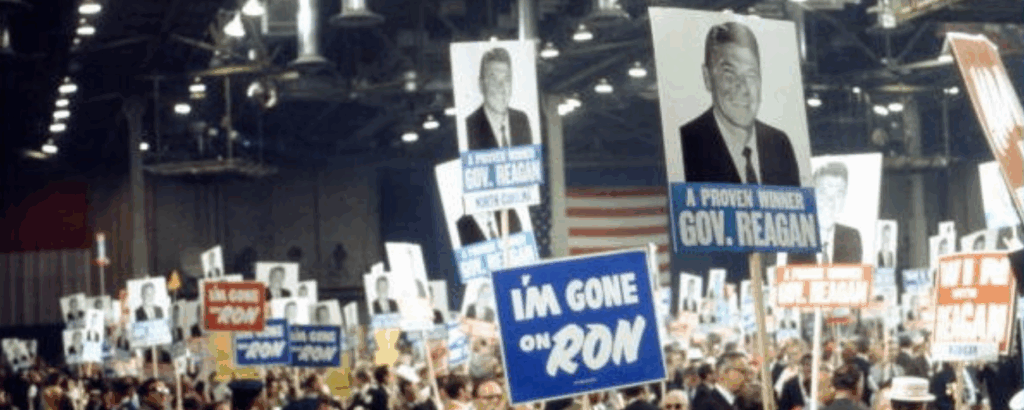
 1968 RNC | Photo by State Library and Archives of Florida
The only thing better than a closed primary is no primary
Imagine an organization with members across the state that chooses its leadership by election. Maybe a union, a trade group, a fraternal organization — whatever. Now imagine that the state government, which already has the equipment and expertise to run elections, offers to do it for them. The group might look favorably on that. It might save them some money and effort.
But now imagine that the state says, “and by the way, non-union people get to vote in your union elections.” Or “non-members get to vote in your club elections.” What organization members in their right mind would accept that?
But that is exactly the case being made for open primaries around the country and, lately, here in Pennsylvania. The political parties are private organizations dedicated to electing people who will further the political aims of their members. Now, many in Harrisburg want to invite non-members — even members who outright oppose a given party’s mission — to help choose the parties’ nominees.
It doesn’t make a lot of sense.
The problem in this debate is that people forget what parties are for. Even the name “primary election” gives the impression that this is a sort of first round before the main event when it was never intended to occupy that role.
Democratic elections are a part of our national heritage and an essential part of how Americans view fairness and consent of the governed. So we feel good about having elections not just for government but for all the various other groups we join. In corporations, unions, clubs, HOAs, PTAs, and everything in between, we like to have something resembling “democracy”. But in all of these groups, we also manage to remember who the demos in question is: the members of the group.
A century ago, when Progressive Era reformers began the push for the primary election system, it was to remedy what they saw as an undemocratic and corrupt method of selecting nominees for office — the system commonly called the “smoke-filled room,” where party big-wigs divvied up the spots on the ticket as they thought best. That system was not perfect, but it had a few things the primary system lacks.
For one: everyone in those smoke-filled rooms was thinking about the big picture when they drew up the slate. They created balanced tickets that would keep the party faithful enthusiastic while (in some cases) appealing to independent or even opposing party voters. This is the same thing open-primary advocates want, but the party bosses didn’t trust to chance or randomness the way we do in our increasingly multi-candidate primaries.
Look at the two tickets in Pennsylvania’s 2022 gubernatorial race. Democrats cleared the field so effectively that their primary was just a formality. As a result, they nominated a candidate for governor who had that cross-over appeal while still satisfying the base. And they added a lieutenant governor nominee who ensured that ticket was balanced geographically (one candidate from eastern Pennsylvania, one from western Pennsylvania), demographically (one white candidate, one black candidate), and in their somewhat different backgrounds (both long-time government employees, but one had more executive experience, the other legislative.)
Republicans rolled the dice and ended up with a gubernatorial nominee far outside the mainstream and a ticket that was completely unbalanced (both candidates were white state legislators from western Pennsylvania), limiting their appeal in several ways.
The reason Democrats were able to do this is the second reason open primaries are flawed: everyone voting in the Democratic primary wanted Democrats to win. The party narrowed the field and the voters approved it. In an open primary, that’s no guarantee. It’s bad enough to have non-members decide your party’s choices, but in an open primary you could have people who hate your party doing so. Maybe they’re members of the other party — it depends on what kind of open primary law we’re dealing with. But many independents also hate one or both parties. Why invite someone into the group who wants to work against it?
Some of those who favor open primaries have filed suit about it here in Pennsylvania, including CNN’s Michael Smerconish, who wrote about it here last week.
“There are more than one million such registered voters here in Pennsylvania,” Smerconish writes, “and yet, we don’t have a say in primary elections even though our tax dollars are being used to stage such contests.”
The good news is, there’s a remedy for this problem that is simple and costs zero dollars: join the party.
If you want to have a say in what a party does, you should start by joining that party. I did it by filling out a form back in 1997 and mailing it in. Didn’t even need a stamp. Today, it’s even easier because of motor-voter opt-outs. You can even switch parties, as many Republicans in Philadelphia do when they want a say in the city elections. Again, it is free and easy.
But I have to agree with Smerconish on one point: the state is paying for primary elections, and it really shouldn’t be. These are the elections to decide the endorsement of a private group: why is that a concern of the taxpayer?
A political party is not exactly like a union or a fraternal organization, but it’s not exactly like a government either. If anything, it’s more like the former – after all, unions and other non-governmental organizations also endorse candidates. But because the government runs a party’s election, people get the impression that it is a governmental thing — and that they should have an equal right to it.
Better than open primaries would be to get the government out of the business of party nominations altogether. If the Republicans and Democrats want to keep having primaries, they should run them — and pay for them — with their own money and resources. If they want to nominate in a convention or caucus, as minor parties often do, they could do that instead — in fact, they already do have conventions and sometimes even endorse at them (though not in 2022). And if they want to go back to the smoke-filled room, they can do that too. And if people don’t like it, they can switch parties, or start a new one.
The concept of a government-run primary has never made complete sense, and having them has muddied the idea of what elections are for. Don’t make the state-run primaries worse when the better option is to end them entirely.
Kyle Sammin is the managing editor of Broad + Liberty.