
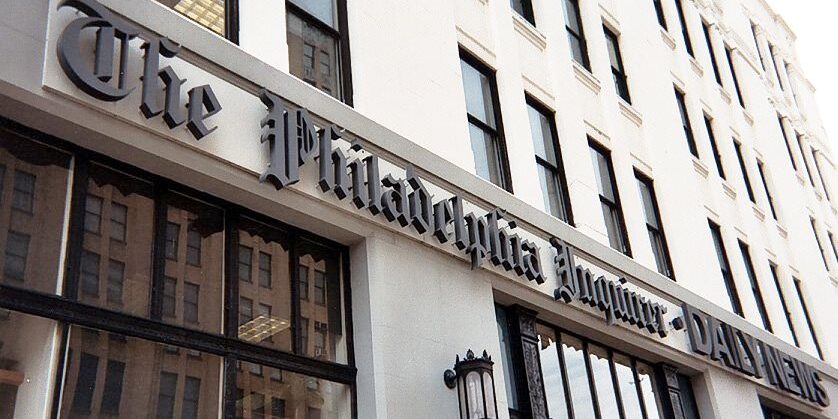
Terry Tracy: When silence becomes policy at the Philadelphia Inquirer
At some point, editorial omission stops being incidental. It becomes patterned, predictable, and eventually, it becomes policy.
The modern debate over media bias too often fails to engage this reality.
It focuses on tone — whether coverage leans to the political left or right — while overlooking the more consequential decision: selection. Editors decide what to cover, what to ignore, and what never reaches publication. Those decisions define the boundaries of public attention.
That is where power operates.
At the Philadelphia Inquirer, the exercise of that power reveals a consistent pattern. Scrutiny does not distribute evenly. Omission does the real work.
Agenda-setting theory makes the dynamic clear. The press does not tell the public what to think; it determines what the public thinks about.
The result is not necessarily falsehood. It is selective visibility. Some issues receive attention. Others never enter the frame. The question is not whether this occurs. It is how — and in whose favor.
Consider the administration of Governor Josh Shapiro.
Other outlets have reported on a taxpayer-funded sexual harassment settlement involving former cabinet secretary Mike Vereb. They have also examined litigation over whether the administration preserved a tranche of government emails belonging to the accuser, as required under state law.
The anomaly is specific. The missing records appear limited to the accuser’s emails, while thousands of communications from other officials remain intact.
If the administration failed to retain those records, the implications extend beyond politics. They go directly to the enforceability of transparency laws — and whether the commonwealth’s Right-to-Know regime has meaning at all.
Perhaps the Governor has a legitimate explanation. A legitimate reason for deleting the emails of a young woman staffer who accused his friend of sexual harassment — hers and only hers. Maybe there is an answer that would explain it. Does that remove the so-called paper of record’s obligation to investigate?
When records tied to a $300,000 taxpayer-funded settlement disappear — and only those records — the public deserves an answer. The decision-makers at the Philadelphia Inquirer, however, have decided they do not.
This is hardly an anomaly.
As reported in these pages, on August 31, 2023, the woman who worked in the Governor’s office and alleged sexual harassment signed that $300,000 taxpayer-funded settlement agreement with a non-disclosure agreement. On September 1, the administration countersigned.
The accused, Secretary of Legislative Affairs Mike Vereb, remained in his role for nearly four weeks. He continued to operate as a senior official and appeared publicly with the governor during the September 2023 Chester County prison escape response.
That sequence forces a basic question: what did the governor know, and when did he know it?
The facts point to two possibilities.
If the governor knew, he chose to retain and publicly present a senior aide tied to a taxpayer-funded sexual harassment resolution.
If he did not, his administration approved and executed a $300,000 payment — paired with a nondisclosure agreement — without his awareness.
Both scenarios carry consequences. Again, the Philadelphia Inquirer’s editors have not once pressed this question. That absence is not neutral. It is a decision.
Instead, the paper has prioritized human-interest features, including recent front page retrospective coverage of the governor’s high school basketball team.
Those stories are not inappropriate in isolation. But the editorial threshold appears unusually flexible — high enough to exclude questions about missing public records, and low enough to accommodate a well-lit memory of a high school basketball game.
That is not an accident.
The pattern extends beyond the governor’s office.
When State Treasurer and de facto Republican gubernatorial nominee Stacy Garrity appeared last week with legislators and advocates to raise concerns about workplace misconduct involving young woman staffers and related transparency failures, the event met every standard for newsworthiness.
Other outlets covered it. The Philadelphia Inquirer did not.
The asymmetry continues at the local level.
The paper scrutinized a Republican township candidate’s past social media activity. At the same time, it has declined to cover materially significant issues involving sitting officials.
In Chester County, Treasurer Patricia Maisano, a Democrat, faced two independent findings from court-appointed fact finders concluding she systematically overbilled an incapacitated elderly ward. A second family raised similar allegations, and additional reporting questioned her credentials and expert witness work.
The Philadelphia Inquirer has not covered this.
In Bucks County, Commissioner Bob Harvie, a Democrat and congressional candidate, oversaw an election system where campaign finance enforcement appears uneven. Records indicate allies received and failed to report substantial union PAC contributions, while enforcement targeted others.
The Philadelphia Inquirer has not covered this.
In Delaware County, Council President Richard Womack, a Democrat, carries more than $230,000 in unpaid taxes, including a six-figure federal lien, while serving in a government that has imposed significant tax increases. The all-Democrat county council even knowingly elected Womack as its chair — to lead enforcement for taxes he does not pay.
The Philadelphia Inquirer has not covered this.
These are not underreported stories. They are unreported ones. And in each case, the absence of scrutiny falls in the same direction.
At some point, the pattern becomes the story.
The Philadelphia Inquirer scrutinizes lower-level or politically convenient targets while leaving higher-impact issues unexamined. Documented findings go unaddressed. Public accountability events go uncovered. This is not a series of isolated decisions. It is a system.
The question is not simply whether bias exists. It understanding how it operates.
Editors make judgments. Institutions develop narratives. Resources are finite. But when those forces produce the same outcome repeatedly, the explanation matters less than the result. The pattern defines the reality.
The absence of coverage is not incidental. It is the argument.
When a clear line of inquiry remains unexplored, it demonstrates how agenda-setting works — not through distortion, but through omission. The public is not misinformed. It is selectively informed.
A credible press proves its value through consistency. Comparable power should invite comparable scrutiny. When that standard fails, journalism does more than fall short. It begins to define the limits of accountability itself.
And this is where the distinction matters. Silence is not always intentional. Yet, when it becomes patterned — when it aligns repeatedly with the interests of those who benefit from it — it ceases to be incidental.
At that point, silence is no longer a byproduct of editorial judgment. At the Philadelphia Inquirer, it begins to function as policy.
Terry Tracy is the CEO and Publisher of the Fideri News Network.

Terry- the Inqy is very busy writing about the demands of terrorist sympathizers and ICE OUT protestors. In 2026 there is only so much space on each page to fit a story.
Its very very difficult.
Excellent summary– thanks for your work.
Liberal media regularly places a news embargo on info that may damage a Democrat. When that info becomes impossible to continue to embargo, they begin to report only the newer, subsequent details which should rbut doesn’t raise red flags among its loyal brainwashed readers. I.E. Hunter Biden laptop was ignored until it was impossible to do so. Then the media tried to portray it as a plot by Rudy Guliiani.
The Inquirer is still publishing?
I had no idea.