Three years in, key conditions at Delco prison have gotten worse, state monitors show
When Delaware County took over the George W. Hill Correctional Facility in April 2022 — ending nearly three decades of private management — county officials framed it as a humanitarian turning point.
“There really is just one metric: recidivism,” then-county spokesperson Adrienne Marofsky told this reporter at the time. “Currently over six out of ten inmates at GWH have been there before. We can do better. And doing better would mean a reduction in the prison population, and a reduction in the cost to the taxpayer.”
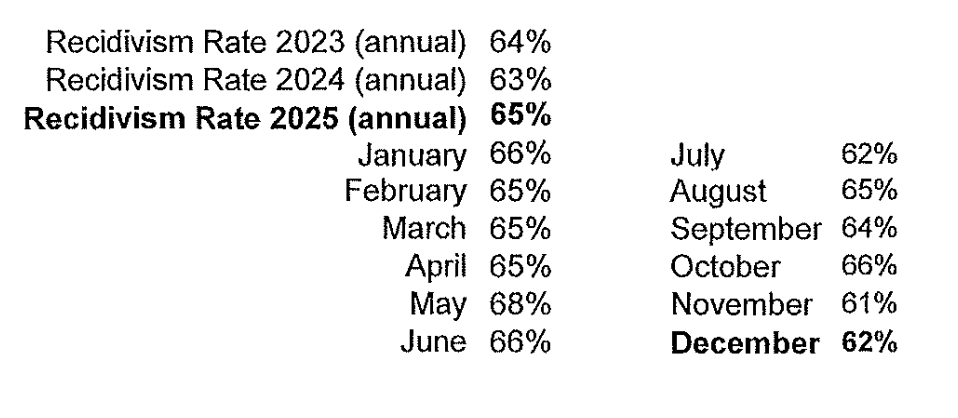
Three years later, the county’s own data shows the recidivism rate has never fallen below 63 percent in any calendar year under government management, registering 64 percent in 2023, then 63 and 65 percent in ‘24 and ‘25. By the county’s own chosen standard, the experiment has not worked.
But recidivism is a lagging indicator, shaped by forces well beyond any single facility’s walls. What is more directly within the county’s control — and what the data now documents in striking detail — is what happens inside the building every day.
Those numbers tell a harder story.
+ + +
The Pennsylvania Prison Society has conducted five walkthroughs of George W. Hill since December 2021 — one under GEO Group’s private management, four under the county. The numbers below track each key metric from that first walkthrough through the most recent one in November 2025.
A note on what follows: the Prison Society’s own reports caution that small sample sizes and voluntary respondents mean fluctuations of a few percentage points may not be meaningful. We applied that same standard. We are not reporting on metrics that moved 5 or 10 points between any two walkthroughs. We are reporting on metrics that moved in the same direction, across multiple consecutive measurement points, by double digits — in some cases by nearly 50 points. Those are not statistical fluctuations. Those are trends.
(Reports referenced, using date of walkthrough: Dec. 2021, Dec. 2022, March 2024, Jan. 2025, Nov. 2025. Where figures in the “longitudinal appendix” of the November 2025 report conflict with figures in the individual contemporaneous walkthrough reports, we have relied on the individual reports as the primary source.)
Time out of cell. Under GEO in December 2021, every single person interviewed reported going multiple days without leaving their cell, with weekends meaning full lockdown. By December 2022, eight months into county management, 92 percent reported getting out daily — a dramatic improvement. That figure fell to 79 percent in March 2024 before taking a more precipitous dive to 33 percent in January 2025, and 44 percent in November 2025. The county never recovered to its own early baseline.
In-cell emergency buzzers. Under GEO in 2021, every person reported buzzers went unanswered. Under county management, 81 percent reported no response in December 2022, 84 percent in March 2024. By January 2025 the figure reached 100 percent — and the facility’s own warden acknowledged in writing that the system was non-functional prison-wide. The November 2025 walkthrough found the same result.
Family visits. Not measured in the 2021 GEO walkthrough. Under county management: 61 percent reported successful in-person visits in December 2022, falling to 26 percent in March 2024, recovering partially to 50 percent in January 2025, then collapsing to 13 percent in November 2025.
Staff assault. Under GEO in 2021, eight of 53 interviewees reported physical assault by corrections officers. Under county management, witnessed staff assault was reported by 30 percent of respondents in December 2022, rising to 71 percent in March 2024, falling to 44 percent in January 2025, and rising again to 58 percent in November 2025 — nearly double the starting point.
Food. Not measured in the 2021 GEO walkthrough. Under county management, the percentage reporting insufficient food was 89 percent in March 2024, 93 percent in January 2025, and 92 percent in November 2025. In November 2025, 96 percent reported going hungry between meals. Asked directly whether those findings reflect a real problem, Prison Society monitoring director Noah Barth said simply: “Yes.”
Hygiene. Under GEO in 2021, women reported running out of toilet paper and feminine hygiene products. Under county management, the percentage reporting insufficient hygiene items was 56 percent in December 2022, 54 percent in March 2024, 81 percent in January 2025, and 77 percent in November 2025. In the most recent walkthrough, every woman in the general population unit — all 24 interviewed — reported being unable to obtain adequate hygiene products. Monitors documented women being told to flip over used menstrual pads when they asked for more.
+ + +
Delaware County, through Communications Director Mike Connolly, did not address the specific metrics. Instead, the county pointed to its $50 million capital improvement program — new cell locks, cameras, HVAC, and a kitchen renovation — as evidence of commitment to improvement. “We believe these investments will not only improve the facility and conditions for incarcerated people and staff alike, but also result in reductions in annual operating costs,” Connolly wrote. On staffing, he invoked national context: “This is a nationwide crisis in correctional officer vacancies and GW Hill is not immune.”
That framing deserves scrutiny. A nationwide staffing crisis may explain difficulty recruiting officers. It does not explain why reported CO availability at this specific facility fell nearly 50 points over three years of management by this specific county. It also does not explain a transparency decision the county made in its very first weeks in charge.
Within weeks of taking over, the Jail Oversight Board’s attorneys informed a former board member that staffing levels would no longer be publicly reported, citing security concerns and personnel matters. Under GEO Group’s private management, staffing data had been reported publicly at every JOB meeting, with financial penalties assessed when the prison was understaffed. That accountability mechanism vanished the moment the county took control — and has never been restored.
It vanished even as the county was openly signaling a staffing problem serious enough to require outside help. By August 2022, Delaware County Council had committed nearly $1 million to a recruiting firm to fill correctional officer positions. County Manager Howard Lazarus said at the time that starting pay had been boosted from roughly $14.50 an hour to $22 — an increase of roughly 50 percent. Before deprivatization, the county’s own consultants identified “extremely high staff turnover rates” as a key challenge and recommended salary increases to address them.The county raised the wages. Three years later, by the Prison Society’s measure, the problem had gotten significantly worse.
New Warden Willie Bonds, in his March 2026 written response to the Prison Society, was more candid than the county’s public statement. He acknowledged that nine housing blocks share a single officer rotating between two units, and that the facility budget “does not allow” for full staffing. That is not a security rationale. That is a budget admission — and it raises an obvious question the county has not answered: if the budget does not allow for adequate staffing now, after three years of rising operating costs and a $50 million capital commitment, when will it?
Barth, asked whether the double-digit declines in the Prison Society’s data reflect real deterioration, retreated carefully to his own methodology. “Given sample size, these are not conclusive studies,” he said. “Rather, they point to the occurrence of issues that we believe should be further investigated and addressed.” Asked whether conditions have overall improved or worsened under county management, he declined to say they had worsened — noting that the Prison Society’s position remains that conditions have improved compared to the GEO era. That is a defensible position. It also, notably, does not answer the question this story asks.
The Prison Society’s November 2025 report recommended that Delaware County seek its assistance in selecting new prison leadership, citing turnaround successes at jails in Allegheny County and Philadelphia where it had participated in similar searches. The county declined. “The county already had a hiring process underway,” Barth told Broad + Liberty.
That process produced Bonds, who replaced Warden Laura Williams — whose tenure included a union vote of no confidence signed by more than 500 staff members, a state senator’s unannounced visit prompted by officer complaints, and a sergeant’s resignation letter that described the facility as operating under an “ethos of retaliation.”
The Delaware County Coalition for Prison Reform, which championed deprivatization and conducts its own independent monitoring, pushed back on several of the Prison Society’s findings. On food, the organization argued that asking incarcerated people whether they feel they receive adequate food is the wrong question. “We do not ask the residents if they like the food or if they feel it is adequate because we already know the answer,” Delco CPR wrote. “In fact, you will get the same answer from every resident of every correctional facility.” The organization instead measures institutional compliance — whether bag meals have ended, whether a dietician-approved menu is posted, whether two hot meals are served daily — and says those goals have been largely achieved.
On staffing, Delco CPR asserted that during its own walkthroughs it had “observed full staffing on the housing units” and that the GEO-era practice of locking inmates down from Friday evening to Tuesday morning had ended. Those are meaningful improvements if accurate. They are also difficult to reconcile with the Prison Society’s finding that 88 percent of inmates reported no CO presence at night as of November 2025.
The two organizations monitor the same facility using different methods and reach different conclusions. The Prison Society captures inmate experience through structured anonymous interviews. Delco CPR relies on a combination of walkthroughs, direct communications from inmates and families, and ongoing dialogue with facility administrators. Both methodologies have value. Both have limits. What would resolve the dispute — actual staffing numbers, reported publicly — is precisely the information the county has declined to provide since May 2022.
Delco CPR also noted that it anticipated the full transition from private to government management would take no less than five years. By that clock, the county is still one year short of the finish line. Whether year four produces the improvements years one through three did not is the question Delaware County has yet to answer — and that the people inside George W. Hill Correctional Facility are waiting on most urgently.
The county’s annual operating budget for GWHCF has ballooned from $53.4 million in 2023 to $56.6 million in 2024 to $59.3 million in 2025, with $60.5 million budgeted for 2026 — a 13 percent increase in three years, not counting the $50 million capital program. That rising prison budget exists within a broader context of county fiscal strain that taxpayers are now feeling directly.
Delaware County levied a five percent property tax increase in 2024, followed by a 24 percent increase in 2025, with a 19 percent increase proposed for 2026. A Broad + Liberty analysis found that a homeowner with a median-valued property would see their county tax bill rise from $763 in 2023 to $1,172 if the 2026 increase is approved — a 53 percent increase in three years. The Democrats who swept to power in 2019 ran, in part, on a promise to deprivatize the prison. The prison’s budget has increased every year since they made good on that promise. Asked what measurable improvements Delaware County citizens are receiving for those increases at the prison specifically, the county did not respond to that question.
NOTE TO READERS: This story was reported entirely by Todd Shepherd. The first draft of this article was written with significant assistance from an AI writing tool as part of an editorial experiment at Broad + Liberty. Shepherd reviewed, edited, and is responsible for all factual content.
Todd Shepherd is Chief Investigative Reporter and VP of News at Broad + Liberty. He can be reached at tshepherd@broadandliberty.com or via encrypted email at shepherdreports@protonmail.com.