 Photo by Wendles56 via Flickr
Thom Nickels: Literary criticism in the Trump era suffers from an excess of politics
The American left has not only come to dominate the theater world — most plays produced today have woke themes — it has pretty much reconfigured literature and the world of literary criticism. Like the Hollywood movie industry, where most of the new films contain woke teaching points — this is why movie attendance has been down significantly for some years — the book publishing world has also become a medium for leftist signaling.
Novelist and journalist Lionel Shiver’s new novel, A Better Life, is about the effects of rampant mass migration on a progressive New York City divorced mother who invites a migrant to live in her house. In a recent interview about the book, Shiver said that literary critics with a leftward bias have not criticized the satirical novel from a political angle (that would show blatant prejudice) but engaged in sneak attacks and excoriated the book in other ways. They criticized the artistry of the book, the sentence stricture, the overall narrative of the story, even the author’s talent.
“The novel certainly risks irritating progressive readers who might characterize some of its views as right-wing. Because, for a long time, nothing got you into more trouble than being down on mass immigration,” Shiver told the Telegraph in February 2026.
In her column in the Spectator, Shiver criticizes transgender ideology. She writes that “woke” is no joke, and that the term for left-wing tyranny is too lighthearted. On a number of podcasts, she talks about being interviewed by British journalists, the most dangerous journalists in the world, she says, because they appear to be so nice and polite. She’s learned valuable lessons from her dealings with them: Never invite them into your home because they will look for any hook to “hang you with.” A rum bottle thrown carelessly into a wastepaper basket; a stopped up toilet, anything — however insignificant — that will make you look bad.
She said she feared Harper San Francisco would not publish her novel because it takes such a strong stand against mass migration. She had every right to have these misgivings.
Consider the prime example of woke literary criticism in the United States, the New York Review of Books. The magazine was founded by Robert Silvers and Barbara Epstein in 1979 after a long New York City newspaper strike. The first issue of NYRB appeared on February 1, 1963. Its sixty pages included articles by Gore Vidal, Alfred Kazin, Irving Howe, Mary McCarthy and Susan Sontag.
During a 1997 C-Span About Books interview, Silvers said that one of the reasons for finding NYRB was “to go behind the particular propaganda of the day… We feel that we have an extremely independent review.” (The propaganda of 2026 definitely comes from the left.)
Much of the early success of the magazine can be attributed to the unpopularity of the Vietnam War; this unpopularity certainly fueled the magazine forward long after the war protests had subsided. Silvers also told C-Span the magazine didn’t have a particular political line and that it did not identify with any political party.
Silvers’s observation was still true in 1997; it is not true in 2026. Susan Sontag, for instance, authored a defense of Salman Rushdie in NYRB’s April 1990 issue when Rushdie was put under a fatwa by the Ayatollah Khomeini for “insulting” Mohammed in his novel “Satanic Verses.” Sontag’s work on Rushdie’s defense, both as a writer for NYRB and as president of Pen at the time, was a remarkably brave thing to do, and yet it is highly unlikely that in 2026 any writer from NYRB would take a similar position when it comes to Islam. What is far more likely is that any novel perceived as insulting Mohammad would simply not be reviewed or discussed.
With Silvers’s death in 2017, the NYRB’s streak of independent thinking, or what was left of it, disappeared altogether. Silvers’s replacement, Ian Buruma, published an essay by Canadian broadcaster Jian Ghomeshi, who was accused (but freed by the courts) of sexually assaulting women. That essay, “Reflections from a Hashtag,” was a first-person account by Ghomeshi of being fired amid allegations of sexual misconduct and then acquitted of the charges by a Canadian court.
Ghomeshi’s essay appeared during the height of the #METoo movement. Buruma, who assumed the editorship of the magazine with a promise to make it more “democratic,” was forced to resign as a result of the essay.
“I made a themed issue about #MeToo perpetrators who were not convicted by the judiciary but by social media,” Buruma told the New York Times in 2018. “And now I am on the pillory myself.” Buruma explained that he expected there would be strong reactions but that his hope “was that it would open up the discussion about what to do with people who have misbehaved, but have been acquitted by a court.
While many NYRB staffers called for Buruma’s resignation, many did not. Many stood up for free speech. One contributor noted that NYRB “had a history of publishing tough, controversial pieces that did not kowtow to public opinion,” and regretted that sticking to this ideal had cost Buruma his job.
“Providing a platform for people in Ghomeshi’s position in no way exonerates them,” the staffer stated. “It’s important to hear what somebody has to say in the position of suddenly being exiled from social life, and sentenced to a nonexistence.”
Some NYRB writers worried about coming to Buruma’s defense because in that toxic #MeToo climate any defense might be perceived as not caring about sexual assault, which in the mind of many leftists can be as serious as actually committing an assault. Even soft- left Atlantic Magazine jumped into the fray when it stated, “It is unusual for a well-regarded editor at a prestigious intellectual journal to lose a leadership position over just one article. What are the larger implications for American journalism?”
The London Review of Books (LBR), founded in October 1979, once boasted that it championed independent thought although that reality came to an end with the election of Donald Trump.
The Trump presidency quadrupled LBR’s and NYRB’s leftist identification so that one could not even read an article on an English poet or a Bulgarian scientist without seeing cryptic references to The Orange. The Trump obsession was unrelenting, as if every LBR writer felt it was his/her obligation to state unflinchingly that he hated Trump.
The same might be said for NYRB. During the 2016 and 2024 presidential campaigns, Trump references were as common as commas, even in articles about Monet, Van Gogh, or obscure 19th-century American poets.
Published twice a month, LRB is known for its extraordinarily long essays. In 2014, the Guardian posed the question: “Is the LRB the best magazine in the world?” The magazine has spawned a LRB bookshop and a popular cake shop famous for its pistachio cakes.
Aside from the predictable political rhetoric, the biggest drawback in reading NYRB or LRB are the books that these publications choose to review or have their writers write essays about.
Generally, the books chosen for review, other than biographies of great artists or writers (even here you’re likely to find a Trump reference), tend to have a similar bias. The classic definition of true literary and journalistic independence would suggest a diversity of books and ideas. After all, there’s no reason to suppose why a curious reader can’t jump from the latest biography of Gore Vidal or poet Robert Lowell to the latest book by Ann Coulter, David Horowitz, Bruce Bawer, Lionel Shiver or Andrew Klavan.
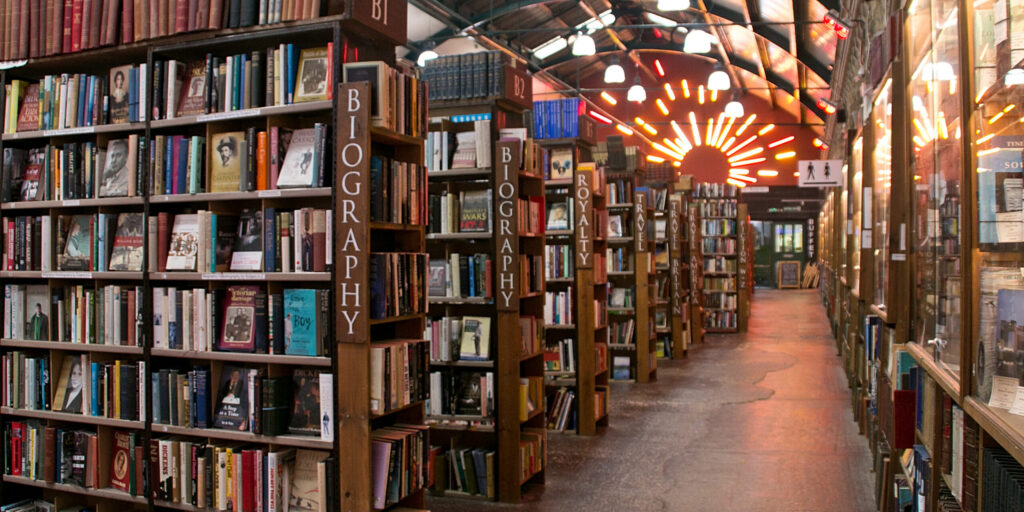
But the narrow book terrain of these journals makes it impossible to get a sense of what’s really being published in the wider world. To discover this, one must put these publications aside and head out to the nearest big bookstore in order to get the real lay of the land.
Thom Nickels is Broad + Liberty’s Editor at Large for Arts and Culture and the 2005 recipient of the AIA Lewis Mumford Award for Architectural Journalism. He writes for City Journal, New York, and Frontpage Magazine. Thom Nickels is the author of fifteen books, including “Literary Philadelphia” and ”From Mother Divine to the Corner Swami: Religious Cults in Philadelphia.” His latest work, “Ileana of Romania: Princess, Exile and Mother Superior,” will be published in May 2026.