
PennDOT says vehicle registration can’t change your voter registration. Its own form says otherwise.
Officials from the Pennsylvania Department of State and Department of Transportation say there is no mechanism — automated, default, or backend — by which address data from vehicle registration transactions can be shared with election officials or the Department of State to update a citizen’s voter registration.
But those claims are directly undercut by the DOT’s current vehicle registration form as well as by the agency’s own sworn court filings. The upshot is the two agencies continue to engage in a practice that the Pennsylvania Supreme Court said was “of questionable validity[.]”
The issue surfaced during a closely contested April 2024 primary, when candidates fought over a small number of disputed ballots.
In one of those cases, a voter named O’Donnell had temporarily established a second residence in Schuylkill County, just a few miles from his primary residence in Luzerne County. At one point, O’Donnell registered a vehicle to the second residence. Months later when he went to vote at his normal polling place in Luzerne County, he learned his voter registration had been shifted to the second address — even though O’Donnell told the court he never made any changes to his voter registration.
That single quirk put under the spotlight the fact that a PennDOT form contained the following provision: “This application will also serve as a request to update your voter registration unless you check this box[.]”
The fact that the update was assumed to carry through unless the person opted out was troubling to the court.
“Any administrative decision by PennDOT or the Pennsylvania Department of State to transfer an elector’s voter registration without that person’s affirmative consent in conjunction with a PennDOT application to change a vehicle registration, as opposed to a driver’s license, is therefore of questionable validity, particularly where, as here, no party has identified a valid administrative regulation authorizing such action,” Justice Mundy wrote in the ruling.
If the check box had been “opt in,” instead, that seems likely to have qualified to the “affirmative consent” Justice Mundy preferred.
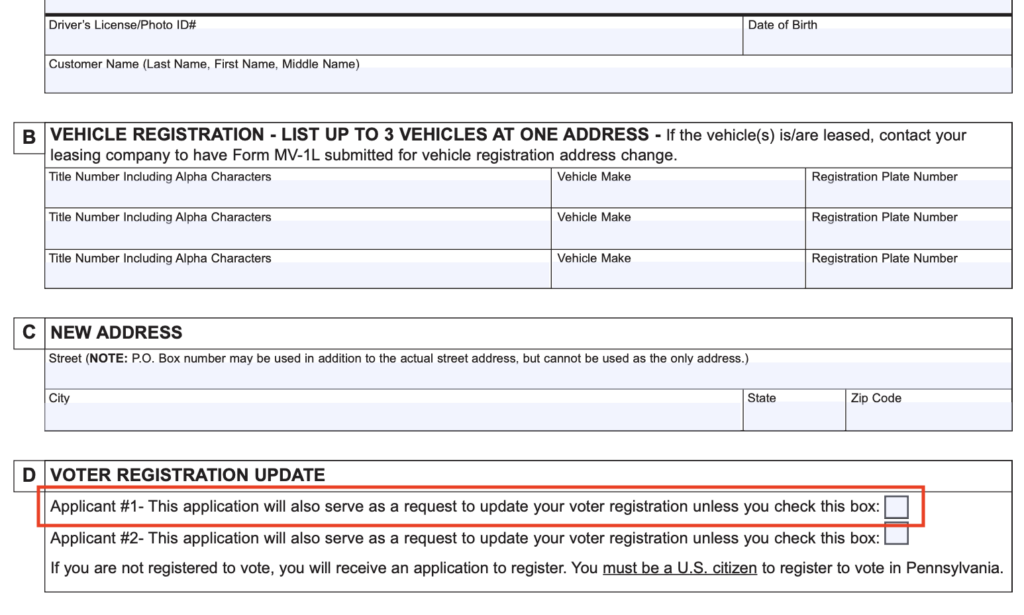
Nearly a year and a half after the court ruling, however, a PennDOT form available online contains the exact same “opt out” language that confronted O’Donnell in 2024.
In February, Broad + Liberty asked PennDOT and the DOS “Is there any mechanism — automated, default, or backend — by which address data from vehicle registration transactions can be shared with election officials or the Department of State?”
The answer from LeAnn Trindel, press officer for PennDOT, was unequivocal.
“No.”
Nevertheless, a 2024 court filing from the Department of State says, “Indeed, the version of the Department of Transportation form (the MV-63) for changing a driver’s license address and vehicle registration address that was in use in December 2023 included a field for the driver to decide if they wanted to update their voter registration with the new address.”
Although the Department of State did not answer any questions for this story, it did provide a copy of the above-referenced court document that appears to undercut PennDOT’s framing.
In follow-up, this outlet presented Trindel with the current version of a form, the MV-63, which still contains the exact same “opt out” language. When pressed how the DOT could say there was no mechanism by which a vehicle registration form could change a person’s voter registration despite the evidence, Trindel argued there was no conflict.
“Our responses are entirely consistent. Vehicle address change transactions and driver license address change transactions are separate and are done in two entirely different systems. Vehicle address changes are not, and have not been, forwarded for voter registration purposes. This was also the case in 2023. For driver license address changes, these are forwarded for voter registration purposes unless the customer opts out.”
Trindel further said, “The MV-63 form you reference provides customers with the ability to change their address for each of these two transactions. When customers move, most times customers need to change their address for both their driver license and vehicle registration. As a customer convenience, the MV-63 includes the ability to change both, so that the customer does not have to fill out two different forms.”
With this last portion of the answer in mind, it would appear, then, that PennDOT is relying on an extreme technical definition of its own systems — something that would be all but invisible to the average person.
According to PennDOT, the MV-63 is a hybrid form that combines both vehicle registration and driver’s license elements. In PennDOT’s view, apparently, voter registration changes happen through the driver’s license portion of the form — even if someone uses the form only to change their vehicle address.
“Section A” of the form is the change of address for a driver’s licence. “Section B” of the form is the change of address for a vehicle registration.
“Section D” will convert these changes over to a person’s voter registration as well unless the person opts out — but critically, the form never explains that Section D should only apply to Section A (driver’s license changes) and not Section B (vehicle registration changes).
When pressed on these questions, PennDOT did not respond by deadline. If PennDOT’s original thesis holds true, that only driver’s license changes can cause a change to voter registration, then it has never carefully explained how the circumstances for O’Donnell came into being.
All of this matters because all available evidence points to the idea that a practice that left the Pennsylvania Supreme Court vexed and upset still appears to be business as usual.
“Although PennDOT’s rogue transfer of voter registration in this case ultimately did not deprive O’Donnell of the right to vote, it would be troubling if PennDOT has a practice of making such a transfer without statutory authorization, or even the voter’s consent,” Justice Wecht wrote in his 2024 concurring opinion.
At the time, many Republicans were suspicious that the automatic updating of addresses was part of Gov. Josh Shapiro’s plan to automatically link voter registration with obtaining a new driver’s license, or AVR plan, for automatic voter registration.
After the court rulings in 2024, Sen. Cris Dush (R – Jefferson) lambasted the Shapiro administration for AVR.
“This is a very unusual situation for me when I’m agreeing with Justice Wecht on election issues where he says that ‘We are called upon to decide whether the election code really means what it says.’ Duh! It does mean what it says, and we’ve never given the executive branch the authority to do this [AVR], whether it’s the Department of State or the Department of Transportation or the two of them working in conjunction with one another,” Dush said.
Days later, a Shapiro spokesman defended all parts of the processes, saying, “Automatic voter registration is completely separate from the process by which a customer changes a vehicle registration address.”
Todd Shepherd is Broad + Liberty’s chief investigative reporter. Send him tips at tshepherd@broadandliberty.com, or use his encrypted email at shepherdreports@protonmail.com. @shepherdreports