
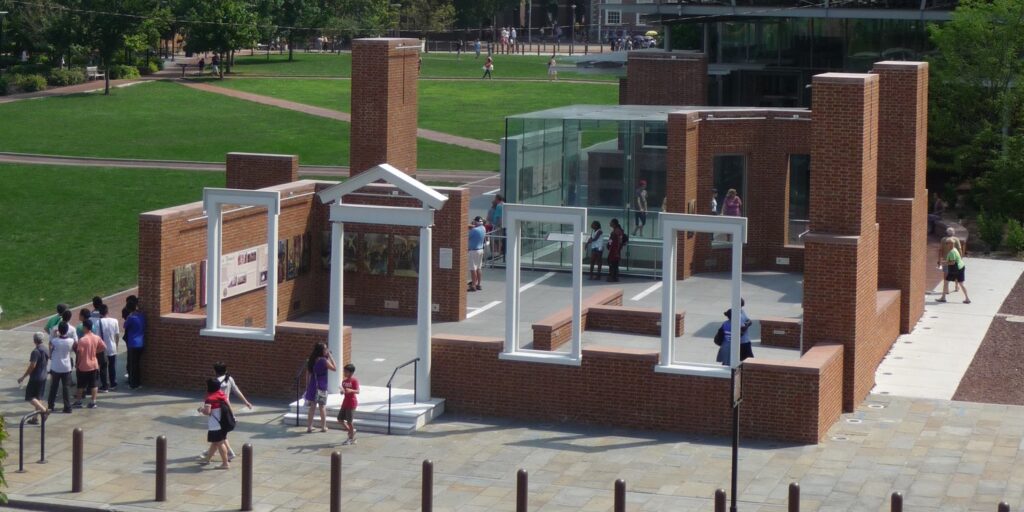
 Photo by National Park Service
Thom Nickels: History and hypocrisy
When I lived as a student in Baltimore I remember being surprised – shocked almost – to discover a number of Confederate monuments in that city. One monument especially stood out, the Confederate Women’s Monument, erected in 1917, that stood at Bishop Square Park at Charles Street and University Parkway.
I often visited one of my professors on Charles Street – one of the best residential streets in Baltimore – when he’d invite me over for “two drinks” and a chat. The monument was a few blocks from his townhouse but I’d always stop and look it over and think how strange Baltimore was, a quasi-southern city, not deep South certainly but southern enough to have Confederate memorials. The monuments struck me as an example of the graciousness of the United States, in allowing the defeated Confederate states and their allied states to honor their dead and war heroes. Magnanimous is the word that applies here.
During the Civil War, 60,000 Marylanders fought for the Union while 25,000 fought for the Confederacy.
As a Boy Scout, I spent time in a Maryland summer camp where I walked with my fellow Scouts through the woods where we sometimes encountered small tombstone-like Mason-Dixon Line markers that showed the dividing line separating the North from the South. These markers were something you could step over, putting one leg in the North and one leg in the South while claiming to be split down the middle.
In the 1960s, the Civil War was still very much a “thing” in schools and in the public consciousness. Neighbors often had Civil War books of one kind or another. As children we often staged Civil War battles in the fields of Chester County. My great aunt was fond of telling stories about growing up in Manayunk and how on Veterans’ Day she’d watch Union Civil War veterans march through the center of town. To that end, she’d always remind me that a great-great-great-uncle of mine fought as a Union soldier and died in an Old Soldiers Home in Ohio.
In Baltimore, I lived at 1812 Bolton Street with two older law students. Not far from the house was the Confederate Soldiers and Sailors Monument at Mount Royal Avenue and Mosher Street, erected by the Daughters of the Confederacy. The striking statue depicted an allegorical figure, or an angel, holding a dying Confederate soldier in one arm while raising the so-called ‘Crown of Victory’ in the other. ‘Gloria Victis,’ or ‘Glory to the Vanquished’ was engraved into the monument.
To my mind at the time the monument represented the fact that in death, there are no victors, but all become equal in judgment before God. The country was reunited after the Civil War, and Confederate veterans went on to serve in other wars, even as US Generals. Yet history revisionists view Confederate monuments as perpetuating the belief that slavery was benign and secession was justified. Some even go so far as to claim the monuments advocate for white supremacy.
In Baltimore, all four of its bronze Confederate sculptures were removed in the middle of the night on June 16, 2017 by then Mayor Catherine Pugh. The five-hour operation also included the removal of a monument of Justice Roger B. Taney, 5th Chief Justice of the US from 1836 to his death in 1864.
All the Baltimore monuments are currently housed in a Los Angeles museum, where curators call them, “A crystalline symbol of a white supremacist ideology.”
Fast forward to the President’s House in Philadelphia, once the home of George Washington and John Adams.
While the building no longer exists – the city allowed it to be destroyed in a series of demolitions – a modernist low level rendition by Kelly/Maiello Architects & Planners opened in 2010 to highlight the slaves that lived in the house. The President’s House, in effect, became the Enslaved House, complete with preachy, simplistic panels entitled “The Dirty Business of Slavery,” that told the story of the nine enslaved individuals who served the Washington family.
The President’s House was harshly critiqued around the world for its awful design. The New York Times found little to like about it. Many objected to the conflation of slavery over and above the story of the first President. The narrative on slavery pinned to its walls resembled a grade school exhibition with big block pictures in case you had trouble reading the story.
Ironically, the African American Museum, just a few blocks away from the President’s House, housed the same slavery display while the whole of the President’s House was reduced to one thing only: the fact that Washington owned slaves.
In January 2026, as the result of an earlier executive order from President Trump, crews removed the slavery exhibit including the names and biographies of the nine people enslaved on the site.
Trump’s executive order accused the Biden administration of advancing a “corrosive ideology” at the nation’s historic sites:
“At Independence National Historical Park in Philadelphia, Pennsylvania — where our Nation declared that all men are created equal — the prior administration sponsored training by an organization that advocates dismantling ‘Western foundations’ and ‘interrogating institutional racism’ and pressured National Historical Park rangers that their racial identity should dictate how they convey history to visiting Americans because America is purportedly racist,” the order declared.
The City of Philadelphia promptly sued Interior Secretary Doug Burgum and Acting National Park Service Director Jessica Bowron. Protests and rallies in support of the return of the slavery exhibit followed. Quakers and chronic left-wing Philly activists held “Restore the Truth” rallies. Local politicians and the mayor herself jumped into the fray.
Pennsylvania Governor Josh Shapiro, who’s taken a sharp leftist turn in recent months, condemned the decision to take down the display, arguing that Trump “will take any opportunity to rewrite and whitewash our history.”
Kenyatta Johnson, the Philadelphia city council president, stated: “Removing the exhibits is an effort to whitewash American history. History cannot be erased simply because it is uncomfortable. Removing items from the President’s House merely changes the landscape, not the historical record.”
A senior US District Court Judge, Cynthia M. Rufe, a Republican, blocked Trump’s executive order and mandated the return of the slavery panels. A federal appeal has already been processed.
Let’s consider Kenyatta Johnson’s line: “History cannot be erased simply because it is uncomfortable.”
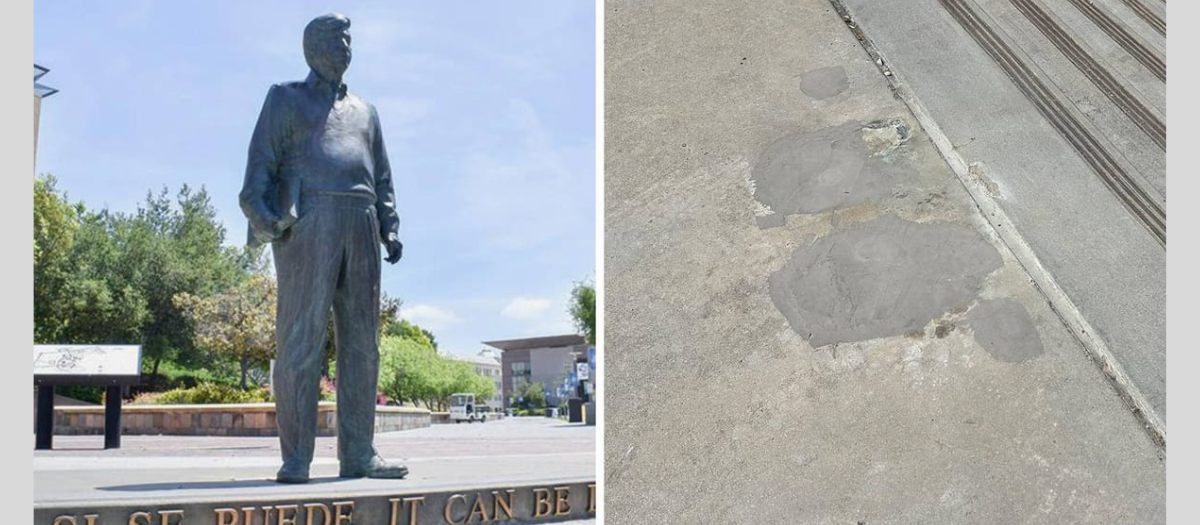
Tell that to the spirit of Kate Smith when her statue, erected in 1987 outside the Flyers Spectrum arena, was cloaked in a black sack and then eventually removed because of two “controversial” songs she recorded out of 3,000. Smith helped raise more than $100 million in war bonds during WWII. In 1982, President Ronald Reagan awarded her the Presidential Medal of Freedom, the nation’s highest civilian honor.
Tell that to the destroyers of the Frank Rizzo statue that stood for years in front of the Municipal Services Building in Center City.
Tell that to the destroyers of more than 220 Confederate monuments removed since 2015 in the states of the former Confederacy.
And tell that to the haters of Christopher Columbus, who don’t want to see any statues of him anywhere.
You don’t get to pick and choose your “uncomfortable history.”
Until this message sinks in, you — meaning the City of Philadelphia — don’t deserve your grade school slavery panels nailed back on the walls of what purports to be the President’s House.
Thom Nickels is Broad + Liberty’s Editor at Large for Arts and Culture and the 2005 recipient of the AIA Lewis Mumford Award for Architectural Journalism. He writes for City Journal, New York, and Frontpage Magazine. Thom Nickels is the author of fifteen books, including “Literary Philadelphia” and ”From Mother Divine to the Corner Swami: Religious Cults in Philadelphia.” His latest work, “Ileana of Romania: Princess, Exile and Mother Superior,” will be published in May 2026.
There is a danger when we let anger short circuit our reason. A mistake that often traps me. Don’t let others’ anger infect you.
There are endless examples of idiocy. One of them is the religious fervor for DEI and ESG scores. These are just Communist tricks to divide and conquer. We must be very intentional and our society is best when we cultivate faith, hope, and love. Consciously choose a determined optimism. The only real freedom you have is no one else can ever control your attitude and efforts.
There is a reason many people are so mad there has been an effort to ignore that Washington had slaves. It should be displayed and reflected at that place. It should also not be the major focus at that place. It is a shame that our leaders (judges, politicians, etc.) are grandstanding and not trying to find reasonable solutions and peace. We need better leaders. What solutions are there?
The history of slavery in the US should be taught. It should also be taught with all of its aspects and in the context of how slavery had been held then. Best estimates are that something north of 12 million black Africans were sold into the Atlantic slave trade by other black Africans. The numbers show that about 4% of that number came to what became the 13 original colonies and then states of the United States. The rest went to the Caribbean colonies and to Central and South America. While slavery can only be viewed as a terrible condition, it was broadly practiced and should be taught in the context in which it existed.
What is not included in the Washington slave story is that he supposedly, by will, manumitted the slaves after the occurrence of Martha Washington’s death. There is never in today’s world of victimizations a complete history of slavery in the Western hemisphere. No real in depth treatment of the abolitionist movement, no detailed history of the workings of the Underground Railroad and no treatment of the Hundreds of thousands of dead and wounded Union soldiers. The tragedy is the use of the reality of a painful, sometimes brutal and always psychologically devastating existence to push an agenda not as a means to gain understanding.
The only reason the Presidents’ House exists is because of the recognition that the plot held slave quarters of people held by Washington. The irony of the first president shuffling humans around to circumvent a law that would have freed them is certainly a story that needed to be told, a context unavailable elsewhere. We did not need more glorification of a fascinating, pivotal, and human Washington. The story of the nine enslaved people was the point of that exhibit.
There is nothing that insists that every historic representation tell the whole context from time immemorial through today. Independence Hall fails to discuss the Spanish American War, WW1, and WW2 — arguably all important points in US history and, after all, the US started there.
Historians continue to document and analyze abolition and the Underground Railroad. Of course, such history is complicated by the distance in the past and the often subversive — or in the case of the Underground Railroad — illegal nature of the activity. Records are sparse for many things that truly happened but how many keep detailed records of their illegal activities?
No treatment of dead and wounded Union soldiers? Have you looked?? Coverage of just Gettysburg and Antietam alone make the scale of the terror and waste palpable and visceral.
The fact that being confronted by documented history of slavery hopefully causes pain in the learner simply proves humanity. Such portrayals add understanding though absent any possible sugarcoating. If the agenda is to make certain that the piece of history does not disappear back into the mist of the past, that is a worthy agenda.
Like the realities of the centuries-long impact on indigenous people, or the cause of Irish immigration and the reception upon settling in America, or the shame of failing to accept Jewish asylum seekers in the 30’s and 40’s, history will make people uncomfortable, sad, and ashamed of forebearers. At least I hope it does.
What a ridiculous response.
The President’s House exists because the President lived there.
Yes the story of the nine slaves needs to be told but anybody thinking it should be the main focus is not a serious person, and the way it was displayed is exactly as the article describes it. It’s like a grade school project. Embarrassing and amateur.
Like everything else the far left does.