Budget fix or legal risk? Delaware County may have tapped restricted funds to ease 2025 tax increase
Delaware County’s use of opioid settlement money in the 2025 general budget may be a violation of the laws and regulations guiding how those funds can be spent, raising further questions about the county’s process in creating one of the most controversial budgets in recent memory because of its 24 percent tax hike.
The revelation about opioid funding is only now in clear view because Executive Director Barbara O’Malley finally explained in October the sources of $7.6 million in money labeled “transfers” in the 2025 budget — even though this outlet asked the county to supply that information eleven months ago.
The millions in transfers were key to helping the county reduce a potential 28 percent tax increase to 24 percent, an increase that, even when lowered, still generated hours of irate public comment at public council meetings and resulted in a flood of angry emails to the council, according to emails obtained by Broad + Liberty.
Tracing the source of the money has been key to understanding the potential for the upcoming 2026 budget. If the county relied on non-renewable revenue sources, it would need to either find cuts or raise taxes in 2026 to offset the shortfall.
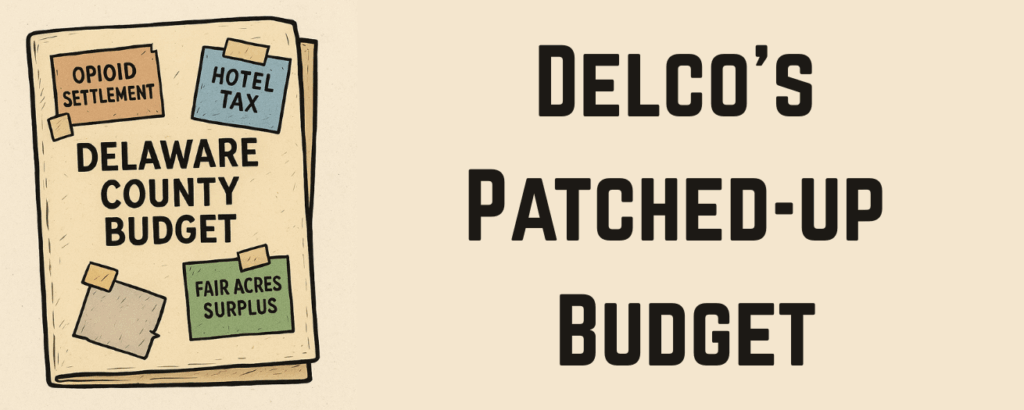
Also included in the transfers category were monies from the county’s tourism tax as well as surplus revenue from Fair Acres, the county-run nursing home — both of which raise their own legal questions. The county has not disclosed how much each source contributed to the $7.6 million total.
Broad + Liberty first asked the county to explain the transfers line item in December of 2024, and the county did not respond. After a subsequent Right to Know request in January seeking documentation about the transfers produced no records, the county again ignored a question asking it to delineate the various sources.
Finally, in a council meeting on Oct. 22, O’Malley explained the sources of the $7.6 million, including the opioid funds.
“The first initial payments [of opioid settlement money] are a bit higher than what we’ll receive in later years, and we are using [that] funding to recover as much of our internal county costs as possible,” O’Malley said.
“So those might be things attributed to the correctional facility staff that work on these issues, the Medical Examiner’s office. We are looking at every single possible opportunity to use the opioid funding to support and reduce the cost that the county bears for those costs related to opioid use.”
Such rationales have been rejected elsewhere in the Commonwealth, however.
In the years after the 2020 pandemic, Cameron County sought to boost its funding for child welfare services, arguing those programs were never “compensated fairly or equitably for the additional requirements the opioid epidemic has caused,” according to a February 2025 report from Spotlight PA.
“But in August 2024, board members for the Pennsylvania Opioid Misuse and Addiction Abatement Trust rejected the county’s use of funds,” Spotlight PA’s report went on to say. “It was a significant decision — trust members have the power to withhold future settlement money if they decide counties spent the funds inappropriately.”
When asked if shifting opioid settlement money to the county’s general fund was legal, Delaware County Communications Director Michael Connolly said, “those funds are allowed to be used by counties to reimburse expenses that are caused by the opioid crisis, as specified in Exhibit E,” but offered no other explanation or specifics.
“Exhibit E,” a document from the Pennsylvania Attorney General’s office, specifies the kinds of “programs or strategies” the settlement money can go to. While Exhibit E offers a permission structure of what the money can be spent on, it does not offer much in the way of prohibitive language — offering clear examples of what the money should not go towards.
The Pennsylvania Opioid Trust is the entity that receives the settlement money in bulk and then “distributes those settlement funds to the Commonwealth of Pennsylvania, counties, and subdivisions[.]” Its website says, “only uses listed on Exhibit E to the Settlement Agreements are authorized” by the settlement agreements.
Even Delaware County’s own opioid settlement website acknowledges, “These settlement funds will support programs directly related to the impacts of opioid overuse and addiction and is restricted to certain remediation purposes[.]”
All available evidence suggests opioid settlement money is meant to support specific remediation programs and, generally speaking, is not intended to offset indirect expenses.
Similar legal questions exist with the hotel tax transfer.
According to county code, the treasurer “shall collect the tax from the [hotel] operator and deposit the revenues received therefrom in a special account established solely for the purpose of travel and tourism promotion and advertising related to such promotion,” (emphasis added).
Connolly said, “that funding is kept in a separate account and Fund center. Portions of the earned revenue get moved to the general fund account quarterly to pay for the debt service reimbursement for the soccer stadium, Visit Delco office rent, and the statute [sic] allowable county 4% administration fee.”
It’s not clear whether the hotel tax can be used to amortize the county’s soccer stadium or any loans which helped fund it, which are, in essence, construction costs.
This summer, the county debated raising the tourism tax from three percent to five.
“Any revenue generated from the tax must solely be spent to promote tourism. The money does not go into the county’s general fund for regular operating expenses,” the Delco Daily Times reported in June.
While there appear to be fewer legal issues related to the Fair Acres transfer, it also appears that money will not be recurring — meaning it was one-time funding that would need to be replaced either with a tax increase or commensurate spending cuts.
Connolly said the county “would not see a $3.8 million revenue surplus” this year from Fair Acres. Connolly also said the county only moved about half of that surplus — approximately $1.9 million — to the general fund.
Transparency issues
After O’Malley itemized the sources of the transfer, the county produced to Broad + Liberty an email showing O’Malley discussing approximately $3.8 million in surplus revenue from Fair Acres, about half of which was transferred to the budget, according to Connolly.
As mentioned previously, when questions first arose about the transfers issue, Broad + Liberty filed a Right to Know request seeking documents, including emails, which might name or identify the source of the transfers. The county eventually said there were no responsive documents, which the county’s newly produced email clearly shows to be untrue.
When asked why the document wasn’t produced, Connolly said, “I can’t speak to the Right to Know search.” When asked why the county did not answer the questions about the transfers issue in December or January, the county ignored the question.
On Tuesday, Delaware County voters will decide whether a Republican could potentially disrupt up the six years of Democratic unanimity on the council that began after the 2019 elections. Republicans Brian Burke and Liz Piazza are running against incumbent council member Richard Womack and Controller Joanne Phillips, both Democrats.
Delaware County’s charter is different from neighboring counties in that it does not require a mandatory seat for a member of a minority party.
Update: An earlier version of this article stated that the county failed to produce a copy of the email about the Fair Acres surplus in response to a second, subsequent Right to Know request that was more generic when compared to the first request detailed in the article.
On Nov. 4, attorneys representing the county pointed Broad + Liberty to the part of the document production of the second RTK in which did, in fact, contain the email, although it was heavily redacted to the point that it was not locatable using the search terms being employed.
The article has been changed from the original to reflect this new understanding. It should also be noted that this outlet asked the county to explain why it appeared the email was not produced in response to both requests, and the county’s spokesperson said, “I can’t speak to the Right to Know search.”
This new information does not change the other assertion, however, that the county failed to produce the same email for the first RTK request when it clearly did meet the standards of the request.
Todd Shepherd is Broad + Liberty’s chief investigative reporter. Send him tips at tshepherd@broadandliberty.com, or use his encrypted email at shepherdreports@protonmail.com. @shepherdreports