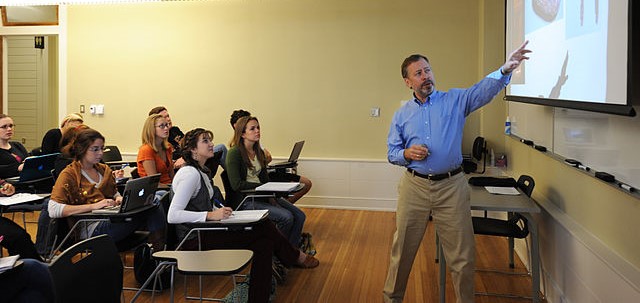
John Rossi: Adventures in education
I taught History at La Salle College — now University — for over fifty years. During that time, I estimate I taught over 5000 students, initially all males and after 1970, women when La Salle became co-ed. I thoroughly enjoyed the experience.
Some of my students became doctors, nurses, lawyers, various kinds of businessmen and women. Some went on to become college teachers earning their Ph.D. One of my students, William Burns, became ambassador to Russia and Egypt, among other nations, and served as head of the CIA. Another, John Rodden, is the leading George Orwell scholar in the United States and author of over 25 books.
Something I learned early was that all classes, whether upper level or introductory, are different. If I had six or seven students who asked questions or took an active role in class discussions, others would gradually join in and the class would be a success. I found it difficult to motivate a quiet group no matter what I tried: special readings, films, class projects, etc.
Another thing I learned was that students were more territorial than wolves. After a class or two, once they settled on their seat they never moved. There were front row seaters and back row seaters but once students chose their seats — it usually took a class or two — they didn’t move. I never complained because it made it easier for me to call roll and get to know them.
This territoriality could be fun. In the early 1980s, I had a young man in one of my classes and I noted that he was the first to arrive and he always sat in the same seat: row one, first chair. Once I decided to try an experiment. I had another student arrive early and sit in that seat. When the original chair holder arrived, he was completely discombobulated and spent the class not looking at me but at the student in his chair. I let things return to normal for the next class.
Among all my classroom experiences one in the early 1980s stood out. I was conducting a survey class in Western Civilization or as students then referred to it, “From Adam to Ike,” or “From Caveman to Truman.” The class was made up of mostly sophomores with a sprinkling of freshmen. It was something of a ‘gut,’ meaning that there wasn’t that much reading and writing and if a student put in any serious effort, it could be an easy B.
We met three times a week. The first week was a kind of feeling out time for me to see just what kind of students I had. There were a couple of readings and discussions and in the Friday class I gave a short writing assignment, a paragraph to discuss any thing that the students found interesting or wanted to learn more about. Actually, I was trying to see if there were any problem students — in other words: could they write a brief paragraph that made sense.
I read the assignment over the weekend. They were fine except for one which consisted of two sentences that made no sense. Before class on Monday, I called the Dean’s Office to ask about the student. As soon as I mentioned the reason for the call, the Dean’s assistant guessed the students’ name. He told me that the young man had the greatest discrepancy between his verbal and math scores in years: very high in math and incredibly low in verbal.
My usual action when I found students with this problem was to recommend the Writing Lab where they could get special attention. After class the student John Ball (not his real name) met to discuss his problems. I suggested the Writing Lab, but he said that hadn’t worked for him in high school. And then he surprised me: he asked if I would tutor him as he liked history and had enjoyed our class and my way of teaching.
I agreed and every week that semester, usually on Friday, we would meet and go over his writing problems. I was impressed by his seriousness and watched his writing improve and his self-confidence grow. He lived with his father, a construction worker, whom he deeply admired but never mentioned a mother or any siblings. He was likeable and had a certain innocent charm about him. He passed my class with C+ average — the kind of story that made me feel good about teaching.
Early in the next semester he showed up and asked if I could help with his assignments for his English class. At first, I was reluctant but eventually agreed. Again, as in my class, we met every week or so to go over the themes he had to write. There were a few problems but nothing serious. His last essay had something to do with developing an argument and making a convincing case. I read the essay, which was fine until I got to his conclusion.
To sum up his argument, he wrote: “My father always said, if you ask 100 girls to have sex with you, ninety-five will say no, but you will still be ahead of the game.” When we met, I suggested another ending. Later he told me he passed the class and I often wondered what would have happened if his teacher, who happened to be something of an angry feminist, read the original version.
During his last two years on campus, we kept in touch but he was in the Business School across the campus from me so I saw him rarely. There were no more tutorials.
Twenty years later my wife and I were at the Willow Grove Mall when I heard someone call my name. It was him. He made a big fuss over me and told my wife how much he enjoyed my class which was nice to hear. He was a lawyer in a suburban law firm and had made partner. He was married with two children and seemed a happy and contented young man.
In all, it was the kind of thing that made teaching rewarding.
John P. Rossi is a retired Professor of History at La Salle University.