
Beth Ann Rosica: Millcreek Township School District violated First Amendment by suing citizen, court says
School districts are prohibited from suing citizens for defamation because it is considered a violation of the First Amendment. However, that didn’t stop a suburban Erie school district from trying — at the taxpayer’s expense.
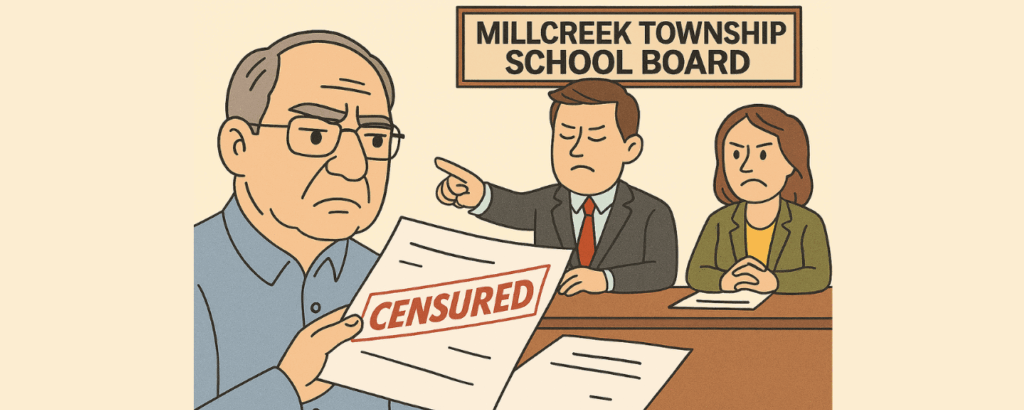
Millcreek Township School District (MTSD), according to a former elected school director, is engaged in a five-year plus legal battle because it objected to his requests for information and comments he made publicly. The school board and superintendent first denied legitimate requests for information from this duly elected school director, and then investigated and censured him, removed him from committee, and silenced him at meetings when he attempted to speak as an elected official.
Ultimately, the school district sued, alleging “defamation” against both itself and the superintendent, despite the fact that school districts are prohibited from bringing forth such actions based on a 1964 U.S. Supreme Court ruling.
Lou Aliota was elected to the MTSD school board in 2015 and served his full term until 2019. Before earning a seat on the board, he was a regular participant at board meetings and frequently made public comments expressing his concerns about financial decisions. As a conservative, Aliota sought fiscal accountability and transparency, but when neither was forthcoming, he decided to run for school board and won.
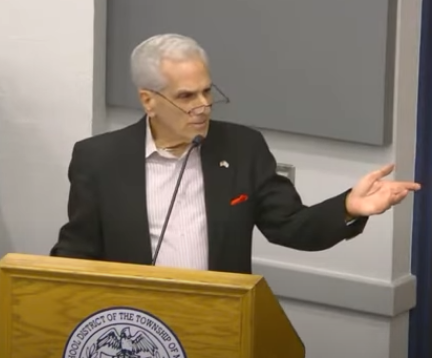
However, Aliota quickly realized that his position on the board was not going to provide access to district information that he was legally entitled to receive. The same board members and superintendent who refused his requests as a taxpayer continued to deny him as a school director. Aliota made multiple requests for legal invoices, employee cell phone invoices, grocery store receipts, and details on the superintendent’s usage of district owned property — all of which were denied.
Aliota’s concerns that the board was spending money illegally heightened as they refused to provide the requested documentation. Left with no other recourse, he hired an attorney one month after being sworn in to defend himself against the first investigation initiated by another board member. His attorney subsequently filed a mandamus suit in June 2017 to compel the board and superintendent to provide the information he was legally entitled to receive.
In the normal course of legal proceedings, the district would simply file an answer to the lawsuit, denying the allegations. Instead, it filed an answer and a counterclaim against Aliota, alleging he “defamed” the board. The district also initiated a similar but separate counterclaim against him, alleging he “defamed” the superintendent at the time, William Hall.
Millcreek used taxpayer dollars to fund both of these suits and alleged Aliota’s critical comments about the district and its superintendent were not protected under the First Amendment.
The district sued one of its own school board directors for engaging in free speech, protected under the First Amendment.
This litigation continued over five years at taxpayer expense and is ongoing. Broad + Liberty obtained legal invoices under a Right-to-Know request revealing the district spent over $330,000 through August 2025 on litigation against Aliota.
In July 2020, the judge dismissed the mandamus lawsuit due to a lack of standing since Aliota was no longer a school board director. Subsequently, his attorney, Brian Pulito of Steptoe and Johnson, PLLC, filed a motion with the court to declare the board’s counterclaim unconstitutional.
Pulito said in an interview with Broad + Liberty that this is the only case that he is aware of in Pennsylvania history where a public agency sued an elected official over their right to free speech.
“In fact, in every reported case in which a governmental body sued a person for defamation, the courts ruled that those lawsuits violated the person’s first amendment rights,” said Pulito.
The judge agreed with Pulito that the board’s counterclaim was unconstitutional and granted the motion to dismiss.
“The Board as a governmental entity may not maintain a libel or defamation action regardless of the veracity of the statements or the existence of malice,” wrote Judge Brabender in his opinion.
It was further ordered that the district could not use taxpayer dollars to fund such lawsuits due to their unconstitutionality.
“The Board’s Counterclaim is unconstitutional, and as such, it must be dismissed,” the judge wrote. “It logically follows the Board may not attempt to silence a critic or otherwise have a chilling effect on free speech, by pursuing and funding, with public resources, Hall’s Counterclaim.”
While the judge’s opinion and subsequent order vindicated Aliota, the arduous process cost him greatly in terms of financial resources, diminished earning potential, and emotional distress. As a result, he filed a lawsuit in June 2023 in federal court against the district and seventeen current and past board members. The suit alleges five violations, including First Amendment Rights, malicious use of process, abuse of powers, tort of negligence, and abuse of process. The matter is still pending in the Western District of Pennsylvania.
“It has been a horrific and atrocious ten plus years fighting corruption and deception, everyday, from both the elected and appointed public officials in trying to get the truth to the public,” said Aliota. “The cost to expose the truth is enormous and those corrupt public officials know they have the upper hand because they have your tax money to use against you, but in many exceptions the true American patriots will fight to the end for the parents, students, taxpayers and residents in the community.”
MTSD’s solicitor, Timothy Wachter from Knox McLaughlin Gornall & Sennett, P.C., on behalf of the district, declined to comment on the Aliota legal cases.
The school district’s response to these issues is hard to understand, and the legal advice from their attorneys is questionable.
The judge was unequivocal in his opinion that the board was wrong to bring forth the defamation suits.
“Defendants cite to no case law or statutory authority which authorize the funding of a defamation suit by the government on behalf of a governmental entity or a public official,” wrote the judge in his opinion. “The Board’s argument that it may bring a defamation action in its own right against Aliota are wholly lacking in merit.”
Now the district and specific board members in their individual capacity are facing serious allegations in federal court. If Aliota prevails, the district could be hit with a significant financial judgement — all because it refused to provide documents that both taxpayers and board members are legally entitled to.
Additional MTSD legal issues
In the midst of this upheaval against Aliota, MTSD hired superintendent Ian Roberts, the now disgraced former Des Moines Public Schools superintendent who was recently taken into federal custody. After attempting to flee from ICE agents, Roberts was charged with being an illegal alien in possession of firearms — a federal offense — and was subject to a previous removal order to leave the country, in addition to a litany of prior charges, including possession of narcotics with an intent to sell and multiple weapon offenses.
Roberts served as superintendent in MTSD for almost three years from August 2020 to June 2023. While current school board members in the Millcreek community were shocked when the district made national headlines, Aliota and others were not surprised and viewed the lack of oversight in hiring Roberts as just one more example of the district’s lack of accountability and transparency.
Details emerged alleging Roberts lied not only about his immigration status and eligibility to work in the United States, but also about his educational degree. In its first statement responding to the situation, MTSD said Roberts “completed and submitted the I-9 employment eligibility verification form and submitted documentation to support his employment eligibility.” It also noted that a national executive leadership firm, Ray and Associates, Inc., conducted the vetting and search process.
The second statement issued two days later was more pointed and said it was considering whether to pursue legal action against both Roberts and the search firm. “The egregious breach of trust that was perpetrated by Roberts, who we hired to lead our schools, is unconscionable.”
MTSD, according to the statements, appears to view itself as the victim of Robert’s deceit, yet the campaign against Aliota and a separate legal settlement suggest a history of poor decision making.
Days before Robert’s last day as superintendent at MTSD, the district signed an agreement with the former Director of Human Resources to settle allegations of unlawful treatment and constructive discharge in the amount of $250,000. Typically in school districts, the Human Resources Director reports directly to the superintendent, and that is the current structure in place as reflected in a 2025 MTSD organizational chart.
As the direct supervisor, Roberts was either the alleged perpetrator of the unlawful conduct or was responsible to address her concerns. While the district admits no wrongdoing in the agreement, it is a sizable settlement for an organization with a $125 million annual budget.
The school district and its attorneys should have suspected something was amiss with Roberts after Aliota’s attorney took two different depositions of his sworn testimony. The first deposition occurred in April 2021 when Roberts was still employed by MTSD, and the second one was taken in April 2025 while he was employed by Des Moines Public School. In the second deposition which lasted only 45 minutes, Roberts responded over 50 times with responses, “I don’t recall” or “I have no recollection.”
MTSD’s attorney at the time, Aurora Hardin from Knox McLaughlin Gornall & Sennett, was present during the questioning when the 53-year-old former employee had no recollection of most issues related to his tenure as superintendent. Yet, the district said it was “incensed by the progression of media reports” regarding Robert’s deceit and voted on October 6, 2025, to investigate the costs to sue the search firm responsible for vetting and recruiting the former superintendent.
Now as the board considers additional litigation, the district and specific board members in their individual capacity are facing serious allegations in federal court. If Aliota prevails, the district could be faced with a significant financial judgement — all because it refused to provide documents that both taxpayers and board members are legally entitled to.
Ultimately MTSD wrongly sued a private citizen and duly elected board member for defamation and lost, and perhaps the only person actually defamed was Lou Aliota.
Beth Ann Rosica resides in West Chester, has a Ph.D. in Education, and has dedicated her career to advocating on behalf of at-risk children and families. She covers education issues for Broad + Liberty. Contact her at barosica@broadandliberty.com.



Scary, this is an example of what far too many school boards have become. A fiefdom under the superintendent, supported by a Sanhedrin of sycophants looking to further personal agendas. It is alarming that in the workings of today’s school districts, actual students are ignored and forgotten as if they were just an ancillary annoyance and parents are viewed and treated as barbarians at the gates.