
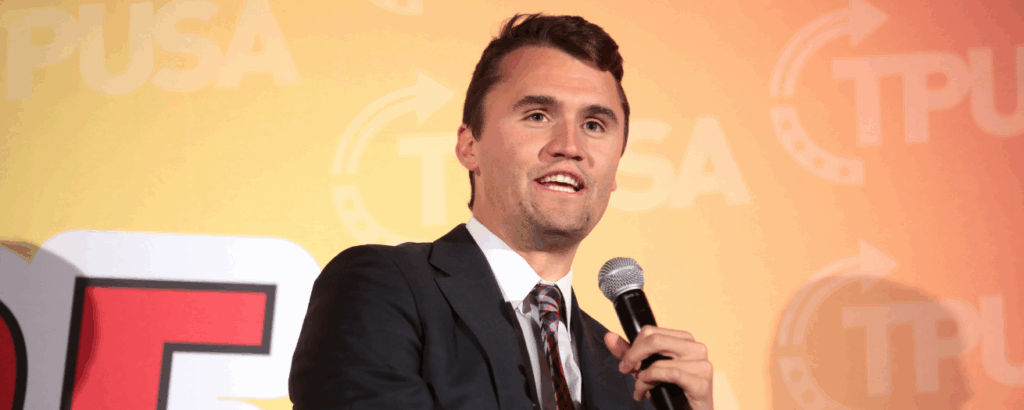
 Photo by Gage Skidmore
When trauma becomes the platform
The tragedy of Charlie Kirk’s murder has reignited a troubling pattern we have seen far too often in the United States: the media and public discourse hijacking grief to build narratives, movements, and platforms that too often overshadow those most directly impacted. This phenomenon is not new; its recurrence demands that we pause and interrogate the ethics behind it.
When twelve-year-old Tamir Rice was killed in Cleveland, his mother, Samaria Rice, spoke candidly about what it meant to have her son’s death instantly politicized. In reflecting on her experience, she stated, “All of the families should be getting therapy, and all of them should be getting the tools to speak for themselves, not have people speak for them.”
Her words highlight a painful truth; in moments of profound loss, families are left without adequate support, while lawyers, celebrity activists, and commentators step into the spotlight. Their stories, however compelling, are not the stories of the grieving mother, father, or sibling who must carry the weight of that loss forever.
What we are witnessing is the commodification of trauma. The media cycle thrives on immediacy, on breaking news, on the microwave model of quick consumption. Yet just as microwaved meals strip food of their richness, these rushed narratives strip tragedy of its humanity. The focus shifts away from the individuals whose lives have been irreparably altered and turns toward the opinions of those with the loudest microphones.
This practice has consequences. It fractures communities by inviting the public to form judgments before facts are fully known. It cultivates division by turning grief into a spectacle. It denies families the dignity of authorship over their own stories. In our hunger for access; intimate, immediate access; we forget that some spaces are not ours to occupy.
Charlie Kirk’s death is the latest example. Platforms are using his name and image as a tool to galvanize others without any clarity about what he truly meant by the things he said. Only those closest to him could ever know the context; only his wife, his family, or his confidants could understand the intentions behind his words. Instead of honoring that complexity, outsiders have filled the silence with speculation. In doing so, grief becomes the raw material for agendas, and the person at the center of the tragedy disappears into a narrative crafted by strangers.
Samaria Rice’s critique of prominent activists in the Black Lives Matter movement underscores the depth of this problem. When she revealed that many who spoke her son’s name on stages and in headlines never once knocked on her door, she exposed a culture more interested in leveraging tragedy for visibility than in offering families true solidarity or healing. The silence of those closest to tragedy should not be mistaken as an invitation for others to fill the gap; it should be recognized as a sacred space for families to grieve, process, and speak on their own terms.
The question, then, is not simply about media responsibility; it is about cultural discipline. Can we, as a society, restrain our impulse to consume and comment long enough to center the people who matter most? Can we learn to honor silence, research with care, and listen to those living the story rather than those profiting from it?
The root of the matter is this; these are not our stories to tell. Until we confront our complicity in turning grief into currency, we will continue to dehumanize those already suffering the greatest loss imaginable.



Ms. Morales,
Thank you for your article. Former DEI and ESG advocates, that pushed their communist ideas upon society, seem unaware that their moral admonishments no longer work on people awake to their efforts. Yet your ideas sound reasonable: let’s advocate for respecting the privacy and agency of grieving families and to discourage speculative or divisive discourse. Yet Charlie Kirk seemed like a man who encouraged hard questions. So your article might come across as simply trying to downplay important and uncomfortable conversations and questions regarding the murder of Charlie Kirk. There are people upset towards others for not accepting the official government narrative of Charlie Kirk’s assassination – as if questioning the US government is somehow disrespectful. Yet, what has our government been up to recently since Charlie Kirk was assassinated on 9/10? Since then, the US government has: 1) blocked Epstein file release, 2) House of Reps passed an amendment to the defense budget that bans Pentagon from boycotting Israel, 3) proposed a bill for State Dept to revoke US passports for critics of the government of Israel, 4) approved $650mm in additional US taxpayer money for missile defense of the government of Israel. Why can’t we ask questions? Why are some topics not allowed to face scrutiny? Why is it noble and virtuous to celebrate certain types of tribalism while others are denied the right to celebrate theirs? Shouldn’t we again teach and celebrate the idea of the US melting pot and celebrate that we are all US citizens? Why is our government making laws against questioning blind support for another government halfway across the Earth? Those were the very difficult and potentially divisive questions Charlie Kirk had just started asking before he was assassinated.
I agreed with her piece in general, but thought the point of not knowing what Charlie’s words meant because they are personal to him. On the contrary, I think he wore his thoughts on his sleeve.
Overall– good piece about not jumping the c shark. Using momentum to make a reasonable valid point and then there is those that overplayed the hand and take it too far.
This has not gone far enough.
This is genuine heartfelt sadness and anger and it is valid. However, it may get hijacked my congressional leaders for midterm fundraising and poison the message.