
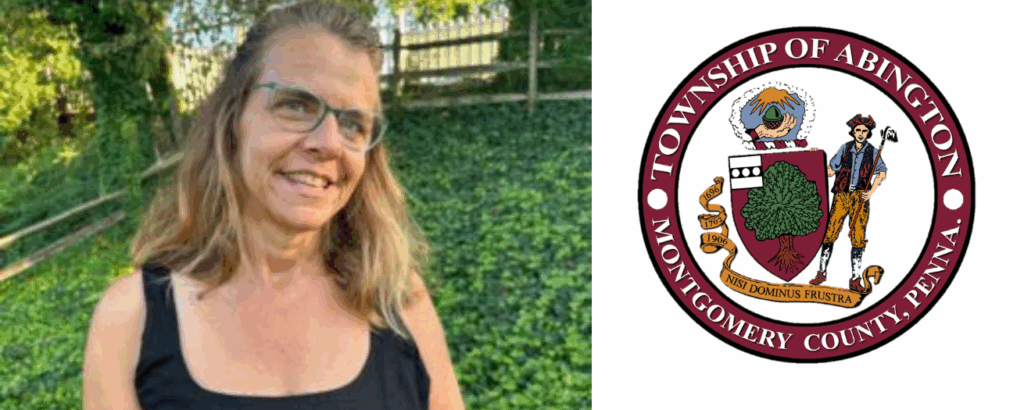
Gag order in Abington? Police chief targets outspoken resident
When two Abington police officers showed up at her front door to deliver a letter, Adele Kubel knew something was amiss.
What she didn’t expect was a letter from Abington Police Chief Patrick Molloy warning her about violating an obscure Pennsylvania law, 5508, which states: “A person commits a misdemeanor of the third degree if, with intent to prevent or disrupt a lawful meeting, procession or gathering, he disturbs or interrupts it.”
Kubel, 58, is a retired art teacher who taught in Philadelphia public schools. She’s also a regular speaker at Abington Commissioners’ meetings. She told DVJournal that she is concerned about blight, development, traffic safety, and bicycle lanes, and asks the commissioners to take action.
Some might view her as a gadfly, but many township, school board, and county meetings feature regulars who sometimes have questions on obscure or esoteric issues. Those citizens are free to exercise their First Amendment rights to tell their elected officials what they think, to ask questions, and to oppose policies.
Except in Abington, perhaps.
Kubel believes her recurring questioning of township policy is the reason she received a cautionary letter. She was served with the chief’s letter after the July 10 commissioners meeting. DVJournal reviewed video of the meeting, which shows that while Kubel spoke loudly—perhaps even angrily—she also sat down after her three minutes were up.
Asked about the letter, Molloy said Kubel was not charged with any crime. However, he wanted to “get her attention.”
Molloy claimed the tape did not show that Kubel called out from the back of the meeting. Kubel denies doing that, except to mutter “Oh, God,” under her breath.
Molloy said Kubel has gotten more strident over the four years she’s been coming to the township meetings, and that he sent the officers to her house for a “well-being check.”
He also mentioned that she has waited for and spoken with township employees outside of work and yelled at a commissioner at the Whole Foods store. Township employees felt threatened, he said.
Kubel denied yelling at Commissioners’ President Thomas Hecker at the grocery store. She admitted talking to township employees, including a man who works in the public works department, but said she spoke to him only when she saw him in passing, as he lives near her.
Molloy said this is the only time he’s sent a letter like this to a resident. And he denied that the letter threatened her freedom of speech.
“Elected officials cannot censor or retaliate against speakers simply because they voice harsh or impassioned criticism,” said Stephanie Jablonsky, Foundation for Individual Rights and Expression (FIRE) senior counsel. “Public meetings are at a minimum considered limited public forums, which means that any restrictions on speech must be reasonable and cannot target disfavored viewpoints.
“While speaking out of turn, beyond the time limit, or on topics wholly irrelevant to township business are disruptive behaviors the commission can address, it cannot cut off speakers as disruptive simply because their speech is critical. Courts also generally require disruptions to be real and material, not trivial, to justify punishment,” Jablonsky said.
Joseph Rooney, chair of the Abington Township Rockledge Republican Organization, frequently attends the Board of Commissioners meetings and also speaks.
He does not believe that Kubel is disruptive.
“I have seen commissioners insult people after they speak, and the person stands up and responds to the insult. (President) Hecker pounds his gavel and states that this is not a discussion and their three minutes are up. Who is interrupting the meeting? The insulted citizen, or the instigating commissioner?” asked Rooney.
Kubel “makes comments that can be heard, but others have also when commissioners decide to denigrate people with whom they disagree. These meetings are anodyne. Commissioners are usually asleep or surfing the web when they should be paying attention. Controversy is what politics is all about. We have a 14–1 Dem vs. GOP board, and they can’t handle any disagreement.”
Rooney said the commissioners are rude when Kubel speaks, rolling their eyes and laughing at her.
Asked if this letter might deter him from speaking at the meetings, Rooney said it would not.
“But my wife would not want to be subjected to rude treatment,” he said.
Kubel, however, is considering whether to continue attending the public meetings.
Hecker did not respond to a request for comment on Monday.
Thomas Estilow, chair of the Cheltenham Township Republican Organization, said the Democrat-controlled towns—Abington, Cheltenham, Jenkintown, and Springfield—have gotten more restrictive about residents’ speech at meetings.
Cheltenham never had limits on speech, but the commissioners recently passed what Estilow dubs a “muzzle law” that restricts the public’s speech to three minutes at the beginning and end of meetings.
“Ironically, Rockledge Borough is the only local municipality that does not have public comment restrictions,” said Estilow. “If you attend a Rockledge Borough meeting, you will observe that the Borough Council encourages public participation and fosters a friendly and respectful environment. If you attend Abington, Jenkintown, or Cheltenham public meetings, you will observe dismissive and disrespectful behavior directed to citizens by their elected officials.”
Linda Stein is News Editor at Delaware Valley Journal.
This article was republished with permission from the Delaware Valley Journal.

It would be interesting for a reporter from B&L to attend one of these meetings to observe and report back on the conduct of the township or borough commissioners. If the meetings are broadcast on public access TV, then perhaps they should be noted so that the voters in these communities could see for themselves. I know the Abington Commissioner who represents my portion of the township and I would like to know how he comports himself before the next election.