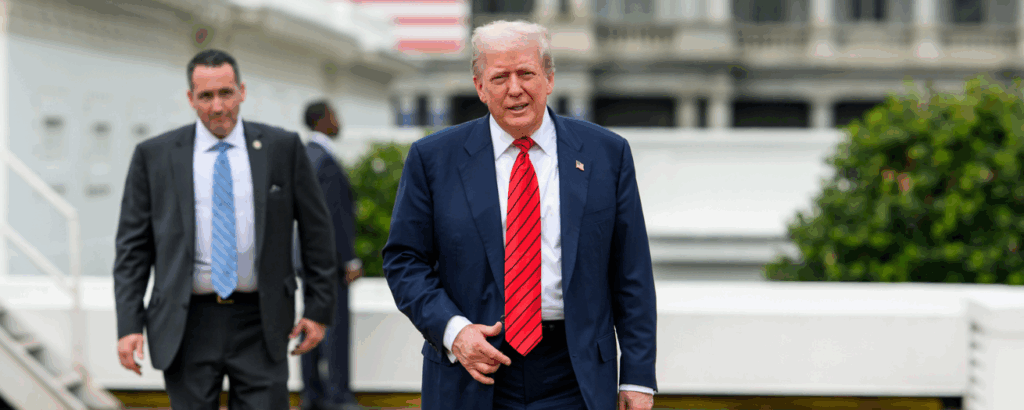
 Photo credit: The White House
Washington, Philadelphia, and the problems of home rule
On August 11, 2025, the Trump administration announced a historic escalation of law enforcement in Washington, DC, placing the Metropolitan Police Department under federal control and deploying the National Guard to patrol the District’s crime-ridden streets. In doing so, Trump has reignited a push to end Washington, D.C.’s home rule status, arguing that nearly five decades of limited autonomy have failed to deliver public safety or governance reform.
The proposal is drawing attention beyond the Beltway, as some see echoes in Philadelphia, which also operates under a home rule charter with limited state oversight, high crime, a pension shortfall, and a long string of corruption scandals.
This week, Jeanine Pirro, the US Attorney for D.C., publicly blasted Washington unique set of local laws and prosecution standards, setting the stage for Trump administration to call for an end to the district’s home rule status, and arguing that nearly five decades of limited autonomy have failed to bring about meaningful public safety or governance reform in the nation’s capital. Citing chronic mismanagement, persistent crime, and a judicial system that remains tethered to federal oversight, administration officials claim that D.C.’s unique hybrid of local governance and federal control has created a gray zone of accountability that harms residents, law enforcement, and the rule of law.
Since Congress granted limited self-governance through the Home Rule Act of 1973, D.C. has operated with a locally elected mayor and council. But unlike the 50 states, D.C. lacks direct control over its courts, prosecutors, or even its corrections system.
“D.C. is a cautionary tale of what happens when ideological politics are layered over an incomplete and dysfunctional governmental framework,” one senior Trump official said in a background briefing. “We’re not seeing a functioning city, we’re seeing the nation’s capital in crisis — with no clear chain of accountability.”
A Judiciary Without Local Accountability
Since the 1973 home rule act was passed, the District has never had a local prosecutor’s office, sheriff, or judiciary. The D.C. Superior Court and Court of Appeals judges are quasi-federal in nature, who serve fifteen-year terms, are nominated by the President and confirmed by the Senate. To make matters worse, the system is more federalized since D.C. lost Lorton, its only prison, in a 1997 budget bailout package brokered between President Clinton and then-Mayor Marion Barry – meaning criminals convicted of even minor, local crimes are subject to federal correctional and parole systems.
A key factor in this argument rests with the fact that the District also lacks a locally elected district attorney for adult crimes but has a locally elected attorney general responsible for juvenile crime. Instead, the U.S. Attorney for the District of Columbia, an appointee of the President, handles all adult prosecutions. This leaves the city without the discretion to prioritize or pardon certain offenses.
It adds up to a fundamental democratic deficiency that, regardless of the regular statehood protests emblazoned on D.C.’s license plates and in Democratic talking points. There was no local bill to establish these local agencies until 2006, in the unsuccessful District of Columbia District Attorney Establishment Act. Then, when the DNC drove talking points to make DC a state with two new Senators, these efforts were again launched from 2015 to the present — despite the city managing a host of other key services, including the Metropolitan Police and DC Fire and EMS Departments.
A City of Contradictions
Critics of home rule argue that this lack of institutional accountability has led to paradoxical criminal justice outcomes that undermine public trust. While violent repeat offenders are often offered restorative justice alternatives, including record expungement and no-bail releases, thousands of otherwise law-abiding citizens remain burdened by felony convictions stemming from unconstitutional local gun laws.
Before District of Columbia v. Heller decision in 2008 overturned D.C.’s near-total handgun ban, the city aggressively prosecuted firearm possession, with convictions disproportionately impacting residents of nearby states and veterans stationed in the area who were charged passing through DC with valid permits in Maryland and Virginia, and even active-duty military who found themselves arrested and branded felons for simply possessing a legally purchased firearm in the wrong ZIP code. Meanwhile, violent criminals were — and are — being diverted into programs that prioritize ideological reform over victim justice.
I personally experienced this in 2005 when I had a Virginia permitted weapon while working as a cleared Homeland Security Inspector, and was arrested in D.C. “carrying a pistol without a [D.C.] license, an irony considering they didn’t issue permits in D.C. at the time. I was later reinstated to the department with back pay and have moved on, but am still plagued with the stigma of a record because the only person with the power to pardon a D.C. offense is the President of the United States.
Crime, Cost, and Mismanagement
Though the District boasts the highest per capita police presence in the nation, it has consistently ranked among the most dangerous U.S. cities for over 45 years. The city’s Metropolitan Police Department (MPD) operates alongside a patchwork of more than two dozen highly funded federal and special jurisdiction law enforcement agencies, yet D.C.’s violent crime rate remains stubbornly high.
“The city’s crime rate isn’t a new issue. It’s been persistent since the 1970s,” said George Washington University political science professor Carla Jenkins. “What’s unique is that D.C. has one of the largest tax burdens in the country and an unusual ability to request direct federal funding without going through a state legislature. But the results don’t match the resources.”
Despite generous federal aid, high property taxes, and elevated income tax rates, the city has struggled to maintain basic public safety and administrative integrity. Since D.C. first elected a mayor in 1974, nearly every administration — including “outsider” Anthony Williams (1999–2007) — has faced serious ethics scandals from misused funds to criminal indictments.
Recent administrations have been plagued by procurement controversies, campaign finance violations, and allegations of political patronage. Meanwhile, the city’s public schools and housing agencies remain in near-constant states of reform.
Statehood or Federal Stewardship?
Advocates for D.C. statehood have long argued that the solution lies not in revoking home rule, but expanding it — by making the District the 51st state. President Joe Biden and most Democrats support this idea, framing it as a civil rights issue. As someone who policed the District, the absurdity of this argument is shown by simply looking at a map and knowing your American history.
Washington, D.C. only covers about 61 square miles of land. Of that, about 24–29 percent of D.C.’s land is controlled by federal agencies, including national parks, military sites, and other government-managed areas — amounting to roughly 18 square miles under federal jurisdiction. In 1790, the U.S. Constitution authorized the creation of a federal district, causing Maryland and Virginia to cede land along the Potomac River to form the nation’s capital in 1800. In 1846, amid economic neglect and political dissatisfaction, Virginia successfully petitioned Congress to return its portion, now known as Arlington County and Alexandria, in a process known as retrocession.
If the D.C. statehood argument is truly about civil rights and not an overt attempt to get two new Democratic senate votes, why hasn’t anyone argued for the District to be absorbed back into Maryland in the way the other half rejoined Virginia in 1849?
Therefore, there is good support to the Republican argument that the District’s track record shows it is uniquely unfit for statehood. Instead, they propose scaling back local control and returning more authority to Congress or federal agencies, especially when it comes to criminal justice.
“Washington, D.C. is the seat of our federal government. It’s not just any city,” said an unnamed Trump administration official to the AP. “If the local government is unable or unwilling to enforce the law and protect its residents, then federal intervention is not only justified — it’s necessary.”
While the Trump administration’s proposal targets Washington, D.C., the nation’s only “federal city”, there is a parallel much closer to home. Philadelphia operates under its own Home Rule Charter, without direct state or county oversight. That autonomy has coincided with some grim superlatives: the highest violent crime rate in the Commonwealth, the largest municipal pension shortfall, and a long-running history of corruption scandals that have ensnared mayors, councilmembers, sheriffs, and agency heads alike. Critics argue that if Harrisburg were empowered to revoke or reform Philadelphia’s home rule status, it could address entrenched dysfunction and curb what they describe as “the lunacy” of the city’s political culture — a challenge not unlike the one now confronting the nation’s capital.
The renewed push to end home rule is likely to inflame an already polarized debate on Capitol Hill. While the GOP-led House may be receptive to the Trump proposal, Democrats on Capitol Hill remain firmly opposed. For now, the future of D.C.’s autonomy hangs in the balance, caught between competing visions of self-governance, federal responsibility, and public safety.
Meanwhile, in Philadelphia — where the state house of representatives provides a far less daunting venue to establish checks and balances, the argument has yet to be raised.
Based in Philadelphia, A. Benjamin Mannes is a consultant and expert witness in security, premises liability, and criminal justice reform based on his own experiences on both sides of the criminal justice system. He is a compliance executive who previously served in federal and municipal law enforcement, and as the former Director, Office of Investigations with the American Board of Internal Medicine. @PublicSafetySME