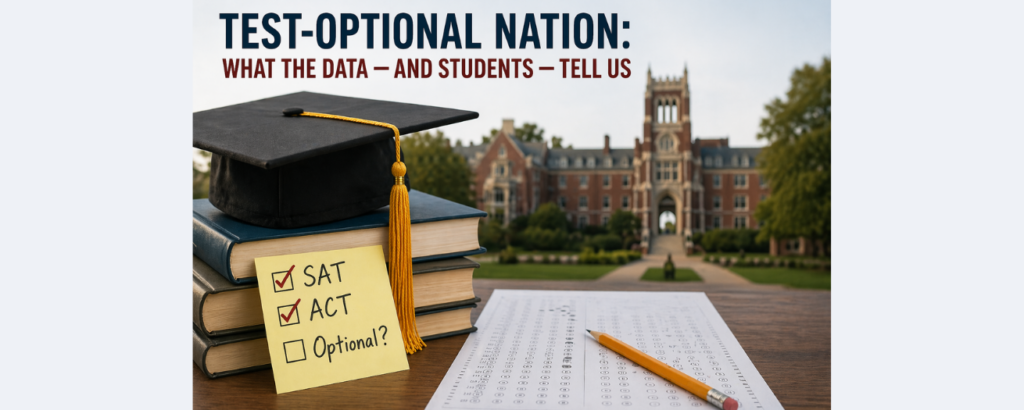
AI can write the essay, but it can’t take the test
Beth Ann Rosica’s writings are a blend of news, opinion, and analysis.
Prior to the extended school closures, most universities required standardized college admissions exams — typically the SAT or ACT. In 2019, only 25 percent of higher education institutions were test optional, meaning the assessment was not required for admission consideration.
Fast forward to today and approximately 90 percent of schools are test optional, a result of Covid-19 lockdowns. When schools closed, the tests were cancelled and universities pivoted to test optional. Yet, six years later, the majority of institutions remain test optional, although some universities are bucking the trend and returning to mandatory scores for admission.
Locally in the Commonwealth, only one higher education institution requires SAT or ACT scores for admission. In line with other Ivy League schools, the University of Pennsylvania just reinstituted testing requirements for the current school year.
Proponents of optional testing believe the practice increases opportunities for students who might not otherwise be admitted or considered. The Urban Institute wrote in 2021 about the positive impact of eliminating test scores.
“The expansion of test-optional policies during the pandemic will provide more opportunities for students who are seeking to enter college without standardized test scores and could lead to a more diverse pool of applicants.”
Those in support of required test scores cite the need for an objective measure that predicts future college success in light of the increased use of Artificial Intelligence (AI) and high school grade inflation.
The National Test Prep Association is an organization for test prep professionals to promote best practices in the industry. Jim Wismer, its Director of Community Relations, explained in an interview with Broad + Liberty the importance of standardized testing in the admissions process and countered the opposing viewpoint.
“Colleges need third-party, independent validation of a student’s academic performance,” said Wismer. “Great grades are necessary for selective admissions, but pairing them with a strong standardized test score is key to making colleges confident in a student’s ability to succeed on their campus.”
In the Commonwealth, with the exception of UPenn, all higher education institutions are test optional with some exceptions for specific majors or programs. Even though the vast majority of schools do not require tests, some percentage of students still submit scores. Wismer provided statistics for several Pennsylvania colleges, demonstrating the relatively low submission rate, ranging at the high end of 49 percent of all applicants at the University of Pittsburgh to the low end of 15 percent at West Chester University.
Sample of Pennsylvania universities and SAT/ACT submission rates
| University | Percentage Submitting SAT | Percentage Submitting ACT | Net submission percentage |
| University of Pittsburgh | 40% | 8% | 49% |
| Drexel University | 34% | 5% | 39% |
| Penn State University Park | 31% | 5% | 36% |
| Villanova University | 19% | 9% | 28% |
| Temple University | 18% | 2% | 20% |
| West Chester University | 14% | 1% | 15% |
While the Urban Institute may be correct that test optional admissions provides more “opportunities for students” seeking college entrance, the research indicates that opportunity does not translate into academic success.
Wismer cited a 2024 study showing the negative impact of high school grade inflation on student success in college.
“When 84 percent of college freshmen had an A or A- average in high school, grades lose much of their predictive power,” said Wismer. “With grade inflation comes grade compression — grades simply don’t differ as much from one student to the next as they have in the past. For most of the history of American educational statistics, high school grades were the strongest predictor of a student’s college grades. Now, scores from the SAT or ACT are the strongest predictors.”
Wismer’s assertion is supported by another recent report of Ivy-Plus colleges (the eight Ivy League colleges plus Chicago, Duke, MIT, and Stanford), concluding “standardized test scores are four times more predictive of academic achievement in college than high school grades.”
This report is, in part, what led the Ivy’s and some other schools to reinstate the SAT or ACT requirement. The study cited three findings related to academic performance in college.
- The SAT and ACT provide substantial predictive power for forecasting a college student’s first year GPA.
- High School GPA has little predictive power related to first year academic success.
- The standardized tests do not have a calibration bias, meaning that students from less advantaged backgrounds do not outperform their peers from more advantaged backgrounds with similar test scores.
Compounding the high school grade inflation issue is the problem that students are increasingly using AI to write or assist their writing for the general essay prompt, therefore making it more difficult for admissions counselors to objectively evaluate their application.
“We know that students are using AI to submit work that is not their own for their college essays and many school assignments,” said Wismer. “There is precious little evidence on a college application of a student’s ability to do intellectual work without AI. Standardized tests are taken in a proctored environment, and the testing companies use data analysis to detect anomalies consistent with cheating. As such, standardized testing remains the most reliable predictor of a student’s performance in college.”
As the Urban Institute cites a more diverse pool of applicants as a positive outcome for discarding standardized testing for college admissions, it fails to address the significant consequences of this action. When students enter a university ill-prepared for academic rigor, in addition to taking on student loans, they are left with only debt, without a degree or earning potential to pay back the loans.
A 2013 study of the University of California system also debunked the idea that optional testing helped more students achieve a better future. Only 4.2 percent of students admitted to STEM programs with SAT scores in the bottom quarter managed to graduate in a STEM major within four years. Many of these students took on substantial student loan debt, only to fail to earn a degree in STEM or earn a degree in a lower paid field.
Despite this data, the University of California system is now test blind, admitting students without test scores into programs that its data shows students without strong test scores can’t persist in.
It is incumbent upon higher education institutions to ensure that the students it accepts are academically prepared for the rigor of college level coursework before they take on student loan debt. Ultimately student success should be every university’s goal, and based on the data, the best predictor of success is a standardized test.
Beth Ann Rosica resides in West Chester, has a Ph.D. in Education, and has dedicated her career to advocating on behalf of at-risk children and families. She covers education issues for Broad + Liberty. Contact her at barosica@broadandliberty.com.