
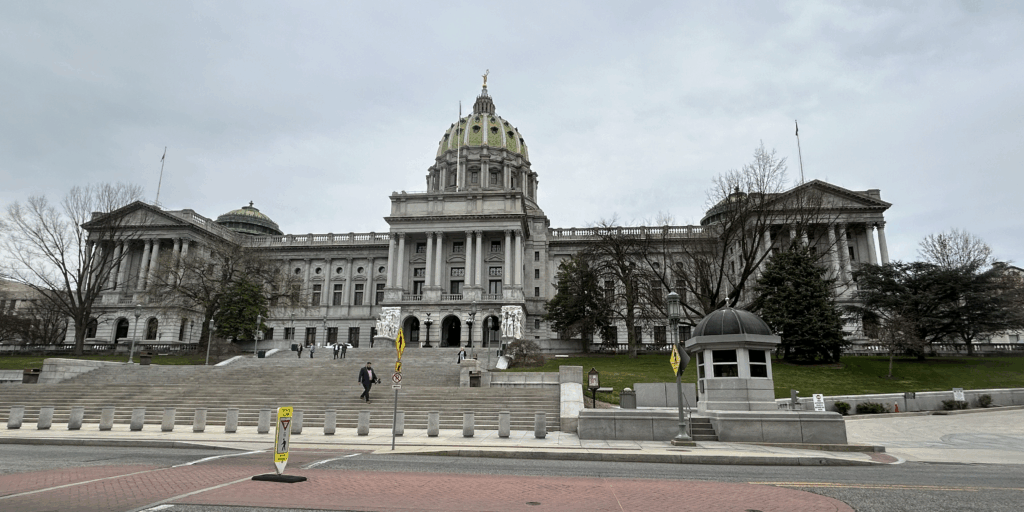
Ben Mannes: Pennsylvania’s welfare fraud rate soars 165% in 2025
Pennsylvania’s welfare fraud rate surged 165 percent in 2025, vaulting the Commonwealth to the fourth‑highest rate in the nation and raising fresh questions about whether Harrisburg and its largest cities are equipped to protect taxpayer dollars.
The spike comes as the state’s primary anti‑fraud watchdog, the Office of State Inspector General, operates with long‑standing vacancies and limited independence, while major jurisdictions such as Philadelphia and Pittsburgh lack their own welfare fraud units or truly independent inspectors general with law‑enforcement authority.
State data reviewed in the report show welfare and medicaid fraud complaints and confirmed cases grew far faster than overall benefit enrollment in 2025, resulting in a 165 percent jump in the fraud rate and placing Pennsylvania fourth among states. That surge stands in stark contrast to federal improper‑payment trends, where major programs like Medicare — specifically in “home health aid” programs in where tax dollars are spent to pay family members to stay home and care for elderly relatives — have pushed error rates under ten percent for nine consecutive years, underscoring what tighter controls can achieve.
Officials in Harrisburg have touted headline arrests and restitution totals, pointing, for example, to the Attorney General’s Medicaid Fraud Control Section, which was ranked first in the nation for the number of Medicaid fraud charges filed in 2024 and third in convictions, recovering more than 11.3 million dollars in misused Medicaid funds that year. Yet the 2025 figures suggest that prosecutions alone are reactive in nature, and not keeping pace with nor attempting to prevent the growth in suspected fraud and that front‑end prevention and oversight may be lagging.
An overstretched state inspector general
By statute, Pennsylvania’s Office of State Inspector General is responsible for investigating and prosecuting welfare fraud referrals statewide and conducting collections on behalf of the Department of Human Services. The office’s mission includes preventing, detecting and deterring fraud before benefits are authorized, and recovering overpaid program benefits after improper payments occur.
But lawmakers have acknowledged that the welfare fraud unit has carried a “fairly high number” of vacant positions over multiple years, with unfilled investigator slots reported as ranging from 25 to 39 at points in the last decade, raising concerns that the office lacks the manpower to keep up with caseloads. The Department of the Auditor General notes that it can only review and audit welfare programs and has no enforcement power over individual recipients, meaning all welfare fraud complaints must be handled and prosecuted by the already‑stretched inspector general’s office.
Unlike some states where inspectors general enjoy fixed terms and statutory insulation from political pressure, Pennsylvania’s OSIG operates as an executive‑branch agency whose leader serves at the pleasure of the governor, limiting its independence. Furthermore, a lack of bipartisan consensus on Republican-led bills to strengthen fraud-fighting laws, and the 2025 fraud spike is prompting advocates to question whether an office that is both understaffed and structurally subordinate to the administration can effectively police billions in annual public assistance spending.
Local blind spots in Philadelphia and Pittsburgh
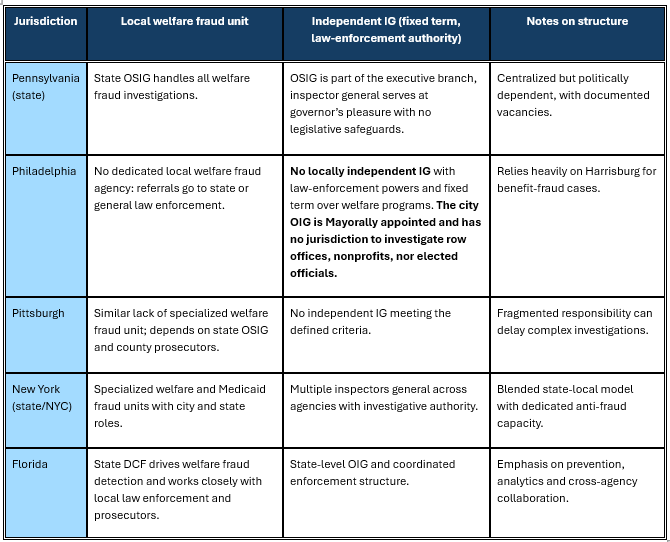
Those concerns are compounded at the local level, where Pennsylvania’s largest cities lack dedicated welfare fraud investigation forces and independent inspectors general with their own law‑enforcement authority and fixed terms that outlast the political administrations that appoint them. Complaints about welfare fraud originating in Philadelphia and Allegheny County must typically be referred to state agencies or general‑jurisdiction law enforcement, rather than to specialized local units trained to investigate benefit schemes.
Reformers point to other big jurisdictions as models. New York has built a network of inspectors general embedded across agencies, and the state’s welfare and Medicaid anti‑fraud efforts combine specialized state investigators, city‑level enforcement in New York City, and close coordination with prosecutors. Florida, meanwhile, has Inspectors General in every state agency under the command of Melinda Miguel, a Chief Inspector General at the Gubernatorial level who has served under three bipartisan governors. implemented a comprehensive anti‑fraud strategy in which the Department of Children and Families uses data analytics, audits and coordinated investigations with local law enforcement and state attorneys to pursue welfare fraud, backed by a robust reporting and case‑tracking system.
Oversight structures across jurisdictions
Calls for independence and resources
Policy experts say Pennsylvania’s experience illustrates the difference between counting prosecutions and actually preventing and reducing fraud. While the Attorney General’s office can tout record numbers of Medicaid fraud charges, the rapidly rising welfare fraud rate suggests systemic weaknesses in screening, data‑sharing and oversight that a small, politically dependent inspector general’s office may be ill‑equipped to address.
Reform proposals now circulating in good‑government circles include giving the state inspector general a fixed term and clear law‑enforcement authority independent of the governor, increasing funding to fill long‑standing vacancies, and authorizing major cities to create their own inspectors general with jurisdiction over local benefit programs and contracts. Without such changes, critics warn, Pennsylvania may continue to rank among the worst states for welfare fraud, even as other jurisdictions demonstrate that stronger oversight structures and investment in prevention can bend the curve in the other direction.
Based in Philadelphia, A. Benjamin Mannes is a consultant and subject matter expert in security and criminal justice reform based on his own experiences on both sides of the criminal justice system. He is a corporate compliance executive who has served as a federal and municipal law enforcement officer, and as the former Director, Office of Investigations with the American Board of Internal Medicine. @PublicSafetySME

Ben doesn’t know what is going on in DHS. He is wrong about Noem too.
PA DHS does not want to stop welfare fraud. They fire caseworkers if they spend too much nime looking into someone’s financial background. The OSIG is even worse. What a reduictulous suggestion that OSIG is the answer.
I had a welfare applicant who had a current electric bill of well into the thousands of dollars, current, not late, and the next months balance was also in the thousands. She was related to the “landlord” who refused to give her a copy of her rental contract due to a family dispute. I asked if she was paying the electric bill for the entire apartment complex. I tasked the IG to go out and gather the information necessary to confirm or deny my intel hypothesis. (7 years and an intel analyst)
IG deleted my complaint and complained to my supervisors and I was reprimanded for making assumptions. That is what intel analyst do. What agents (humint collectors) do is go out and get the information that confirms or denies my hypothesis and then when I infer a new intelligence hypothesis,go do it again. The only difference is that, as a welfare workers, I didn’t have access to sigint, aerial assets, etc…… Humint was it and OSIG is humint. So instead of trying to take the intellectual hill, just go out and gather the information that you were tasked by a person in the analyst role to go get.
That said, the very last thing DHS wants is to stop fraud. If you enforced all of the regulations, you would push at least 50% of the welfare recipients off of welfare, which would severely cut DHS’ budget. So, you wanna talk stttt dollar copper, do something about this. DHS gets an admin clip from each budget stream at each echelon. In order to clip more money, they create more echelons; clip, clip, clip…by the time the budget gets to the local welfare office, money is tight. Therefore, if the caseworker denies food stamps and medicaid, DHS begins to panic because it will get no budget money.
There is more and more and more but the bottom line is that neither DHS, nor OSIG, want to stop the fraud.
“…welfare fraud rate (SURGED) 165 percent in 2025…” Well, what was it in 2024, 2023, blah-blah-blah and etc.?
Percent of what precisely, exactly? E.g., if there was one (1) total fraudster in 2024 and then we had an ARMAGEDDON-SEE-YOU-IN-VAHALLA-CHARLIE-KIRK-AKA-DIRECTOR-KASH-PATEL-WHY-WOULD-CHARLIE-BE-IN-VAHALLA-THAT-IS-BIZARRE-THING-TO-SAY… increase of 165% the next year… that would be 1 x 1.65 (so not even two total shoplifters.) What in-Vahalla garbage propaganda are you guys pushing now? Is it more pop-up ads for credit cards need to charge usury pricing?
Mr. Sweeney– do you make any financial contribution to B&L in anyway at any time?
Dung,
On September 10, 2025, Charlie Kirk was broadcast all over the world getting shot in the neck and murdered. The Prime Minister of Israel even tweeted “Charlie Kirk was murdered for speaking truth and defending freedom…” about Charlie Kirk, 20 minutes before U.S. officials made any announcements about that Charlie Kirk shooting. Look that up. Those are hard cold facts. And it is provable that Charlie Kirk was so close to Tucker Carlson, that Charlie allowed Tucker Carlson to be speak at multiple Turning Point USA events in 2024. And Tucker Carlson was even included as part of the Student Action Summit in Tampa, Florida, in July 2025, where Tucker appeared alongside Donald Trump Jr., Pete Hegseth, and Charlie Kirk… shortly before Charlie Kirk’s death.
Now Tucker Carlson just interviewed a guy, Joe Kent, a former military officer, who was awarded six Bronze Stars for his service, which reflects his significant combat experience and contributions during his eleven deployments. Joe Kent, was the director of the National Counterterrorism Center, and he literally just resigned over the war in Iran, stating in his resignation letter that Iran posed “no imminent threat” to the U.S. and criticizing the pressure from the current government of Israel that he believed influenced the decision to go to war. Joe Kent told Tucker Carlson a couple days ago in an interview that he and his team were blocked from continuing to investigate possible leads tied to the killing of conservative activist Charlie Kirk, alleging federal agencies told them to halt their work despite unsolved questions.
So… if you were a family member of Charlie Kirk wouldn’t you want an investigation to see if Joe Kent was a liar?
Yes, or no? No? Then I guess I’ll see you in Vahalla, too? What an incredibly weird thing for Director Kash Patel to say, “Rest now, brother. We have the watch, and I’ll see you in Valhalla” because neither Patel nor Kirk were members of the military. And Charlie Kirk wasn’t a believer in Norse mythology. Valhalla is the hall of slain warriors chosen by Odin, where they dwell in the afterlife until the final battle, Ragnarök. Charlie Kirk was a Christian, correct? You’re allowing really evil people to tax you and take your money for bad things.
Dung,
Also the point of the rant was: (SURGED) 165 percent in 2025… FROM WHAT? What was the previous data point that is being referenced? Numbers are completely lacking in this article. We need three reference points to navigate. We have one in this article: 165%
What happened? Why did it happen? Why should we care?
Were there 2,000 cases in 2024, and now there are 2,000 x 165% = 3,300? It is a mystery, but 165% is bad!
There is nothing to verify 165% is a surge. Was it a reduction even? Maybe. And why is it a “surge?”
Here is an example: Taxes went up 19%… Dems did it… mainstream media says, no problem. Gas goes up 12%… depending on the President’s name… because that happened under Biden, too… now that percentage is called a surge!
Our media is pumping out propaganda that is so yellow that Joseph Pulitzer and William Randolph Hearst would be embarrassed.