Howard Lurie: Asking the right questions about Iran
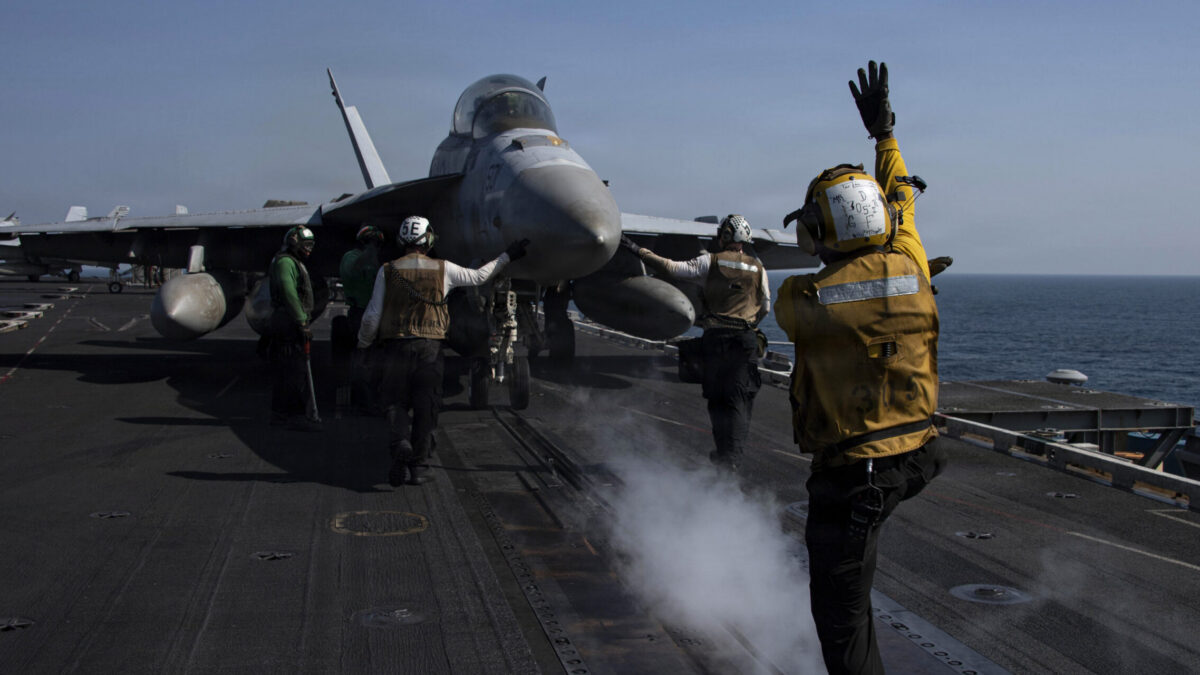
“If” is a very short, but very important and useful word. It enables us to ask questions that need to be asked. Right now it can be very useful in helping us to evaluate President Trump and Israel’s attack against Iran.
A great many on the left are condemning Trump’s military action. As I write this, the number of those on the right who are expressing approval seems to be a greater number. How those numbers will change in the future remains to be seen. Much, of course, depends on what happens next.
Here is where the “if” questions are useful. If, at some point in the future, the situation in the Middle East is better than it was before Trump’s attack, and can be attributed to the attack, then he will likely be given a favorable rating. If, on the other hand, things do not improve, get worse, or a seemingly endless war goes on, he will likely be condemned. Only the passage of time will enlighten us as to the result.
I submit that even if the situation doesn’t improve, or even if it gets worse, it may be of great value. I say that because the attack may prevent an even worse situation from ultimately occurring if no attack had occurred. That is something that we can never know for sure, but about which we can speculate if we ask some “if” questions. Allow me to explain.
Hitler began his ascent to power in 1933, and began German rearmament almost immediately after taking control. Rearmament was in violation of the Treaty of Versailles. By 1935 Hitler made rearmament official and announced conscription. His views about Jews and the need for territorial expansion were well known.
Historians can probably tell us about when, in Hitler’s rise to power in Germany, Hitler and his rearmament of Germany could have been stopped, and World War II and all the atrocities of the Nazi regime prevented. We now know what not stopping Hitler cost the world. Six million Jews were systematically murdered, and an even greater number of non-Jews were slaughtered. Poland, Russia, England and other European nations suffered terrible destruction. By the end of the war even Germany had suffered immense destruction. All that could have been prevented if England and France had not chosen “peace for our time.”
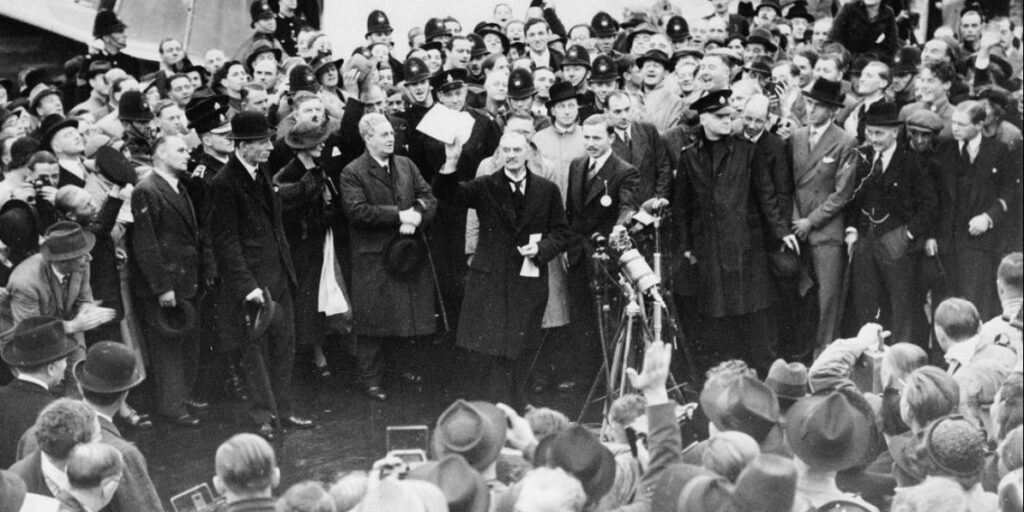
The desire for peace rather than confronting Hitler early on allowed him to get more and more as time moved forward. It was on September 30, 1938 that British Prime Minister Neville Chamberlain landed back in England after a meeting with Hitler. He spoke to the spectators at the airport:
“The settlement of the Czechoslovak problem which has now been achieved is, in my view, only the prelude to a larger settlement in which all Europe may find peace. This morning I had another talk with the German Chancellor, Herr Hitler, and here is a paper which bears his name upon it as well as mine. Some of you perhaps have already heard what it contains, but I would just like to read it to you. ” … We regard the agreement signed last night and the Anglo-German Naval Agreement as symbolic of the desire of our two peoples never to go to war with one another again.”
Later that day, he stood outside 10 Downing Street, and read again from the document and concluded:
My good friends, this is the second time in our history that there has come back from Germany to Downing Street peace with honour.
I believe it is peace for our time…
We thank you from the bottom of our hearts. Now I recommend you go home and sleep quietly in your beds.
So let me ask an “if” question. What would the reaction of the world, and the US opposition party have been if the US President, Franklin Delano Roosevelt, had ordered and achieved the assassination of Adolf Hitler at some crucial time in the 1930s? He probably would have been subjected to the same vilification that is now being heaped upon Trump for his attack on Iran.
We would not, then, have been able to say that FDR prevented all that ultimately occurred. We would not have been able to know then what actually happened. Now we do know. As the war in Europe was ending and Allied forces discovered the concentration camps, they could hardly believe what they were seeing. The dead and the dying was so horrific that even today many deny that it really happened. If Hitler and his rearmed Germany had been stopped early on, we would not know what his death had achieved.
We know that Iran was seeking nuclear weapons and the means to deliver them wherever they desired. We know that Iran was supplying Hamas and Hezbollah with arms. The mullahs openly shouted “Death to America” and “Death to Israel.” We know from 9/11 and 10/7 what fanatical terrorists are willing to do. We know that Iran supports terrorists. We do not know when and what Iran might do in the future if not stopped.
We will never know what Iran would have actually done in the future if Israel and Trump had not acted. “Peace for our time” does not mean peace forever. Israel and Trump may well have made peace in the future more likely.
Howard Lurie is Emeritus Professor of Law, Charles Widger School of Law, Villanova University