Thom Nickels: A woman in Washington’s army? It’s true.
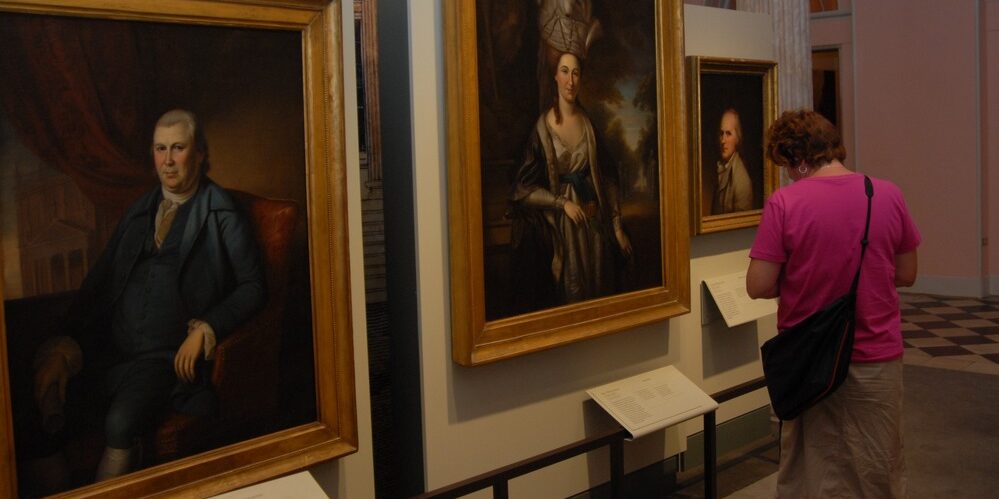
One of the most interesting press events I’ve ever attended was at the Museum of the American Revolution in 2021. The exhibit was titled, When Women Lost The Vote, A Revolutionary Story, 1776-1807.
Despite my rejection of feminism – Carrie Gress’s new book, ‘Something Wicked: Why Feminism Can’t be Fused with Christianity” in on my desk as I write – I’ve nevertheless always admired strong women. Joan of Arc, novelist George Sand, Princess Ileana of Romania, Clare Boothe Luce, Margaret Thatcher, and Ann Coulter come to mind.
What struck me about the 2021 exhibit was a display honoring Revolutionary War hero Deborah Sampson (1760-1827), a strong woman and one of the heroes of the Revolution.
Sampson dressed as a man in order to enlist in Washington’s Continental Army. After one failed attempt to do so, she finally succeeded and served as a male soldier for seventeen months before she was found out.
Sampson was one of seven children and was born on December 17, 1760 in Plympton, Massachusetts, to Jonathan and Deborah Sampson, both descendants of noteworthy Pilgrims. Deborah’s mother was the granddaughter of Massachusetts Governor William Bradford. When she was five years old, Deborah’s father left the family to marry another woman and start a new family, so her mother, financially overwhelmed, farmed out her children to different households. At age 10, Deborah began work as an indentured servant for Deacon Benjamin Thomas, a farmer in Middleborough, Massachusetts where she would work until she turned 18.
Single women in that era had some autonomy but marriage placed women under the direct authority of their husband.
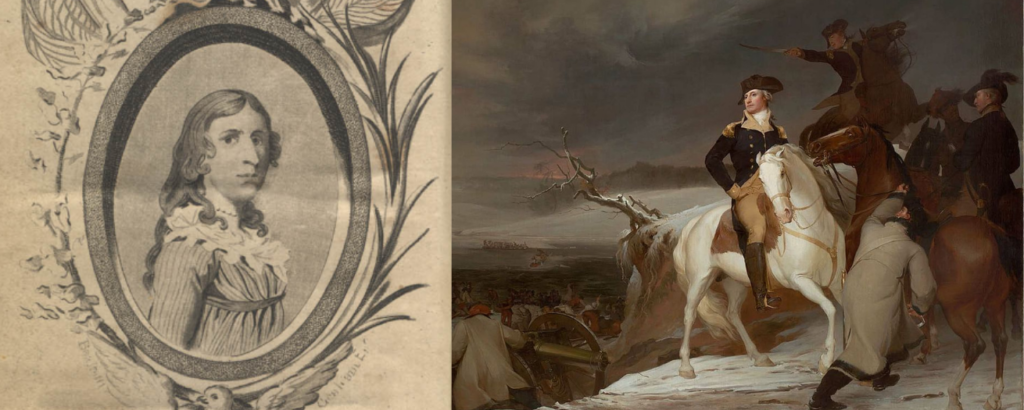
The few sketches of Sampson that exist show a woman with a long and narrow androgynous face. Looking at her portrait in the museum I was reminded of the face of French novelist George Sand (1804-1876), who took a male first name in order to increase her publishing prospects. (Sand defied the authorities in Paris by opting to wear men’s clothing, something women could only do in public with a written permit. Sand considered men’s clothes more practical and affordable. )
While Sampson was not pretty in the traditional feminine sense, she was handsome enough to appear, with the right amount of costuming, as a somewhat attractive, slender, dark-haired young man.
Sampson developed significant skills as a weaver. Many weavers in the colonial era worked in taverns, and many taverns had looms that were rented by weavers for a period of time. Looms generally were expensive and too large to cart around. Wealthy women might take to weaving at home but for a poor woman like Sampson, the only recourse was to work in a tavern. For a time she worked a loom in a tavern while living upstairs with another woman.
General George Washington’s call for troops was Sampson’s chance to escape a life of tavern weaving and to earn some real money. Because many young men in Massachusetts were not heeding Washington’s call to enlist — many had already done their time in their local militia and wanted nothing more to do with war — few were signing up despite the offer of 20 pounds of silver if they signed a contract promising to serve three years.
Sampson sprung into action, pulling her hair behind a man’s cap and making sure her breasts were adequately hidden beneath a bulky top coat. She adopted the first name of Timothy, signed the service contract on the dotted line, received her silver and went home to wait the call to action. Her goal was thwarted when an especially acute snitch happened to notice the scar on Sampson’s left forefinger (caused by a loom accident) as Sampson signed the document just before receiving the 20 pounds of silver.
The authorities were alerted and Sampson was forced to return the silver.
Women who impersonated the opposite gender were either arrested, flogged, fined or paraded through the center of town as harlots. Sampson quickly left town although the local Baptist church where she had been a member branded her a loose woman, the perception being that she wanted to be a soldier so she could work the Revolutionary War circuit as a prostitute.
Her local church excommunicated her, but by this time Sampson was long gone, traveling all over Massachusetts in search of other sign-up opportunities. She found a lucrative deal — 60 pounds of silver for a three-year military contract — at 22 years old and was quickly mixed in with a band of almost 40 recruits, the Fourth Massachusetts Regiment. Together, the Regiment walked all the way to West Point — about 150 miles. When they arrived, they were trained in strenuous exercise and military maneuvers.
Sampson chose the enlisted name of Robert Shurtleff. As Shurtleff, she was selected as a member of the Light Infantry, an elite corps of warriors comparable to today’s Navy Seals. At 5’7” she was taller than the average man at the time (5’5”). She also had good teeth, another Light Infantry requirement because soldiers had to hold a musket while ripping apart gun powder packets with their mouths.
In 1782, she led 30 men in battle. She was shelled at Yorktown, injured twice in combat, once with a sword wound to the head. When a bullet from a musket went into her thigh she removed it herself, fearful that if a doctor did it he would discover her biological gender. She avoided detection by avoiding heavy drinking and carousing with her soldier mates and by always volunteering for single person missions involving riding a horse as a scout looking for British advances.
Alex Myers, author of the novel “Revolutionary,” about the life of Deborah Sampson, grew up hearing his grandmother tell him stories about their famous family ancestor. Myers — in a bizarre Twilight Zone twist — was born female but, perhaps finding inspiration in his famous family member’s story, became a transgender male.
At a talk at the Harvard Book Store in Cambridge, Myers avoided woke hagiography when talking about his ancestor and admits, “Deborah lied a lot.”
He explained that Sampson lived for three months in a tiny cabin in New Windsor, Massachusetts with sixteen men in the dead of winter. Myers went out on a limb and said he was convinced that this experience solidified Sampson’s belief that she really was a “man.”
While on a mission to subdue a mutiny near Philadelphia, Sampson came down with a high fever during an epidemic and the physician treating her opened her jacket and discovered the truth. The full bosom showed that she was female to the core. The compassionate physician did not turn her over to the authorities but offered to write a letter on her behalf that she could keep on her person until her apprehension. He warned Sampson that it was only a matter of time before her real identity was detected.
Soon after this Sampson was found out and given an honorable discharge.
“Walk Boston History” describes Sampson’s discharge: “George Washington did not like any women in the camp due to the impact they had on discipline…. He instructed his generals to remove all women from service to improve discipline. He handed Deborah her honorable discharge in writing but did not utter a word of thanks. “
After the war, Deborah married Benjamin Gannett in 1795 and they had three children (proving, of course, that she was no man.) The family lived on a small farm in Sharon, Massachusetts. She applied for a military pension and Congress denied it, but when Paul Revere became a champion of her cause, she was finally able to obtain a pension.
The amount of Sampson’s pension was $4.00 a month ($104.00 today). She spent her remaining years lecturing about her time in Washington’s Continental Army, sometime appearing in uniform and acting out various scenes behind the podium.
In 2019, Congress passed The Deborah Sampson Act “to improve the benefits and services provided by the Department of Veterans Affairs to women veterans, and for other purposes.”
Thom Nickels is Broad + Liberty’s Editor at Large for Arts and Culture and the 2005 recipient of the AIA Lewis Mumford Award for Architectural Journalism. He writes for City Journal, New York, and Frontpage Magazine. Thom Nickels is the author of fifteen books, including “Literary Philadelphia” and ”From Mother Divine to the Corner Swami: Religious Cults in Philadelphia.” His latest work, “Ileana of Romania: Princess, Exile and Mother Superior,” will be published in May 2026.