
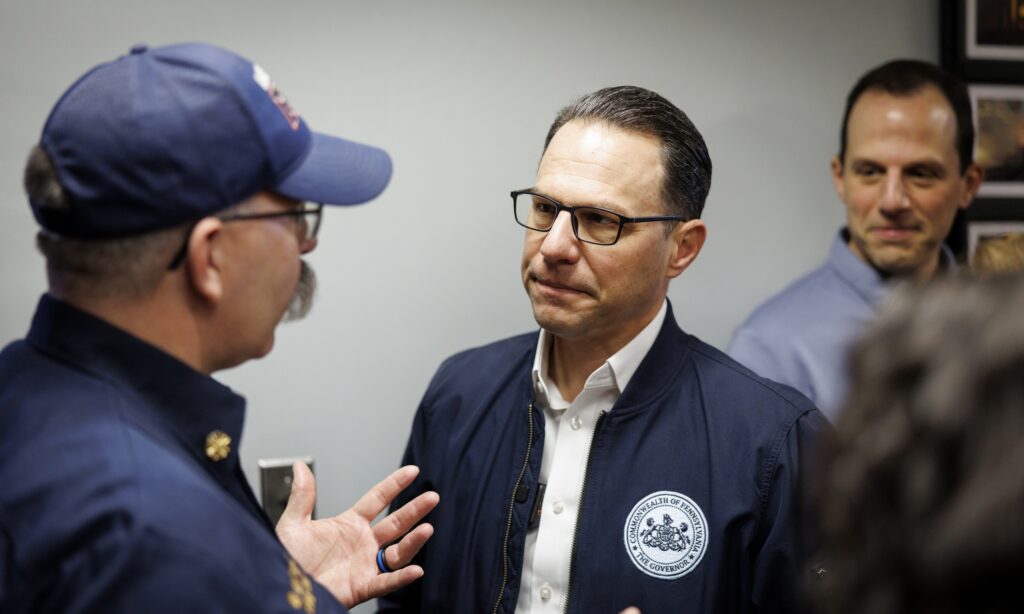
 Photo by Commonwealth Media Services
Andrew Lewis: Shapiro blames everybody but himself for rising electricity prices
When it comes to energy policy, Gov. Josh Shapiro wants to blame everybody but himself for rising electricity costs.
The governor attacked several boogeymen in his recent budget address, blaming Republicans, PJM, and utility companies for out-of-control price hikes.
To make matters worse, he has taken his finger-pointing act on the road. While visiting Washington, D.C., Shapiro, alongside several other governors, criticized PJM, calling the grid operator “inept,” “faceless,” “bureaucratic,” and “too damn slow.”
Last winter, he even sued PJM to set a price cap that — shockingly — didn’t lower electricity prices. Worse, the amount of power purchased fell short of the targets designed to avoid blackouts.
PJM auction prices sent a clear message: Electricity is becoming harder to supply because reliable power plants are shutting down, and regulations are slowing down the development of new projects. The higher prices aren’t a trick or manipulation—they’re a signal that we need more power production.
Blaming PJM for rising electricity costs is no different than yelling at the thermostat for the cold weather.
The real culprit is bad policy.
The governor’s “Lightning Plan” — a lethal cocktail of carbon taxes, energy mandates, and subsidies to politically favored projects — distorts markets, crowds out private investment, and shifts risk onto taxpayers and ratepayers. When government tries to pick energy winners, consumers always lose.
Take Pennsylvania’s Alternative Energy Portfolio Standards (AEPS) for example. Heralded by Shapiro, AEPS forces utilities to purchase specific energy sources — regardless of cost or reliability. These mandates function as a hidden tax on ratepayers, inflating bills while delivering minimal environmental benefits.
AEPS compliance costs totaled $702 million in 2024, a 33 percent increase from the previous year. In fact, these costs have grown over the last decade, by about 637 percent since 2015, meaning higher electricity bills statewide.
Similar price hikes were likely under Pennsylvania’s recent flirtation with the Regional Greenhouse Gas Initiative (RGGI). This cap-and-trade program would have imposed an industry-wide carbon tax, increasing energy costs for homeowners by 30 percent.
Despite claiming to oppose RGGI on the campaign trail, Shapiro sued to stay in it, even after the Commonwealth Court ruled it unconstitutional as a unilateral tax hike. Shapiro had to abandon RGGI during budget negotiations.
In lieu of RGGI, the governor has even more disastrous policies on deck. Shapiro has proposed his own energy tax and mandates: the Pennsylvania Climate Emissions Reduction Act (PACER) and the Pennsylvania Reliable Energy Sustainability Standard (PRESS).
PACER and PRESS are the sequels to AEPS and RGGI that nobody asked for. Like RGGI, PACER would establish an energy tax. And PRESS ups the ante set by AEPS, requiring 50 percent of Pennsylvania’s energy to come from wind, solar, and other unreliable sources by 2035.
Combined, PACER and PRESS will impose $157.2 billion in new electricity costs on Pennsylvanians through 2035, according to recent analysis by the Commonwealth Foundation. This would result in families paying twice as much on their annual electric bill.
Shapiro’s Lightning Plan doubles down on Pennsylvania’s already restrictive energy regulations. The governor’s administration has proposed zoning setbacks that would ostensibly ban drilling in seventeen of the commonwealth’s most-productive counties.
Instead of identifying the root causes of these increasing prices, Shapiro has opted to gaslight Pennsylvanians.
“For the last several years, I’ve heard people on the other side of this building making excuses for why they couldn’t talk about energy,” Shapiro said during his recent budget address.
Nothing could be further from the truth. Those who have opposed Shapiro’s expensive energy policies have been quite vocal. The governor just doesn’t want to listen.
If Shapiro wants to lower energy costs, he must (1) stop vilifying the sources and suppliers who keep the grid reliable, (2) roll back costly mandates that force consumers to subsidize special interests, (3) streamline permitting so new power plants and pipelines can quickly come online, (4) lean into Pennsylvania’s competitive advantage as an energy powerhouse with abundant natural resources, and (5) trust markets — not bureaucrats — to deliver affordable, reliable energy.
Rising energy prices are the predictable result of years of bad policies — and more of the same will only make things worse. The governor can blame others all he wants, but he had better look in the mirror.
Andrew Lewis is President and CEO of the Commonwealth Foundation, Pennsylvania’s free-market think tank.
He’s really rather just keep lying and allow friendly media to keep covering for him. That sounds easier.