 Photo by National Park Service
D.G. Hart: Mr. President, open these doors!
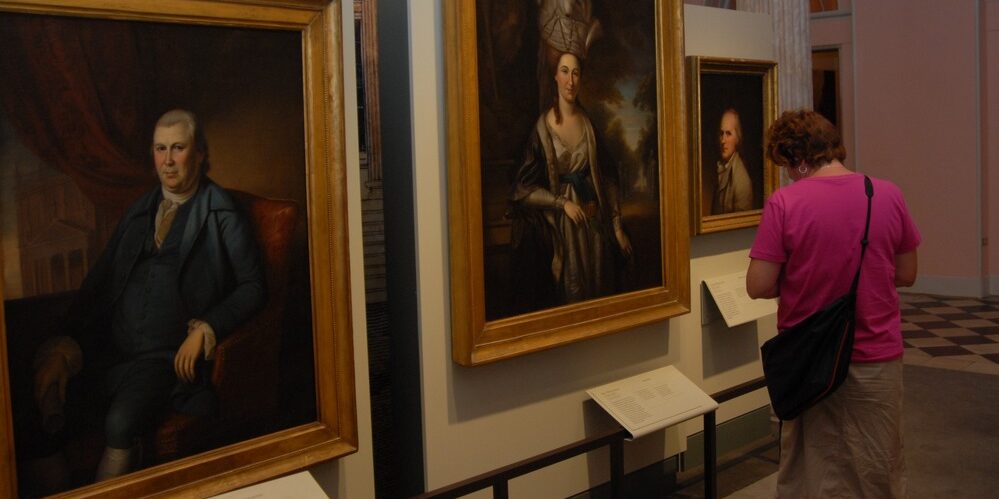
Controversy over the removal of the slavery exhibits at Independence National Historical Park (INHP), has diverted attention from National Park Service’s refusal to display a remarkable collection of portraits of Continental Congress’ members that hang in one of the parks’ prized Philadelphia buildings. Architecture and paintings hardly compete with slavery for space in the nation’s historical imagination. Even so, exhibitions about George Washington’s slaves and portraits of the Founders deserve to be open to visitors during the semi-quincentennial.
The same government that is removing the slavery exhibits apparently has no intention to open Philadelphia’s portrait gallery.
The paintings in question are the creation of an amazing and underappreciated figure among the Founders – Charles Willson Peale. The Forest Gump of the Founding, Peale may be most famous for his self-portrait, “The Artist and His Museum” (1822), a painting that offered a rare glimpse inside the upstairs banquet room at Independence Hall. Born in Maryland and trained as a saddle-maker, Peale studied painting in England. Back in North America, in 1776 Peale moved to Philadelphia, enlisted in the Pennsylvania militia, and rose to the rank of captain. He served in close proximity to General Washington and used those observations to render a signature portrait, “George Washington After the Battle of Princeton” (1779). After the Revolutionary War, President Washington commissioned Peale to paint a portrait of the Marquis de Lafayette. The artist added six more portraits of Washington. His museum inside Independence Hall combined, oddly by modern standards, art and natural history. Cages of stuffed animals hung below rows of portraits.
Peale’s paintings now hang inaccessibly inside a Greek Revival edifice built originally for the Second Bank of the United States (1824). Designed by William Strickland, who also restored Independence Hall’s clock tower (1828), the building brought a taste of Athens to the nation’s original federal capital. The Second Bank building was one of many structures the federal government acquired in 1948 when Congress approved over four million dollars for the creation of INHP.
Prior to that appropriation of funds, Independence Hall and related buildings had a rocky ride in public memory. Some buildings like the home where Thomas Jefferson wrote drafts of the Declaration were razed for new businesses. Others like Benjamin Franklin’s home came down to make room for new housing. Independence Hall itself had a variety of uses between 1800 (when both federal and state governments vacated Philadelphia) and the 1948 creation of a national park. For a time, the city even used the basement as a dog pound.
A number of Philadelphians worked with the city to maintain Independence Hall. The most successful of those was the Independence Hall Association, founded in 1942 by local business and civic leaders, architects, and historic preservationists. This group celebrated when Congress created INHP and let the Department of the Interior, through the National Park Service, maintain and lead tours at Independence Hall.
This history provides some perspective on the Trump administration’s removal of the slavery exhibits at INHP. Critics object both to the heavy hand of a brash executive and whitewashing slavery from the Founding. These critics stress the need for a full account of the nation’s origins to show that liberty and slavery co-existed and to minimize the hypocrisy of merely celebrating freedom.
Those who argue for a full history of the Founding should also consider at least whether the federal government is the best way to run and interpret sites like Independence Hall.
Unlike INHP, some of the most popular and revered living history museums in the United States — places like Mount Vernon and Colonial Williamsburg — are privately owned, managed, and funded. George Washington’s home along the Potomac owes its existence to the Mount Vernon Ladies Association, a 1850s band of middle-class Southerners who purchased, refurbished, and raised funds for a museum and library, complete with archives and research fellowships that put many colleges and universities to shame. Colonial Williamsburg depended on the philanthropy of John D. Rockefeller. He responded to calls from local residents to create a living history museum in the former capital of the Virginia colony. The project started in the 1930s before historic preservationists and activists began making demands on history museums. The failure of Colonial Williamsburg or Mount Vernon to feature slavery, however, has not generated the backlash that recent news about INHP has. Private ownership has advantages.
Critics of INHP may have a point about removing exhibitions that were once regarded as valuable correctives. On the other side, those who object to one-sided portrayal of slavery at the President’s House also have a point that public history funded by government should tell a story that unites rather than polarizes. Neither side notices that the problem at INHP may be the original decision to make Independence Hall one of the many sites, along with wildlife, forests, rivers, and minerals. Americans do not lack alternatives for cultivating public history.
Most of these alternatives are more flexible than the federal government. Chances are that under different management, INHP’s slavery exhibit along with the Second Bank of the United States would be open to those making a special effort to visit Philadelphia this year.
D. G. Hart teaches history at Hillsdale College and is the author of the forthcoming book, Independence Hall: The History of An American Icon.