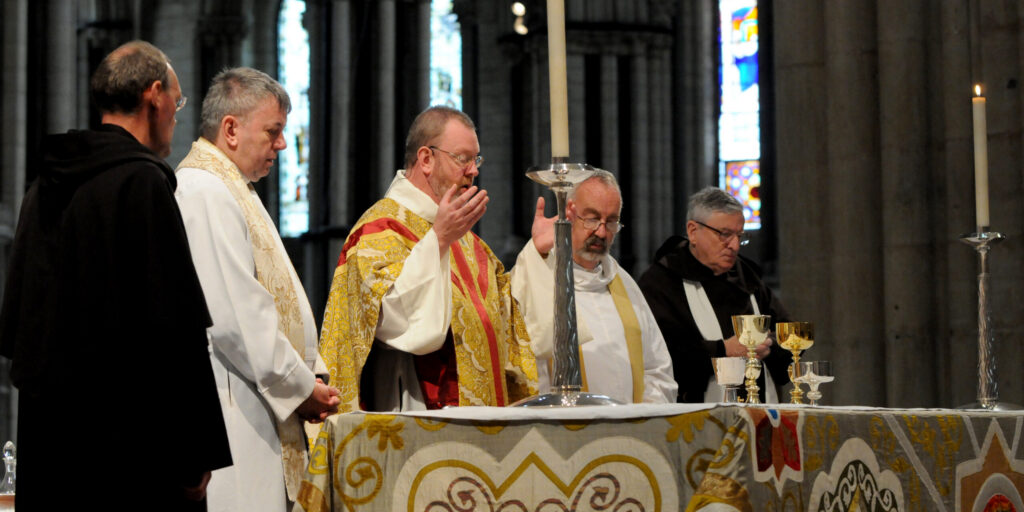
 Photo by catholicrelics.co.uk via Flickr
Gerard St. John: The lector’s challenge
Serving as lector at a Catholic Mass is a pretty easy task; you simply read the words that are put in front of you. The degree of difficulty increased dramatically one morning when I saw that a Mass was to be said for the intentions of “Maria-Hoang Thi Nghiem.” I could handle the “Maria” part of it, but after that I had no clue as to the pronunciation. I needed help. Jim Coolican came to mind. Jim was in the class behind me at St. Joseph’s College. He is No. 42 in this photo. Wilt Chamberlain is No. 13.
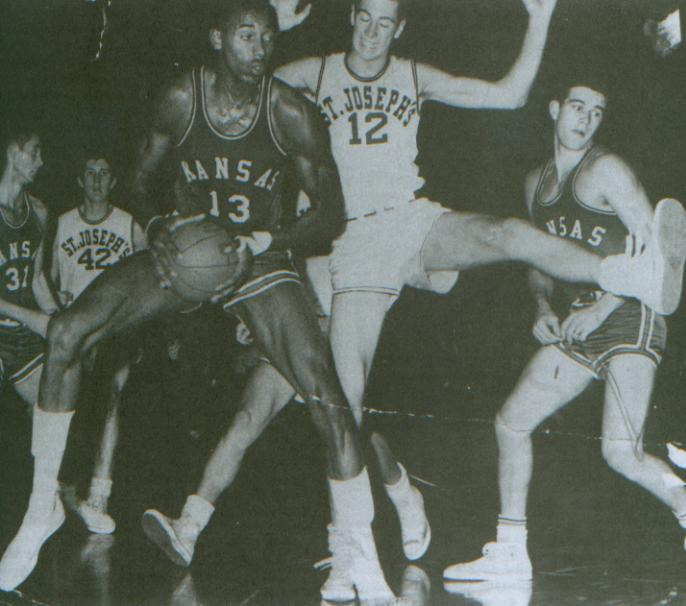
After college, Jim and I both went into the Marine Corps. Our paths crossed briefly on the island of Okinawa in 1963, but my service time was then coming to an end and Jim decided to make the military his career. During that career, he spent a substantial amount of time in Vietnam. He must know how to pronounce “Maria-Hoang Thi Nghiem.”
It was about 7:30 AM when I sent an e-mail message to Jim asking if he could give me a phonetic pronunciation of Maria’s name. Almost immediately, I received a copy of an e-mail message from Jim to “Harry,” asking if Harry could “help my friend with the correct pronunciation.” Within an hour, I was copied on an e-mail message from Harry to Jim Coolican, stating “You should ask your friend [to send] me his phone number, I will [teach] him to speak Vietnamese like a Vietnamese.”
I sent the phone number and Harry called me as he promised. It did not take too long. With Harry’s guidance, I was soon speaking an acceptable version of “Maria-Hoang Thi Nghiem.” At least the pastor, Monsignor Grous, did not question my pronunciation.
Shortly after my conversation with Harry, I received an e-mail message from Jim Coolican which stated:
“Gerry:
A little background on Harry. His name is Hue, we gave him the nickname [Harry]. He was a Lt.Col. in the Vietnamese Army. I was his adviser in 1967-68. He was the commanding officer of the 1st Vietnamese Division Reaction Force (Black Panthers). We moved into Hue City the day before the start of the TET offensive and were the only combat unit in the city for about ten days. The fighting was in the streets and house to house. He was awarded a Silver Star by the USMC. We took the Citadel from the North Vietnamese. In 1971, the Vietnamese army was going into Laos after the North Vietnamese Army. Our president did not want advisers going into Laos because the peace talks were on. Without the advisers, the Vietnamese did not have a chance since we controlled the fire power. Harry was wounded, and he ordered his battalion to leave him behind so he would not slow down the troops. He was captured and spent 13 years as a POW in the same camps as our POWs. When he was released, the NVA would not let him return to Hue City so they sent him to Saigon as a political prisoner. We got him out 11 Nov 1991. We set him up in Falls Church, VA with his wife and three young daughters. His wife died a few years ago. The three girls are college graduates and live near Harry. He is a great guy, a good soldier and a good friend. He recently retired from the Navy Federal Credit Union.”
This background information was unnecessary. At Jim Coolican’s suggestion, I had already read Andrew Wiest’s book Vietnam’s Forgotten Army: Heroism and Betrayal in the ARVN (2008). Wiest focuses on two of South Vietnam’s best military leaders. I recognized Harry immediately. And Jim Coolican? You can find him in the first few chapters of Mark Bowden’s history, Hue 1968 (Atlantic Monthly Press 2017).
Who said that being a lector is dull?
Gerry St. John is a retired lawyer who lives in the suburbs of Philadelphia. He was graduated from St. Joseph’s College and Temple University School of Law. Between these educational endeavors, he spent nearly four years in the United States Marine Corps, most of it in Camp Pendleton, California, and in the Far East during the Cuban Missile Crisis. For more than 45 years was a civil trial lawyer, and for nine years a member of the adjunct faculty at Saint Joseph’s University.