
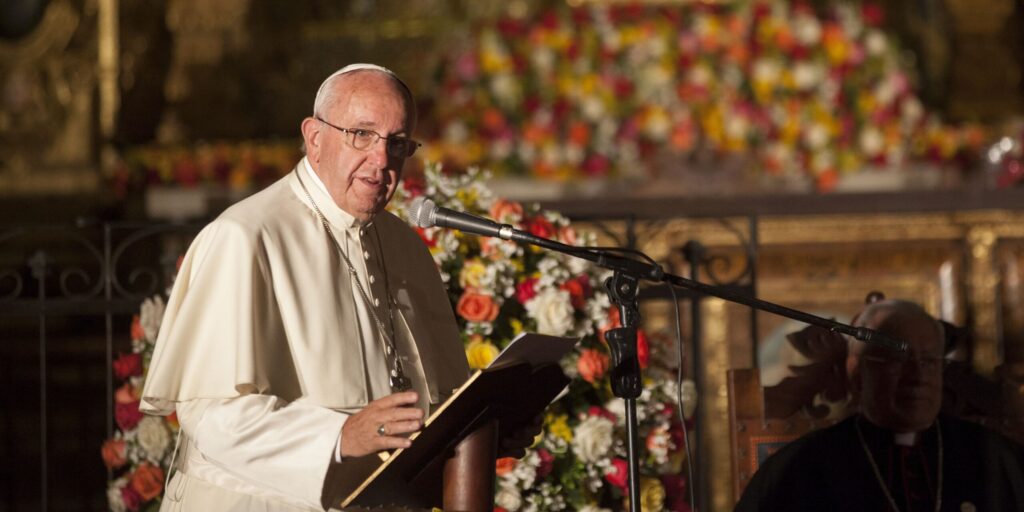
 Pope Francis in Ecuador 2015 by Cancillería del Ecuador via Flickr
Thom Nickels: Was Pope Francis ‘disastrous’? One author thinks so.
A new book, “The Disastrous Pontificate,” by Dominic Grigio (a pseudonym, since the author is really a well known Catholic priest and thinker) was just published by Os Justi Press.
The 900-plus page volume is a scholarly work years in the making that “rigorously contrasts the teachings of Pope Francis with Sacred Scripture, Sacred Tradition, and the perennial Magisterium.” It’s also been called a “clinical analysis of Bergoglio’s rule….identifying through the entire Pontificate countless divergences from Catholic truth.”
In an article by the author for the Catholic publication Rorate Caeli, Grigio explains that “Pope Francis was inexplicably sanguine about the chaos that he was inflicting on the Church, declaring in response to those raising valid concerns about his words and actions, ‘In the Church there is always the option for schism, always. But it is an option that the Lord leaves to human freedom. I am not afraid of schisms…I pray that schisms do not happen, but I am not afraid of them.’”
Grigio then confesses that Francis’s offhand, arrogant disregard for the divisions he was sowing deeply troubled him. “I watched faithful Catholics walk away in distress — some turning to the Orthodox, others to sedevacantist sects, and many simply abandoning the Church altogether, utterly disillusioned.”
I was one of those who walked away over a decade ago when I embraced the Orthodox Church. The Philadelphia parish I chose to enter was full of ex-Catholics: the wife of the pastor, members of the choir, and so many in the congregation I lost count. I think if Pope Leo XIV knew how many Catholics have gone over to Orthodoxy since the papacy of Pope Francis and the advent of the so-called Synodal Church — a term invented by Justin Welby when he was the Anglican Archbishop of Canterbury and then picked up by Pope Francis when he wanted to institutionalize his reforms — he might be tempted to put on the breaks and stop the creation of what many say is a new false Catholic Church.
The author writes that the more he compared and contrasted Pope Francis’s innovative, ideologically driven teaching with the Church’s perennial sacred doctrines, the more obvious it appeared to him “that he was attempting to shoe-horn his own personal opinions, idiosyncrasies and prejudices into the Church.” Not only that, but this “new religion,” as taught by Francis, “signified a stark, and at times absurd, rupture.”
Scary words, indeed.
Let’s recall that when Pope Francis was elected he made a show of his humility when he opted to forgo living at the official papal residence, the Apostolic Palace, instead taking a so-called modest apartment in the Domus Sanctae Marthae, a building where cardinals stay during papal conclaves. This move enhanced the myth of the man’s humility although this fact was recently revealed to be a lie.
This was brought to light in a recent podcast by John-Henry Westen in his interview with Rome professor, theologian, and mariologist Dr. William Anthony Thomas. Here Dr. Thomas states that Francis’s decision to not live in the Apostolic Palace had nothing to do with humility but everything to do with his hatred of former popes and long-standing papal traditions.
Ironically, Francis’s “humble” apartment, according to Thomas, contained an entire floor of the building – larger space than the Apostolic Palace — and his move there prevented anyone else from living in the building during the thirteen years that he was pope. Thomas also recounts that by the end of his papacy, some $26 million dollars had been spent on this special living arrangement.
That’s not humility; that’s a waste of money.
The theologian also claimed that the only publication Francis read on a daily basis was a Communist publication — this alone is pretty shocking — and that his vision and obsession of a new Synodal Church, as I stated above, came from Justin Welby, the Anglican Archbishop of Canterbury (2013 to 2025).
The Synodal Church idea, says Dr. Thomas, was concocted when Welby met Francis for a special meeting.
That meeting caused a bit of a scandal among real Catholics when Francis knelt before the Anglican archbishop and asked for his blessing, in effect canceling out what the Catholic Church has always believed: that Anglican religious orders are not valid.
In other words, according to the Church’s teachings, Francis received a fake blessing from a fake archbishop as the two of them came up with an even bigger fake idea: a Synodal Church based on conversations, listening, and feelings rather than the old biblical notions of sin and personal accountability.
Fast forward to Leo XIV, the first American pope, educated at a minimalist Catholic university, Villanova, noted for its obsession with sports teams and weekend frat parties. Leo, once known as Robert Prevost, had a long tenure as a missionary in Peru and, from what I can see, returned to the United States a changed man.
When Catholic clerics spend any time in Latin America they almost always come back radicalized to some degree. This is no reflection on the people of Latin America. What it reflects is the ideological component of the Church’s mission there, when fighting poverty and for social justice replaces the greater message of the Gospel.
This perversion eats away at the “Catholic” soul and gives birth to what one might call the quasi-Catholic priest with a soft spot for communism.
Francis’s Synodal approach to the Catholic Church is not the Catholic Church of history and apostolic times, but a new worm-filled creation, divorced from tradition and the Church Fathers. It is a new religion based on feelings and sentimentality where it is now no longer acceptable to call anyone out as a sinner – even a Democratic politician who supports abortion — because it might hurt their feelings.
Immediately after his election, Pope Leo declared he was going to continue the mission and reforms of Francis, or the new Synodal Way. Would Bergoglio approve? What would Bergoglio do?
So far, “Bergoglio idolatry” has come to define Pope Leo XIV’s papacy. It certainly defines the mindset of most Vatican bureaucrats, as well.
Once can only hope Pope Leo will eventually stop following the pope that preceded him, and find the self confidence to mark his own path apart from the South American pontiff so many now call “disastrous.”
Thom Nickels is Broad + Liberty’s Editor at Large for Arts and Culture and the 2005 recipient of the AIA Lewis Mumford Award for Architectural Journalism. He writes for City Journal, New York, and Frontpage Magazine. Thom Nickels is the author of fifteen books, including “Literary Philadelphia” and ”From Mother Divine to the Corner Swami: Religious Cults in Philadelphia.” His latest work, “Ileana of Romania: Princess, Exile and Mother Superior,” will be published in May 2026.
I am not a catholic so I do not have the insights a practicing catholic would have. I will comment that I have followed developments in the catholic church from the outside and as a Protestant whose denomination was born from the martyring of a reform-minded catholic priest in the 1400s. It is my opinion that over time, catholic practice has changed from salvation, redemption and personal responsibility for good works, to one where the secular arm of society is the path to salvation. Jesus seems to have been relegated to the position of an old-timey wise man with some good ideas and scripture a collection of precepts on the level of a book on manners and social graces. I can see where the Orthodox Church is attractive to believers.