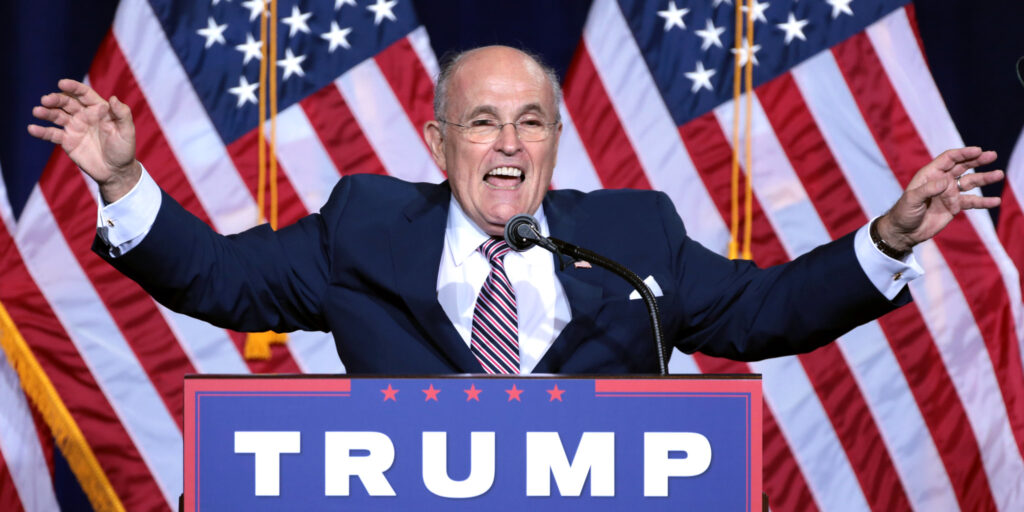
 Photo by Gage Skidmore
Stew Bolno: Trump’s tutors (real or imagined)
Many Gen Z’ers believe “social influencers” originated with the introduction of the internet, but they didn’t. Every adult through schooling, persuasion, and work experience adopts or rejects people who, directly or indirectly, enter their consciousness. It’s also true for Donald Trump. Below, I’ll provide the reader with a short list that, likely, impacted him during his young adult years as well as his lifetime career in the world of business, prior to his presidency.
Although I have never met or sat by his side, my age, educational background, and work experience enables me to comprehend Trumpism in a unique manner. The “influencers” can be slotted as celebrities, business leaders, and politicians. Obviously, It’s not a comprehensive list and I’m quite aware it’s a bit presumptuous of me to place it in front of you. However, I don’t believe I’m going out on a limb and would bet money the President is familiar with all of them, has picked up a tip from each of them, and has met some in person. They’ll be introduced in chronological order, so one can perceive where Trump, born in 1946, was at the time of awareness.
From the list of “tutors”, I’ll start with the first and simplest; all of us are influenced by our parents. In his book, The Art of the Deal, Trump defines them as such: “My mother loves splendor and magnificence, while my father, who is very down-to-earth, gets excited only by competence and efficiency”. Love him or hate him, this tribute is demonstrated to all by acknowledging Trump’s approach to style and substance.
Cassius Clay/Muhammed Ali – When he first appeared on the national scene as a professional, Clay was detested by the boxing establishment as well as a large share of the public. They perceived him as a braggart, boisterous, and disrespectful. As Clay evolved into Ali, his “predictions” proved uncannily accurate and since he never was a one-punch knockout artist, boxing aficionados came to appreciate his ability as a high-level counter puncher — something Trump advised us about him from his first days as a serious candidate.
As Ali matured as a boxer, his skills increased, his thoughtfulness became evident, and his good humor combined with courage won the affection of boxing fans around the world. A fitting Trump quote from The Art of the Deal: “…you can’t con people…if you don’t deliver the goods, people will eventually catch on”.
Peter Drucker (Business Professor/Author) – He is known as “Father of Modern Management”. In the 1960’s as well as today, every business student became aware of his contributions to the profession. He introduced the concept of Management by Objectives, among many others. If I learned about Drucker in my management courses, it’s well-nigh impossible to believe they weren’t teaching about his contributions when Trump was an undergraduate at Wharton Business School. Trump possesses significantly more leadership knowledge, executive skill, and street-smart experience than any other President preceding him. Those with a capitalist’s perspective recognize and fully appreciate how he applies what he learned on the job. He possesses a clearly defined vision, communicates his goals, and he’s tuned in to the public’s perceptions.
Robert Townshend – As President of Avis Rental Cars, he raised the image and profits of the company by showing up as one of the first CEOs to appear in a television commercial. His message “We try harder” provided him with public recognition and is one of the classic examples of highly effective branding. According to Google, in only three years as CEO (1962-1965), he transformed the company from losing $3 million annually to generating a profit of $2.8 million. This act elevated his image and paved the way to gain attention for his highly popular book “Up the Organization”, which focused on where bureaucracies go wrong. Trump is credited as a branding genius by those who know; it’s unlikely he’d be ignorant of Townshend’s achievement.
Lee Iaccoca – An automobile business executive, he came to public prominence in the late 1980’s. According to an article published in Politico and written by Jack Shafer he appeared as #3 on the most admired list behind Pope John Paul II and Ronald Reagan in the 1980’s. He earned an interview with Oprah Winfrey and many viewed him as someone who would be a solid candidate for President.
Rudy Giuliani – Adapted business principles, including serious statistical analysis to urban government; it worked. “America’s Mayor” uplifted New York City while decreasing homicide rates from over 2,300 in 1993 to less than 600 at the end of his second term in 2001. Combined with the twelve years of businessman/mayor Michael Bloomberg who built upon that model, New York City enjoyed a golden age turn-around for 20 years.
Bursting into politics from outside the system, it’s no wonder the establishment of both major American parties attempted to reject Trump the interloper. After all, what’s considered as solid business practice and acceptable behavior, is, mostly, outside the norm in politics. From the beginning, Donald Trump was perceived as a threat by the DC elite.
All of us live in a personally designed bubble; but it is clear Trump’s bubble is larger, more visible, and more varied than that of any life-long politician. In the areas of self-appreciation, common sense, communications, and leadership… Trump learned from some of the best.
Stew Bolno is a chronological peer of Donald Trump. He’s been a student, college professor, and consultant on leadership during his 50-year career. He’s followed politics longer than that time. His recent book is “Leadership Lessons And You: From A to Z – featuring Donald Trump” and he’s written scores of essays about him since he descended the Trump Tower staircase.