
Ben Mannes: ICE shooting exposes America’s willful amnesia on law enforcement
A deadly encounter between a federal law enforcement officer and a Minneapolis woman last week is exposing not just a city’s tensions over immigration enforcement, but a deeper national confusion over what federal agents are, what authority they carry and what the law requires of motorists during a stop.
Two widely shared bystander videos capture the moments before and during the shooting of 37‑year‑old Renee Nicole Good during an ICE enforcement operation at East 34th Street and Portland Avenue in south Minneapolis on Wednesday morning. Another angle shows agents approaching Good’s SUV as it is positioned in the street amid what officials describe as an organized protest aimed at obstructing an immigration arrest.
Witnesses and officials say Good’s vehicle was described as “the lead car” in a rolling protest that had been blocking and shadowing ICE teams as they attempted to carry out arrests, which legally constitutes an obstruction of justice. In the video, agents can be heard giving commands as they move toward the driver’s side; Good does not comply and instead reverses before shifting into drive and accelerating forward as an agent stands in front of the SUV.
Use of force and the moment of fire
Slow‑motion analysis of the footage circulated by multiple outlets shows the agent jumping or sidestepping in front of the car as the SUV lurches forward, only then drawing his weapon and firing several shots through the windshield. The vehicle continues forward and crashes into parked cars as bystanders scream, and images from the aftermath show a bloodied airbag and Good slumped in the driver’s seat before she was pronounced dead at a hospital.
Officials at the Department of Homeland Security, including Secretary Kristi Noem, have characterized Good’s actions as an attempt to use her vehicle as a weapon, describing the incident as an “act of domestic terrorism” and saying agents have seen more than 100 vehicle‑ramming attempts against federal officers in recent weeks. Local leaders, including Minneapolis officials, have questioned that account and demanded prosecution of the agent, even as federal investigators review the shooting under long‑standing rules that treat a moving vehicle as potential deadly force when used against officers.
ICE, HSI and long‑standing authority
The fury that followed Good’s death has also highlighted how many Americans appear unsure of what Immigration and Customs Enforcement is and what its agents do. Created in 2003 when the Department of Homeland Security absorbed and realigned the former U.S. Customs Service and Immigration and Naturalization Service, ICE brought together investigative, customs and immigration authorities that had existed in various forms in U.S. cities since the late 18th century.
Within ICE, Homeland Security Investigations (HSI) serves as the primary criminal investigative arm, charged with enforcing customs and immigration laws related to cross‑border crime rather than just civil deportation cases. HSI agents investigate human smuggling and trafficking, drug and weapons smuggling, child exploitation and child sex tourism, financial crimes, cybercrime, bulk cash smuggling, cultural property theft and sensitive technology exports, among other offenses that originate overseas or cross international borders.
These agents are fully-sworn law enforcement officers working for agencies which are not new, with roots dating back to 1789, nor are they doing anything new: enforcing immigration laws that have been mainstream since 1933.
HSI and other ICE agents attend the Federal Law Enforcement Training Center alongside counterparts from agencies such as the U.S. Secret Service, U.S. Marshals Service, inspectors general offices and the Bureau of Alcohol, Tobacco, Firearms and Explosives. Per federal recruiting requirements, most agents hold college degrees or significant prior specialized experience. Their authority to carry firearms, make arrests, execute warrants and conduct operations in American cities derives from federal statutes and has evolved from customs and immigration enforcement roles that have placed federal officers in ports, rail hubs and city centers since the late 1800s.
Despite that history, a growing chorus of elected officials has adopted slogans like “ICE doesn’t belong in our cities,” language that critics say blurs the distinction between policy disagreements over immigration and the basic reality that federal officers — funded by Congress — have long operated in downtowns and neighborhoods from New York to Minneapolis. Senate Minority Leader Chuck Schumer and other senior Democrats have backed funding for ICE and its predecessors for years, even as they now face pressure from activists to denounce the agency as an occupying force rather than an arm of the same federal government they help oversee.
Local Officials Chime In
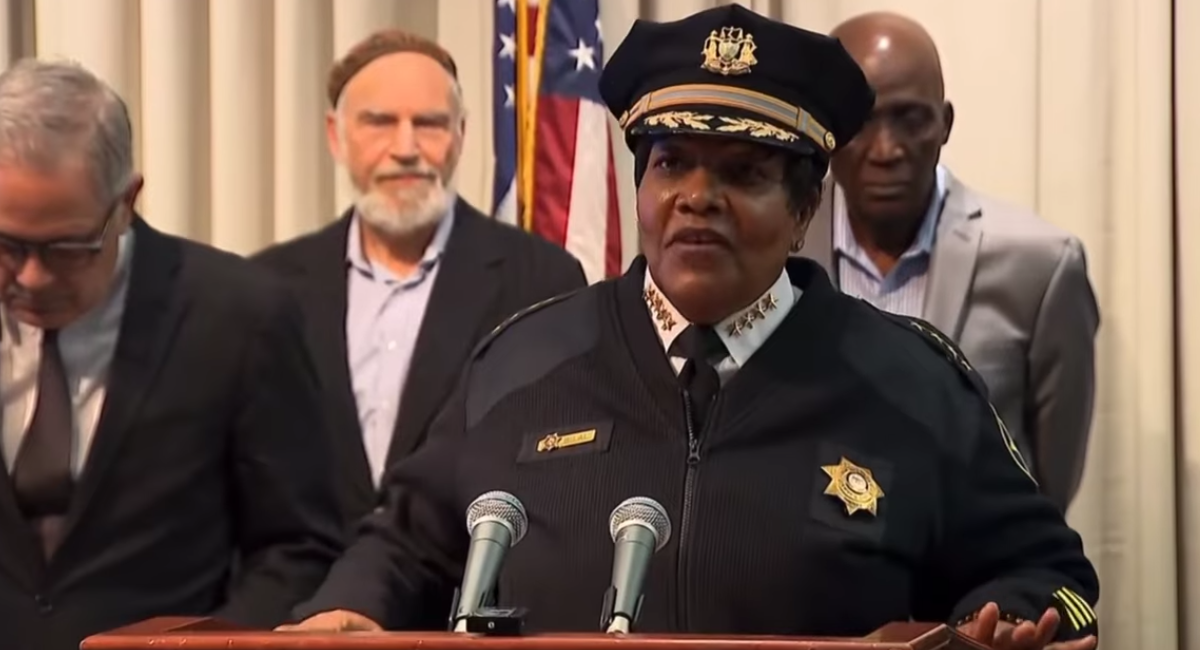
As tensions in Minnesota grow, Philadelphia’s scandal-ridden Sheriff Rochelle Bilal and District Attorney Larry Krasner held a press conference on Thursday to inappropriately judge the ICE shooting that occurred 1,000 miles outside their jurisdiction. This show included a protest style chant to “say her name” for Good by Sheriff Bilal, whose administration has presided over corruption scandals to include missing funds, stolen firearms, and a deputy who illegally sold firearms used in a school shooting. This show was highlighted by Krasner, who threatened to arrest and prosecute ICE agents working in Philadelphia, similar to his track record of prosecuting Philadelphia police officers more aggressively than repeat offenders.
Krasner and Bilal are assuming the Philadelphia voter base that elected them are too naive to look up the fact that they do not have the jurisdiction to arrest and charge federal officers for using force in connection with their duties.
Unless an ICE agent commits a crime off duty, they are covered by the supremacy clause under Article VI of the US Constitution. That is why the FBI investigates deadly force used by federal officers, not local prosecutors. The sad thing is, whether it’s Krasner and Bilal’s empty threats toward federal law enforcement or State Senator Amanda Cappelletti’s attempt at drafting legislation banning ICE agents from state property, the Constitution bans states from interfering with the enforcement of federal law. One would think a District Attorney and lawmaker would know the Constitution.
So why were Krasner and Bilal so quick to opine on an incident five states away? One can speculate that it may have something to do that the ICE protests, largely supported by the TIDES foundation funded by the Soros family and Neville Singham, shares the same fiscal support network that funds their political campaigns. Or maybe Krasner — having just secured reelection despite Kada Scott being brutally murdered by someone released days before by his office, in addition to the aforementioned scandals by Bilal — just want to divert attention from their abysmal performance in the roles in which they were unfortunately elected by an apathetic Philadelphia voter base.
Either way, both Krasner and Bilal were reckless, irresponsible, and ignorant to hold this press conference before any official investigation was complete in Minnesota, especially if it brings protests and threats of violence against federal law enforcement operating in Philadelphia — where there are greater criminal justice issues at play than in Minneapolis.
Confusion over law and obedience
The Minneapolis shooting immediately sparked protests, school closures and a torrent of online commentary, much of it drawing conclusions about the agent’s actions without addressing Good’s legal obligation to obey lawful orders or the authority of federal officers during an operation. On social media, college‑educated commentators and activists argued that Good’s maneuver was defensible because of the direction her wheels were turned or contended that “ICE shouldn’t have been there” and therefore its agents lacked the same authority as city police or state troopers.
Federal law, however, gives ICE and HSI agents broad arrest and search authority when enforcing immigration and customs statutes, and assaulting or using a vehicle against a federal officer is a felony that carries steep penalties. Civil rights groups frequently challenge how that authority is used, especially in workplace raids or collateral arrests, but those debates do not erase the underlying legal requirement that drivers comply with federal commands during active operations, whether or not they agree with the policy.
Mayor Jacob Frey and other Minneapolis leaders moved quickly to condemn the shooting, with the City Council calling for the agent to be “arrested, investigated, and prosecuted to the fullest extent of the law” and describing Good as a neighbor who was “out caring for her community.” Mayor Jacob Frey and other local officials have emphasized community outrage and questioned federal tactics, while largely sidestepping detailed discussion of the videos showing Good reversing and then driving forward toward an agent in the street.
At the national level, Trump administration officials have framed the incident as part of a broader pattern of organized obstruction of immigration enforcement since enforcement operations ramped back up after years of comparatively lax interior enforcement. The clash between those narratives — one centering on a community member killed by federal force, the other on an agent responding to a vehicle attack — has deepened partisan divides over ICE and reinforced a climate in which some protesters see blocking streets, surrounding officers and interfering with arrests as acceptable forms of political speech rather than potential felonies.
A dangerous gap in understanding
The Minneapolis shooting underscores how sustained political messaging can shape public understanding of law enforcement to the point that basic facts are obscured. After years of rhetoric depicting ICE as a novel, fascist, or uniquely illegitimate creation of the Trump era, many Americans now react to routine enforcement of long‑standing statutes as if it were an unprecedented escalation rather than a continuation — albeit with different priorities — of authorities that date back more than a century.
Legal experts and even some DHS assessments have warned that this climate of misinformation encourages people to underestimate the risks of confronting federal officers, blocking operations or using vehicles to impede arrests, with deadly consequences when force is used in response. For Minnesota, and for a country increasingly divided over immigration and law enforcement, the question now is whether the public will look beyond viral clips and slogans to the full record of what happened on a South Minneapolis street — and what the law has required all along.
Based in Philadelphia, A. Benjamin Mannes is a consultant and subject matter expert in security and criminal justice reform based on his own experiences on both sides of the criminal justice system. He is a corporate compliance executive who has served as a federal and municipal law enforcement officer, and as the former Director, Office of Investigations with the American Board of Internal Medicine. @PublicSafetySME
Editor’s note: This article was updated to correct a typo regarding Senator Schumer‘s job title. He is the Senate Minority Leader, not the Majority Leader.

Chuck Schumer is not currently the Senate Majority Leader.
Fixed — thanks, Howard.
Chuck Schumer is now the Senate Pinata.
Is the broadly speaking media at fault for not emphasizing that these are Federal law enforcement and impeding them from carrying out their assigned duties is a obstruction of justice. It should also be noted that those arrested will face a Federal judge, and not a sympathetic local judge. If convicted, they will spend their time in Federal prison. This means that it will almost certainly NOT be a prison in their home state. It could be clear across the country.