
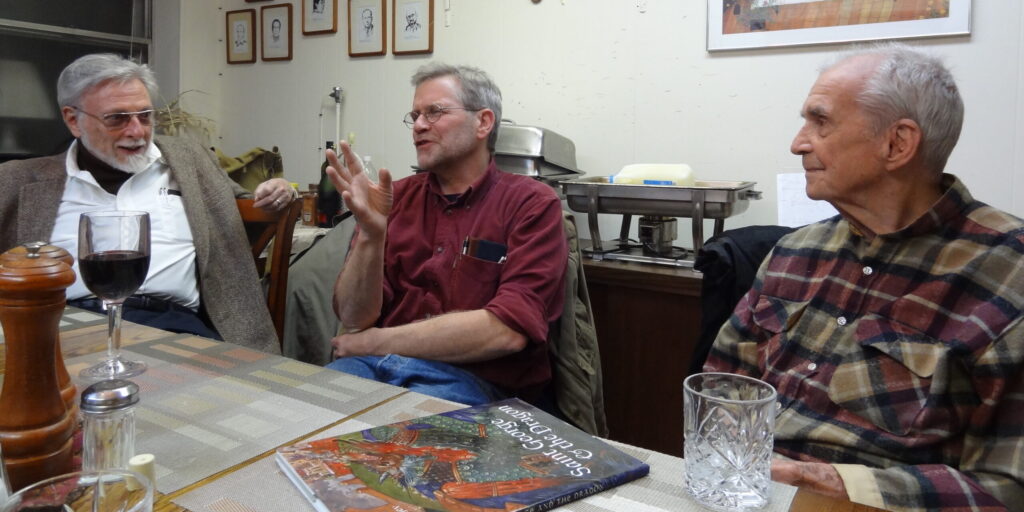
 Tom Cornell, Michael Baxter, and Dan Berrigan, 2011. Photo by Jim Forest via Flickr.
Thom Nickels: Father Berrigan in the lion’s den
A couple of years ago, I headed on out to Villanova University to hear writer and author Jim Forest talk about his new book, At Play in the Lions’ Den: A Biography and Memoir of Daniel Berrigan.
When I was a conscientious objector during the Vietnam War, the brothers Berrigan, Dan and Phil, both Jesuit priests, were heroes of mine. Never mind that in those days every Catholic I knew, including family members, were all “just war” types. Hardly any Catholic in my personal world then questioned authority.
The concept of reading the gospels in an antiwar context was really foreign to the average Catholic parishioner. Good Catholic Irish boys did as they were told. If your country wanted you to serve in Vietnam, you went, you didn’t ask questions. When your draft notice arrived in the mail, you didn’t question the process but did as you were told, signed on the dotted line, and then willingly let yourself be shipped out to a war zone.
At age 19, I became a conscientious objector but not as a Catholic pacifist because at the time I was agnostic — in time I walked away from agnosticism (and my adoration of the Berrigan brothers) and reentered the world of belief.
Jim Forest, born in Salt Lake City, Utah in 1941, is the author of numerous books. At age 12, he became an Episcopalian. When he was in the US Navy, he became Roman Catholic and began working for the Catholic Worker Movement. He applied for (and got) conscientious objector status while in the US Navy. He was arrested for burning draft cards at a Vietnam War protest. His Catholic Worker connections enabled him to get to meet and know Dan Berrigan, Dorothy Day and the Trappist monk, Thomas Merton.
The Catholic Worker Movement in New York was the central nerve of the Catholic peace and justice movement. As managing editor of the newspaper, The Catholic Worker, Forest had amazing access to all kinds of people.
In his book about Dan Berrigan there are his photographs of Thomas Merton in his hermitage at Gethsemane, Kentucky.
In the 1980s, Forest spent a lot of time in the Soviet Union and became acquainted with the Orthodox Church. He became an Orthodox Christian in 1988, something that he says slightly confused Dan Berrigan but which Berrigan supported nevertheless. Berrigan’s Catholicism had cultural roots in his Irish family and could not be reconfigured.
In my brief talk with Forest after the lecture, we both exchanged stories of our discontent with post Vatican II Catholicism and our switch to Orthodoxy) especially in liturgical matters. The so-called “new Mass” with its Protestant innovations seemed far less sacred than the traditional liturgy.
After becoming Orthodox, Forest continued his peace and justice work as secretary of the Orthodox Peace Fellowship.
At Villanova, Forest appeared with noted novelist and author, James Carroll, author of the award winning book, An American Requiem: God, My Father, and the War That Came Between Us.
Carroll, a Bostonian, was once a Paulist priest in Boston and part of the Boston Paulist Center, a place where I sometimes attended Catholic Mass when revisiting my old adopted city when staying with a friend there. My friend, a Catholic radical and a truly prophetic spiritual voice, saw the cutting edge Paulist liturgy with its slide shows, rock music and heavily non-traditional features as a thoroughly fitting worship venue in the modern era. During our friendly debates, he would often call me a liturgical reactionary, a label that at first struck me as having “intellectually challenged” roots but which I later came to embrace.
Forest began his Villanova talk with a warning to the audience that they might hear a tug or two of Parkinson’s disease. In 2007, Forest had a kidney transplant, thanks to a donation by his wife. He lived in Amsterdam until his death in January 2022 at 80 years old. He was the father of six children.
In a funny way, as I watched him speak and later sign books in the great hall of Villanova’s nursing school, I could see that his face and general demeanor still retained much of its decades earlier twenty-something vigor.
James Carroll at that time was in the throes of controversy thanks to a piece he wrote for the Atlantic, in which he calls for the abolition of the Catholic priesthood. The former priest now lives with his writer wife in Boston.
“For the first time in my life,” he wrote, “and without making a conscious decision, I simply stopped going to Mass. I embarked on an unwilled version of the Catholic tradition of ‘fast and abstinence’—in this case, fasting from the Eucharist and abstaining from the overt practice of my faith. I am not deluding myself that this response of mine has significance for anyone else — Who cares? It’s about time! — but for me the moment is a life marker. I have not been to Mass in months. I carry an ocean of grief in my heart.”
“Every sentence of James Carroll’s recent article in The Atlantic, “Abolish the Priesthood,” is theologically inept, historically anachronistic, self-referential, or all three. None of it is a surprise,” The National Catholic Reporter, a radical publication, stated in response.
Carroll, an elegant speaker, impressed the audience with his captivating patrician air, especially when he looked over the rim of his reading glasses. His Catholic critics are legion, however.
Forest, the second speaker, recounted many things about the life of Dan Berrigan, especially how Berrigan wanted to shape his life around the Beatitudes, advising Catholics “to get out of the tomb and make some gestures…a little act of civil disobedience.”
Berrigan, Forest, said, “had powerful convictions but he was not self-righteous.”
Forest recounted how Berrigan once handed him a check for $10,000 when the house that Forest was living in was in dire need of insulation.
He talked about Berrigan’s view of the “micro-gods” that people have in society: obsessions related to gyms, work, sports or politics. According to Berrigan, “If you’re going to have a god, it might as well be God.”
Berrigan recounted how at one lecture somebody asked him how he deals with priestly celibacy. “I am so sorry I forgot to bring my celibacy slide show with me,” he responded.
Forest did not say much about Dorothy Day, although in one of his columns about her, he remembered her “Mass encounter” with a radical priest.
“Pleased as she was when home Masses were allowed – Catholic Worker houses all over the nation usually had home Masses – and the liturgy translated into English, she didn’t take kindly to smudging the border between the sacred and mundane. When the radical priest in question used a coffee cup for a chalice at a Mass celebrated in the soup kitchen on New York’s First Street, she afterward took the cup, kissed it, and buried it in the backyard. It was no longer suited for coffee because it had held the Blood of Christ. I learned more about the Eucharist that day than I had from any book or sermon.”
Many of the radical priests in the 1970s and 80s went on to leave the priesthood. Vatican II was supposed to be a spring time for the Church but instead it had the opposite effect. Certainly at Philadelphia’s Saint Peter Claver Catholic Worker House (now defunct) where I used to often visit, there were many radical Masses, some celebrated by lay people, some celebrated by women pretending to be priests, some celebrated by real priests although the liturgy was usually a patchwork of put together contemporary songs, verses, although occasionally a traditional text was thrown in for tradition’s sake.
What a mess!
The Villanova event was organized by Orbis Books of New York. Unfortunately time constraints prevented a follow up Q and A although the event itself was quite spectacular and deserved a full auditorium. As a friend of mine noted, “If this event had taken place in New York City, every seat in the auditorium would have been filled, but this is Philadelphia, where, after all, people just don’t seem to care.”
Thom Nickels is a Broad + Liberty’sEditor at Large for Arts and Culture and the 2005 recipient of the AIA Lewis Mumford Award for Architectural Journalism. He writes for City Journal, New York, and Frontpage Magazine. Thom Nickels is the author of fifteen books, including “Literary Philadelphia” and ”From Mother Divine to the Corner Swami: Religious Cults in Philadelphia.” His latest work, “Ileana of Romania: Princess, Exile and Mother Superior,” will be published in May 2026.

1-It is a shame that most students at Catholic colleges don’t participate in lectures and discussions like this. Even for those students who are not religious, these discussions have far reaching implications.
B+L readers are fortunate for Thom Nickels.
2-The only mass I’ve ever walked out of was at St Joseph’s University. I unknowingly found myself at the mass closing “Pride Week”. The Jesuit celebrant was railing against then pope JPII, and Cardinal Ratzinger too.
Acting in loco parentis, I stood up and left by the center isle.
Rev. Philip Berrigan was not a Jesuit. He was a member of the Society of St. Joseph, a Catholic religious order of men focused on ministry to African American communities. He passed away in 2002 at the age of 79.