
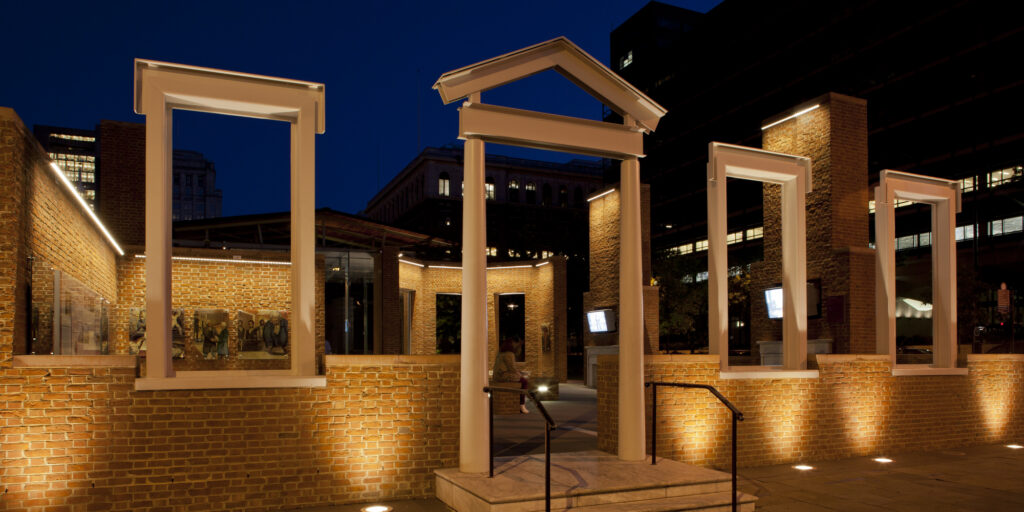
 President's House Site exhibit. National Park Service photo by Joseph E.B. Elliott.
Robert Cherry: The Philadelphia slavery exhibit is seriously flawed
There has been outrage in some quarters over the announcement that the Trump Administration would be reevaluating the “Freedom and Slavery in the Making of a New Nation” outdoor exhibit at the President’s House site in Philadelphia. It housed both President Washington and John Adams in the 1790s.
The exhibit is centered on degrading Washington’s behavior towards his enslaved servants during his presidential stay in Philadelphia. In doing so, it oversimplifies the tragic history of slavery, ignoring modern scholarship for the sake of ideological purity. The main plaque reads:
See the names of the nine enslaved members of President Washington’s household who lived on the site. One of them, Oney Judge, seized her freedom while the Washington family was eating dinner. With the help of the free black community and a white ship captain, she eventually made her way to a new life in New Hampshire.
The plight of Washington’s enslaved servants was presented in three ways. First, in a panel labeled “Washington’s Deceit,” it noted that Washington circumvented the Pennsylvania state anti-slavery law by rotating his enslaved workers every three months. Second, the exhibit links the plight of runaway slaves to the 1793 Fugitive Slave Act, which allowed for their capture and return. Third, the exhibit is critical of President Washington’s efforts to free the enslaved people on his Mount Vernon plantation.
Washington easily could have obtained dispensation from state anti-slavery laws but chose not to ask for special privileges. The Fugitive Slave Act only allowed slaveholders to pay private individuals if they recaptured runaway slaves but did not order states to help in any way. And Washington did not own most of the slaves at Mount Vernon as they were the property of his wife’s family.
A panel documents Native Americans being driven out of the Northwest Territories by settlers. However, no panel discusses Washington’s role in the spread of religious freedom. If you want to read his 1790 letter to the Newport (RI) Jewish community in which he unequivocally supported full religious liberty, you would have to walk a block to the National Museum of American Jewish History.
Most questionably, the exhibit created a vehicle to talk about slavery more harshly. It has a panel that claims rape and breeding were important reasons for the dramatic growth of the enslaved population after importation was disallowed; years after the capital had moved from Philadelphia. Rape was a feature of the antebellum period but recent claims by Shannon Eaves that there was a widespread rape culture are unfounded.
Robert Fogel found that overseers were employed on only one-sixth of moderate-size plantations (16 to 50 slaves) and 25 to 30 percent on larger ones. On three-quarters of plantations with no white overseers, there was only one white adult male; an environment that could not develop a rape culture. Any pattern of raping enslaved women would not have been conducive to the needs on these plantations for unsupervised enslaved workers to perform administrative and skilled craft choirs. Though she believes that there were indirect ways that breeding was facilitated, Aisha Djelid approvingly noted, “Twentieth-century scholars such as Robert Fogel, Stanley Engerman, and John Boles dismissed forced reproduction as an abolitionist trope.”
Rape and indirect breeding had little impact on population growth compared to the stable family structure that typified slavery. The vast majority of children were raised in long lasting two-parent households. Historian Heather Williams reported, “[Herbert] Gutman found that at the end of the Civil War, in Virginia… most families of former slaves had two parents, and most older couples had lived together for a long time.”
Robert Fogel documented that by almost any measure – diet, housing, health, and life expectancy – enslaved blacks fared better than English industrial workers. Rather than having teenage women dying of tuberculosis, slavers often hired Irish immigrants to do dangerous work: the lives of enslaved workers were too valuable to risk. However, this evidence is suppressed. Instead, stressing the vicious treatment the enslaved endured is necessary because anything less would reflect an apologist stance.
In response to pre-WWII books that pictured slavery as a relatively benign institution, Stanley Elkins and Kenneth Stampp emphasized how owners used their unrestrained power to brutalize the enslaved. In Slavery, Elkins claimed that slavery was so brutal that it created child-like behaviors, underpinning the “black sambo” image. that was widely accepted at the time.
In The Peculiar Institution, Stampp claimed that to counter the harsh oppressive regime, many enslaved blacks “feigned childlike behavior to sabotage production: shirking their duties, feigning illness, injuring the crops, and disrupting the routine.” For Stampp, terror and brutalization destroyed the strictly regulated family life and rigid moral code that had prevailed in Africa so that sexual promiscuity was widespread.
For those holding these views, slavery was so brutal that the enslaved had no agency and, as a result, hopelessness bred poor work habits, widespread promiscuity, and no stable family structure. The perceived persistence of these behaviors led Moynihan and other liberals to believe that a legacy of slavery explained the poor employment and high out-of-wedlock birth rate of black Americans.
In the 1970s, a group of left-wing historians countered this victimization thesis. Robert Fogel and Eugene Genovese were members of communist organizations at the time, though both would come to abandon Marxism in later years. They believed the power of the slavers was much less than either Stampp or Elkins believed so that the enslaved had agency to improve their lives. These views were later joined by those of Herbert Gutman. Unfortunately, these historians are now ignored so that the extreme brutalization and the powerlessness of the enslaved is again pervasive, enabling rape and slave breeding to move to centerstage.
This explains the choices made in the Philadelphia exhibit: undermine exalted notions of Washington and exaggerate the viciousness of slavery. Thus, there is every reason to make adjustments.
Robert Cherry is a recently retired Brooklyn College economics professor, American Enterprise Institute affiliate, and author of the forthcoming book, Arab Citizens of Israel: How Far Have They Come (Wicked Son Press, January 2026).

Please excuse me for being rude that pointing out your article might be a tad tone deaf. “…Washington did not own most of the slaves at Mount Vernon as they were the property of his wife’s family.” That sentence doesn’t correctly describe the situation with precision within that time period’s context; also, it seems intentionally inflammatory for any of your readers that struggle with context and would be viewing those words through the current lens of today’s mores. I doubt your goal was rage baiting anyone.
Question: is anyone able to “exaggerate” the viciousness of slavery? Slavery seems worse than any other crime upon a human, other than murder.
As you already know, the word “slave” originates from the Medieval Latin term “Sclavus,” which referred to Slavic people who were often captured and sold into slavery. More Asians and Caucasians throughout history have been slaves than people who were kidnapped from Africa (US Marine Core exists because whites were getting kidnapped and enslaved by Muslim Africans.) Thank God for the Christians from UK who normalized the idea that slavery is evil because we are all made in the image and likeness of God. They mostly tried to stop it in India, the Middle East, and frontier areas like in the Americas and Australia. During the Continental Congress it was a big debate and they arrived upon the (in)famous 3/5’s compromise. Schools should focus on why that compromise was even a debate (ideas about God and humans, and politics.)
These days there is too much focus on trying to teach everyone to be a victim.
*US Marine CORPS (11/10/1775)
The point, poorly made by me, was in 1804 and later when they returned to Africa after the War of 1812 the US Navy and Marines crushed the African Muslim slavers which enabled the United States to start to have true sovereignty, and the ability to liberate its Christian citizens from the brutal slavery happening in the Mediterranean and in North Africa (which had been happening for centuries.)
Roughly 52 years after those Barbary Wars, approx. 360,000 white men died fighting for the Union states to win the US Civil War and consequently abolished slavery within the United States. Most of those 360,000 men believed in God, and they died fighting to free black men from being slaves. The Civil War was over 160 years ago. All wars seem to have a terrible cost; especially Civil Wars.