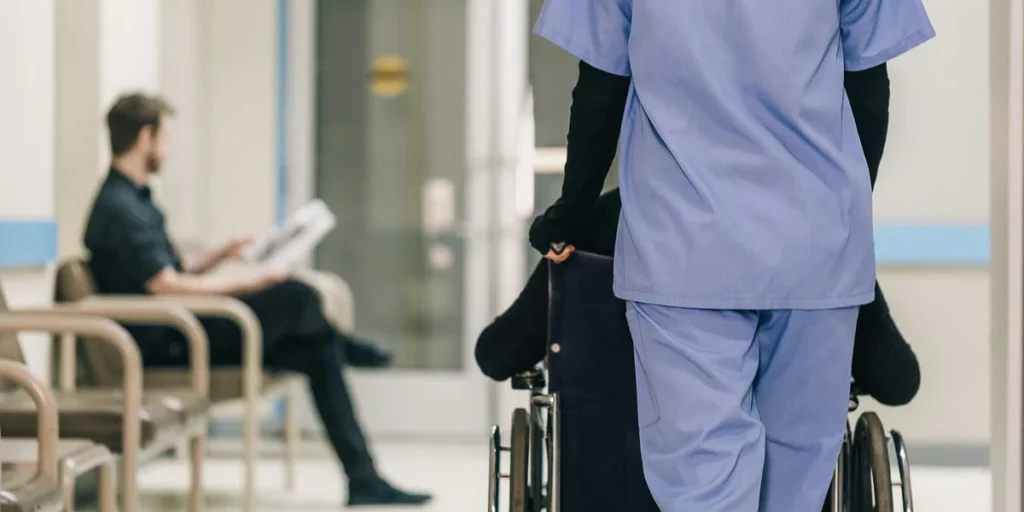
 A nurse pushes a patient in a wheelchair down a hospital hallway. Photo Shopify Partners | Burst
Jennifer Garzia: Congress Created 340B to Help the Poor. Now It’s Enriching Hospitals.
I thought I knew what to expect after my third C-section: sleepless nights, endless diapers, and hefty medical bills.
I didn’t expect to be billed twice for the same surgery.
When I noticed the duplicate charge, I did what patients are told to do: I called my insurance company, the doctor’s office, and Lankenau Medical Center in Wynnewood. Both my insurer and my doctor’s office confirmed it was an error. The hospital billing department didn’t budge.
“Who are you going to believe?” a representative said. “This is what we do for a living. I think we know more than you do.”
They do know more than I do — about gaming the system. Lankenau and its parent organization, Main Line Health, participate in the federal 340B Drug Pricing Program, and they have perfected how to exploit a federal program that was supposed to protect poor patients.
The 340B Program was supposed to help vulnerable patients afford their medications. Here’s how it works: Drug manufacturers must sell certain outpatient drugs to safety-net hospitals at steep discounts —sometimes 50 percent off. Hospitals are supposed to pass those savings to patients who need help most.
They don’t.
Instead, hospitals discovered a loophole that transformed a lifeline into a profit machine. Buy drugs at half-price. Sell them at full-price to patients. Keep the difference.
A 2018 Government Accountability Office report found that 60 percent of covered entities failed to pass on the full discount to patients. Earlier this year, Senator Bill Cassidy’s (R-LA) investigation exposed systemic abuses across the program.
The scope of the abuse is staggering. For every $10 the most profitable 340B hospitals collect, they spend just $1 on charity care for uninsured patients. Sixty-nine percent of disproportionate share hospitals receiving 340B discounts provide less charity care than hospitals that don’t participate.
The verdict is clear: this is not a bug. It’s the business model.
Meanwhile, Main Line Health’s top executives earn millions of dollars per year in salary and bonuses. According to the most recent tax filing, then CEO Jack Lynch earned more than $3 million in total compensation. Just six executives earned more than $7.8 million in total compensation from a non-profit hospital.
Consider what else is wrong with this picture. Nearly 400 oncology clinics have closed since 2008, partly because hospitals using 340B discounts have outcompeted independent practices and community-based providers. More than half of the 340B contract pharmacies supposedly serving rural and underserved areas are actually located in wealthy neighborhoods. Patients have fewer choices. Care is less convenient. Costs keep climbing.
The fix requires Congress to act decisively. First, establish a clear definition of a “340B patient.” Right now, hospitals write their own rules, maximizing profits rather than patient aid. There’s no appeals process. No transparency. Just bills and silence.
Second, demand public reporting. How much profit do hospitals make from 340B? What percentage reaches direct patient assistance? How many patients actually benefit? These aren’t trade secrets — they’re accountability measures. If hospitals can’t justify the numbers, perhaps they shouldn’t be participating.
It took me months of calls and a three-way conference with my insurer to get the duplicate charge removed. No explanation. No apology. Just a quiet keystroke and a dial tone.
That’s unacceptable. Congress created 340B to serve patients like me. It’s time to make hospitals actually do it — or get out of the program.
Congress knew what it was doing when it passed 340B. Now it needs to know what hospitals are doing with it.
Jennifer Garzia is a patient advocate with Patients Rising, a non-profit and nonpartisan patient advocacy organization. She called Pennsylvania home for more than two decades, living in Delaware, Chester, and Montgomery counties. She now resides in Florida.