
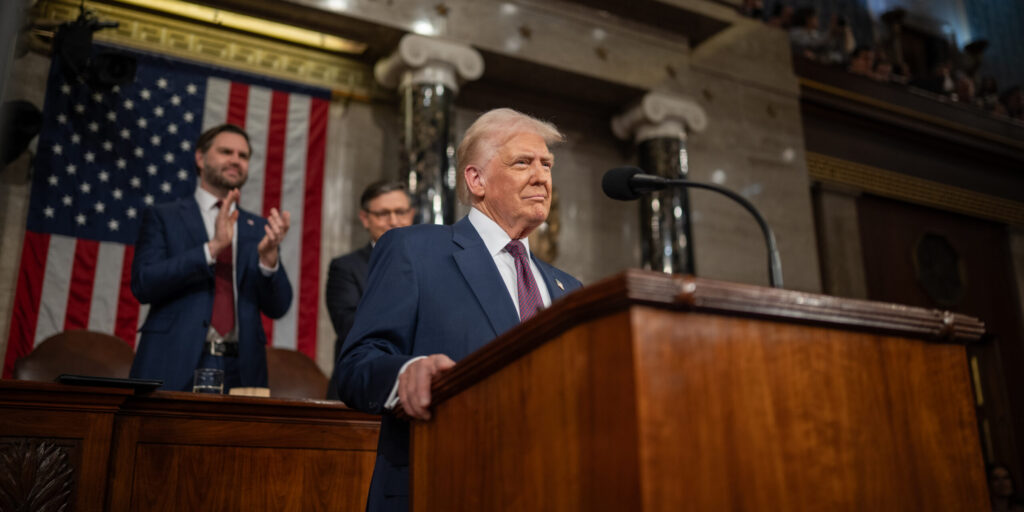
 Official White House Photo by Daniel Torok
From the Editors: Trump has a lot of good ideas, Congress should pass laws about them
President Trump came to office with a lot of good ideas. A few of them have been passed into law, especially in last summer’s One Big Beautiful Bill Act. But many others have been put into force only through executive orders or proposed rulemakings.
This is fine as a temporary measure — rules and executive orders do have the force of law (insofar as they don’t contradict existing statutes) — but they are not a permanent solution. They’re not even a long-term temporary solution. What they are is a quick fix, bringing a policy into action immediately. That’s fine, but if Trump and his allies in Congress want their vision to last longer than that — and if they want Americans and the businesses they run to treat those changes as permanent — they need to make them permanent.
Republicans control Congress by slim majorities that may not last beyond January 3, 2027. They should spend the next year enacting legislation that makes the popular parts of Trump’s agenda into actual laws — you know, the thing Congress is elected to do.
Consider the administration’s greatest success story: resolving the chaos at the southern border. In the first term, Trump worked to stop migrants from gaming the system by requiring those claiming asylum to do so from the first safe country they entered — a system in use already on our northern border and in Europe. Biden repealed that policy and reopened the floodgates to millions, most of whose asylum claims were convenient fictions. Trump reimposed the old rule in January, and it worked, but it remains only an executive order. The next Democratic president could repeal it just as easily. The State Department should negotiate an executive agreement — or better yet, a treaty — with Mexico and the Central American countries that makes it permanent. And Congress should bring that agreement into force by passing a law about it.
At the Department of Education, Trump and Secretary Linda McMahon are working toward a long-held conservative dream of reducing Washington’s power over our local schools. But, again, no permanent solution can exist as long as the statutes creating the Department of Education and enabling it still remain on the books. Trump could fire everyone there, but the next president could hire them all back. Returning control of education to the state and local governments is a worthwhile pursuit — Congress should pass a law about it.
Also in the education arena, Trump has issued orders clarifying that Title IX requires that girls’ sports teams be populated entirely by actual girls. It was a great victory for women’s sports and for common sense, and about 80 percent of the country agrees with it. But it is, again, a temporary solution. Many Democratic state officials are treating it as such and ignoring it, hoping that they can run out the clock on Trump. In 2028, or 2032, or whenever, a Democrat will sit in the Oval Office again. And when that happens, this victory could vanish and we could return to the same extremism that the Biden administration fostered. Congress should pass a law about it.
Even on the seemingly less important issue of the disappearing penny, we have the same problem. The penny has cost more than a cent to produce for decades now, but Congress was too risk-averse to act. So Trump did, and the backlash has been basically zero — everyone knew the penny’s time had come. But the Coinage Act of 1864 authorized the penny and it is still on the books. Will a future president resume copper-zinc penny production? It’s unlikely. But Congress should look at the coinage laws and decide on a permanent solution, rather than a hodgepodge of executive orders. We should get rid of the penny, and Congress should pass a law about it. To do otherwise would be, forgive us, penny-wise but pound foolish.
None of these are policies that should be a heavy lift for a Republican Congress. Even in the best of times, a party that controls Congress has a limited window to enact policy. The news cycle is ever-changing and Washington is what it is – there is always something that can distract or drive an agenda off course. If you don’t score some runs in the early innings, you run the real risk of getting shut out.
Democrats should understand this problem even if congressional Republicans don’t. Consider all of the things Joe Biden did by executive order or regulation, things that his base supported. Many have been repealed by Trump. The same could happen to Trump’s orders. Both parties ought to take an interest into governing by law, not by executive order.
President Trump’s policies aren’t all extremely popular but these are, especially with the voters who elected him. Congress has a year to make these ideas into laws. They should not waste any time doing it.
Broad + Liberty is a news and editorial outlet dedicated to freedom of thought and giving voice to issues and ideas that have been shut out of our discourse for too long.



Unfortunately, the fact of the matter is that a good proportion of Republican House and Senate members are either anti-Trumpers and/or RINO’s who are definitely not on the Trump train. John Thune, Senate majority leader, is the most prominent example of this phenomenon and I repeat, he IS the Senate majority leader. The most obvious evidence of this is Thune’s refusal to let the Senate go into formal recess which would allow Trump to make recess appointments to flesh out his administration in the wake of Democrat appointee obstructionism. Another is the refusal of Senate leadership to dispense with the “blue slip” gentleman’s agreement that has held back Trump’s ability to put US attorneys into place in blue states such as New Jersey and Virginia where key government corruption cases have now been stifled. The fact of the matter is that the Congress is really controlled by a uniparty made up of all of the Democrats and plenty of Republicans who have betrayed the people that they are supposed to represent for the sake of ultimate political power.