
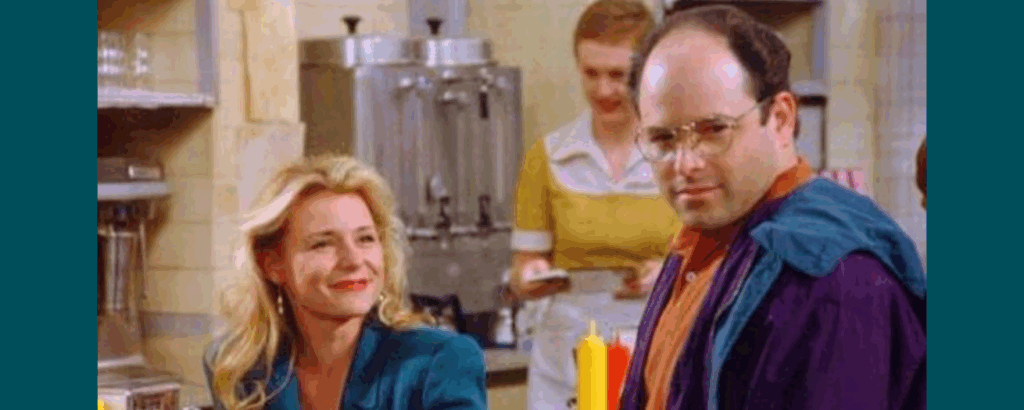
Stew Bolno: Doing the opposite — The Republican Party, George Costanza, and Donald Trump
Regardless of your Seinfeld knowledge level, you may wonder why the fine editors at Broad + Liberty would even consider publishing this essay based on its title. After all, in the TV show George is depicted as a low-ego loser who constantly expresses personal dissatisfaction with his circumstances. My ask: put your biases aside and defer judgement while I make my case.
If you’re a devoted Seinfeld fan, you’ll probably smile with recognition as soon as I remind you of the “do the opposite” episode. Additionally, the more you know Costanza and Trump, the less likely you are to see any connection between them. It’s clear to all; The Donald possesses a healthy ego, constantly boasts about winning, and visibly thrives in the presidential role regardless of the daily challenges, disappointments, and friction that are inherent in the job. This is the opposite of George.
For the non-Seinfeldians, the premise of that specific 22-minute work of art is based upon George’s commitment to perform a 180-degree behavioral change in all situations. The logic of this self-realization being that, if his instincts generally yield a negative outcome then doing the opposite will deliver dramatically improved results. And guess what, that’s what happens; a pretty woman is attracted to him, he’s able to side-step his personal demons, and is offered a job with the New York Yankees even after dressing down the fabled authoritarian George Steinbrenner, the real-life owner of the team at the time.
Since I’m old enough to have observed all Republican candidates running for office since 1960, I can confidently state that, since Richard Nixon — after he was hounded and forced to grudgingly leave office in 1974 — no Republican candidate for President represented a media driven public image of a charismatic person blended with a comfort for interpersonal conflict. Candidate Trump did. President Trump still does.
Gerald Ford, George Bush Sr., Bob Dole, and John McCain were long-term mediator types with decades of insider relationships. George Bush Jr. and Mitt Romney opted not to retaliate against lies their opposition trumpeted, foolishly believing the repeated canards wouldn’t have much impact on voters’ perceptions. Boy, were they wrong! Only charismatic Ronald Reagan was able to rise above the smears of a “Star Wars warmonger” and “amiable dunce” because of his skill in presenting a televised speech in a smooth manner, combined with the bearing of the professional performer he was.
Donald Trump, was raised, reared, and resided in New York for most of his life. He earned his bones as an entrepreneur and businessman. He is comfortable with conflict and manufactured a persona of an entrepreneurial capitalist with extremely high public visibility. GOP insiders rejected this interloper when he opted to run for president. His mannerisms, language, and image were the opposite of the Republican norm. He wasn’t an intellectual like Wiliam F. Buckley who died seven years earlier. He wasn’t shy about showing his rough side, nor possessed any deep history as a GOP team member. Conservative journalists like Bill Kristol and Jonah Goldberg never bought his act — and still don’t. If you want a very long list of on-the-record “Never Trumpers” in 2016, look it up on Wikipedia. Trust me, if you’ve been following politics for a while, you’ll recognize scores of familiar names.
It’s quite possible The Donald possesses little or no awareness of Seinfeldian culture, but his entry on the political stage was a precise demonstration of the ultimate George Costanza strategy. As the rawest politician on the primary stage, he attacked the favorite in the race by redefining and branding Jeb Bush’s sanguine and serene mannerisms as “low energy.” Once he slew the favorite, the others fell like dominos. It wasn’t even close; Trump was victorious in forty-one Republican primaries in his first run for office. Being on the receiving end of tough talk and rough actions by Ms. Clinton, he disregarded her gender and gave as well as he got. “Crooked Hillary” stuck. It contained more than a kernel of truth and the public knew it. There’s no Republican who would have even been that direct towards the first female candidate of a major party for President.
As president, Trump has reversed economic policies by lowering taxes, removing tax on tips, focusing on revenues, and revamping tariff policies. In negotiations with foreign countries, he’s pulled back on our voluntary “obligations” and reminded our enemies about the power of the American market. Although a noted peace president, he’s demonstrated he’s willing to be efficient in directing the military to slay foreign enemies while showing off American power by tactical bombing applications. As Commander-in-Chief, he has removed DEI policies from the military culture with one swift stroke and quickly turned a declining enlistment number into one that meets recruiting goals. The modern Mideast miasma is more hopeful because of his strong negotiation team, the development of the Abraham Accords, and the visible support for peace from leaders of countries from around the world. These are only a few of the positive visionary, goal oriented, and strategic opposites that have occurred because of his leadership style and presidential priorities. Even Costanza would be jealous.
To be successful as an innovator, problem solver, or successful person it’s often necessary to do the opposite of the status quo. George Costanza stumbled on this concept of wisdom. Donald Trump seems to have known it all along.
Stew Bolno is a chronological peer of Donald Trump. He’s been a student, college professor, and consultant on leadership during his 50-year career. He’s followed politics longer than that time. His recent book is “Leadership Lessons And You: From A to Z – featuring Donald Trump” and he’s written scores of essays about him since he descended the Trump Tower staircase.


Classic episode. “Who are you, George Costanza?”
In a sense, DJT is ‘the opposite of every man ( president) you’ve ever known’.
Thanks for reading. I’m pleased you enjoyed it.