
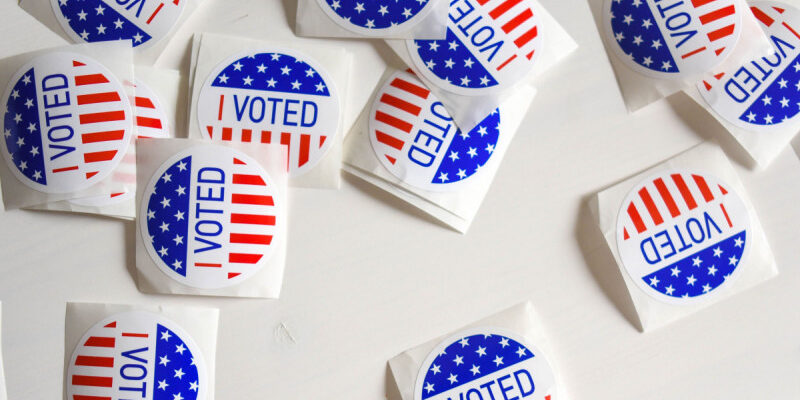
 Photo by Element5 Digital on Unsplash.
David Thornburgh: Independent voters aren’t the problem
Over the last five years of my forty year career as a Pennsylvania civic leader, I have been a strong advocate for primary elections in Pennsylvania that embrace all voters, including our 1.4 million independent voters. I agree with former state GOP chair Alan Novak, who said that inviting independents to the primary table is the right thing and the smart thing to do. It’s right because all voters should be treated equally. It’s smart because bringing more and different voters into the process promotes healthy political competition from the start.
Out on the advocacy trail I thought by now I’d heard every possible argument in opposition to the proposition that all voters should be able to vote in all elections. I’ve heard lazy incumbents argue that more primary voters would just force them to work harder, knock more doors and raise more money. I’ve heard the uninformed expert suggest that independent voters don’t really want to vote. I’ve heard political operatives say that independent voters should just lie about their true political identity, suck it up and pick a party if they want to vote in primaries. I thought I’d heard everything — until I read Villanova Law School Professor Emeritus Howard Lurie’s recent op-ed in Broad + Liberty: Independent voters are good people. That’s the problem.
We’ll return to his argument in a minute, but first let’s review the facts, a set of facts that I believe make a convincing case that this provision in our 1937 election law (yes, the same one that requires polling places to offer a lantern to voters in order to illuminate their choices) should have been repealed a long time ago.
Here are the facts:
- Pennsylvania is one of only nine states that still strictly excludes independent (or non-affiliated) voters from the opportunity to vote in primary elections.
- All taxpayers pay for primary elections (to the tune of $75 million a year) but indies don’t get to participate. The phrase taxation without representation comes to mind when you learn that 80-90 percent of local elections are effectively decided in the primary.
- For the last couple decades, indy voters have been the fastest growing segment of the Pennsylvania electorate, and now represent about sixteen percent of the voter pool.
- Nationally a recent Gallup survey reveals that 43 percent of all voters consider themselves independent, the highest number since Gallup started asking the question. Other surveys reveal that about two-thirds of young voters, 52 percent of veterans, and high proportions of Latino and Asian-American voters identify as independents.
- Over the last few years, a robust set of public opinion polls reveal that 75-80 percent of Pennsylvania voters — across both parties —support opening primaries to independents.
Now back to Professor Lurie’s op-ed. In his own words:
Independents are good people doing nothing. Doing nothing is what allows evil to triumph…They are allowing the extremists to gain control. In some states, like Pennsylvania, Independents cannot vote in the political primaries. Independents have, in effect, dropped out of the political process. They think that they have taken the high road, when in actuality, they have taken a dead end…They could have an impact if they stayed within either the Republican or Democratic parties. They could have a moderating effect.
I guess I should be pleased that Professor Lurie thinks all indies are exemplary human beings and that we wield enormous political power.
But wait a minute? If I hear the Professor right, independent voters are to blame for the sad state of the political parties because we chose to leave rather than reform them? And it’s our fault that we can’t vote in Pennsylvania’s primary elections, where 80 to 90 percent of all state and local elections are effectively decided? The Gallup numbers suggest an awful lot of folks are making this “mistake”. And, if we’re championing free market principles here, shouldn’t the political parties themselves do some soul-searching to understand why almost half of all voters are rejecting them? I guess the “customers” are always wrong. I don’t know whether to laugh or cry.
Maybe a private sector analogy would help clarify. Let’s say Automaker A produces a certain line of trucks (let’s call them Fireballs) that shows a certain tendency to catch on fire. After a few well publicized explosions, consumers rush to avoid the prospect of imminent immolation by buying a truck from another automaker, maybe one that doesn’t flare up on their way home from the Wawa. Facing plummeting demand from consumers eager to avoid a fiery death, Automaker A’s stock price plummets. The company is forced to respond. Maybe they recall the defective car, or fire their CEO. Or, maybe, Auto Maker B seizes the opportunity to develop better trucks that don’t explode, and consumers flock to Automaker B, forcing Automaker A out of business.
In Professor Lurie’s world, the consumers who turned in their Fireballs are to blame for the company’s misfortunes. If only they’d kept driving, invested their 401k’s in the automaker, attended more corporate meetings, maybe just bought a fire extinguisher, the company would have stayed profitable. Sure, at some point Auto Maker A might get around to fixing the Fireball problem, but there’s no need to overreact. Maybe they could form a committee to “address” the problem.
This is not how the private sector works, and it’s not how democracy works either. You change because you have to. Competition is a powerful force, in politics as in the car business. It demands change, brings about better ways of doing things, and combats complacency. But to work to maximum effect, competitive forces have to be set free. Parties will become more representative if voters demand it. And adding a million four new independent voters to primary elections will absolutely build that demand.
Are indy voters ready, willing and able? Absolutely.
Polls show that overwhelming percentages of indy voters want to vote in Pennsylvania’s primary elections. And if Professor Lurie is correct that independents represent more pragmatic, moderate voices that will help calm our turbulent political waters, then it’s imperative that we put out the welcome mat ASAP to open the door to allow all 1.4 million of us to enter the voting booth in every election. We’re not the problem, but we’re glad to be part of the solution.
David Thornburgh serves as the Chair of Ballot PA Action. From 2014 to 2020, he served as the President and CEO of the Committee of Seventy, the venerable Philadelphia-based good government group.
Previous examples of do-gooders’ “election reforms” include expanding mail-in ballots, electronic voting, voting weeks before election day, and ranked-choice voting.
How are those reforms working out?
Election integrity reforms are much more important, such as voter ID, cleaning up the voter rolls, and getting teacher union money out of politics.
Don’t forget fair districts — that was a big win for democrats. Especially when they went into the pa supreme partisan court and violated the constitution to turn down Republicans map. Gerrymandered or not, it was a constitutional map. Now dems get everything and continue to lie, cheat, steal their way through our Commonwealth while shutting down the legislature and any opposition for roof leaks.
Thanks, David. I do appreciate independents being in the primary process, but where are you on more obvious issues — like voter id and abiding the constitution? Step up when its inconvenient for dems, too.