
 Photo by Anthony Hennen
Kyle Sammin: So-called skill games are a racket the state should ban, not tax
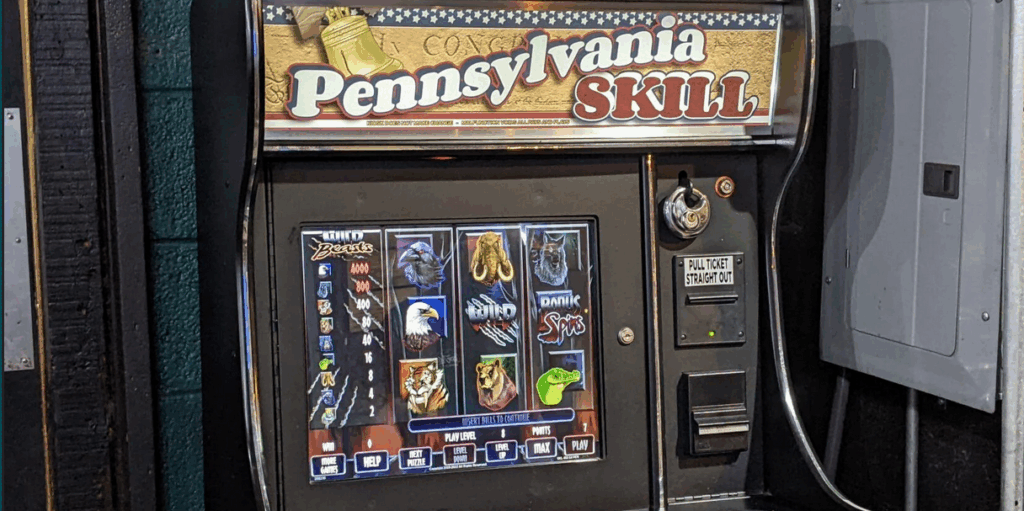
Gambling has been legal in Pennsylvania for 21 years now, long enough that the youngest gamblers can’t even remember a time when their favorite pastime was not permitted in the commonwealth. In that time, the law has been amended and the number of casinos has expanded, but the biggest fight still ongoing involves that gambling that exists at the margins of the law: the so-called “skill games” that have popped up in bars and convenience stores across the state.
Casinos, racetracks, and the increasingly ubiquitous gambling done on people’s phones — it’s all regulated under the Race Horse Development and Gaming Act and the state Gaming Control Board that the Act created. Love it or hate it, Pennsylvanians can at least rest assured that when they gamble in one of these state-sanctioned ways, they will get a game or wager that is conducted in accordance with rules, that will pay out when you win, and that (for the in-person versions) is conducted in a safe environment.
In return, the companies turn a profit and the state gets the taxes — last year the state’s licensed and regulated casinos generated a total of $2.66 billion in tax revenue, including $1.2 billion in slot machine taxes alone.
And then we have the skill games. You can’t just put a slot machine in a bar: that would violate the law and even if it were legal, it would incur the same hefty tax . But if the machine’s programming is tweaked just enough to be considered a “game of skill,” all of a sudden it’s legal, untaxed, and essentially unregulated. So by adding a pattern-matching minigame to the otherwise random game, the game manufacturers — led by Pace-O-Matic, a Georgia company — have concocted a “Pennsylvania skill” version of what is still essentially a slot machine.
State courts have upheld this, and they’re not wrong to have done so: Skill games violate the spirit of the law, but they are narrowly within the letter of it, and that’s what courts rule on. It’s up to the legislature to refine laws that don’t work and close loopholes that are causing harm. But they haven’t done this. Instead, Gov. Josh Shapiro and many legislators from both parties want to explicitly legalize them — and tax them, of course.
The result would be a product that is less regulated and more lightly taxed than casino gambling. The casinos understandably do not love this, having invested millions to build the structures and hire employees for what they were assured would be the only legal gambling locations in Pennsylvania. If that were the only problem, one might be forgiven for declining to shed a tear. But there are wider concerns here, as well.
Safety is a big one. Just like underground poker and dice games, the places that have skill games get robbed. There was a lawsuit about it just last week that led to a $15.3 million verdict following the murder of a store clerk in a robbery in Hazleton. The jury found that Pace-O-Matic and Miele Manufacturing were negligent in placing the machine in an unsafe location, in violation of its own regulations.
These things happen in an unregulated and widely disbursed industry. The drafters of the 2004 legislation knew that gambling can be a risky business, but one that many Pennsylvanians wanted to be legal. So they designed a system where it was all kept in a few places and the state could keep an eye on it. That, plus the fact that it kept horse tracks afloat, led to a reasonable compromise on the regulation of the industry.
Instead of blowing up that bargain, Shapiro and the legislature ought to close the loophole and shut down those barely legal machines.
Kyle Sammin is the managing editor of Broad + Liberty.


Skill games provide an essential source of revenue to both VFWs and American Legions that would otherwise have to reduce their community support to zero or close to it. If local charities or preferably state government would make up the difference in revenue lost due to either heavy taxation or outright banning. then there is no issue. I can’t speak to convenience stores having to close due to loss of skill game revenue except to note that convenience stores are operate on razor thin margins (Not all convenience stores are Sheetz, Rutters or WAWA). I don’t think it is valid to imply that convenience stores are robbed because they have skill game machines. They get robbed al the time because they are easy targets, some because they also have ATMs. Shall we get rid of ATMs at other than bank locations. BTW, all forms of gambling are a plague on society, (the house never loses) but the worst are state run lotteries with their odds of winning subject to change at the discretion of the state, there is a reason Voltaire, in the 18th century stated that lotteries “were a tax on the foolish.”