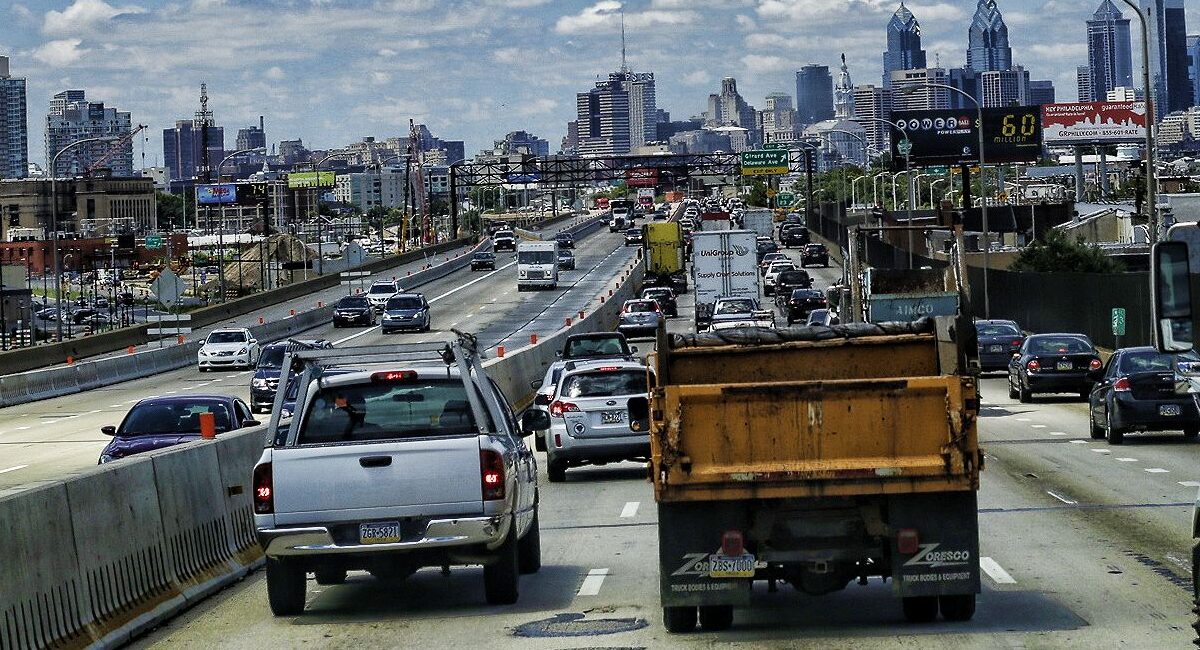
Photo by Elvert Barnes via Flickr
Life, death, and poetry on the Frankford El
Not all that long ago I boarded the Market-Frankford El at Front and Girard with the intention of taking it to Second Street to meet a friend at a coffee house. It’s a humdrum route I take all the time. Most days, no matter what time you take the train, there is standing room only. That’s how crowded the city is now.
But on this day I found a seat and opened two books, Thomas Devaney’s “Getting to Philadelphia, New and Selected Poems,” and Brian Selznick’s “Walt Whitman: Live Oak, With Moss.”
Devaney’s book was published by Brooklyn’s Hanging Loose Press. Before the train pulled into the Spring Garden Street station, I had read his poem, ‘Memory Corkscrews So You Can’t Remember It’:
I make my prayers in another part of the city,
but they keep blowing back:
Philly makes, Philly breaks –
What the hell are you looking at?
At the end of the year something
called Sneaker Day,
Swedish Fish and tail pipes in the breeze.
After the train pulled into the Spring Garden station, it remained there for a considerable time, passenger doors open, with no explanation from the crew as to why the train wasn’t moving. This gave me time to delve into the second book, Live Oak, With Moss.
“In the 1850’s Whitman had written a cycle of twelve poems called ‘Live Oak , with Moss,’ which Maurice Sendak had described as a love story between two men who eventually part.”
Selznick goes on to say that Whitman never published the cycle but cut the poems up and rearranged them in the ‘Calamus’ poems in the 1860 edition of Leaves of Grass. They remained completely unknown for a hundred years until their rediscovery in the 1950s.
Meanwhile, there was no official word from SEPTA about the stalled train. We were still at the station, stuck in a situation that would very likely get worse, a parallel situation to the two men in Whitman’s poem:
I now suspect there is something terrible in you,
Ready to break forth
Finally there was an announcement on the train’s public address system but static garbled the words. The speaker was also talking so fast that, combined with the static, the message was a blur. What was the poor man saying? By now the students on the train were getting rambunctious, running from one passenger car to the next, screaming with delight that something different was happening in their lives, an event to break the boredom of the day.
Devaney:
Children have their own music; and the owls,
The Snow Owl: always five beats off the blink.
Miracle of miracles, an audible SEPTA announcement indicated that the train would be moving in a few minutes. I kicked back and resumed my reading and waited for the repetitive “doors are closing” recording. Soon it became obvious that this was not going to happen. When a train going in the opposite direction also stalled at the station, I knew an emergency was in the works.
This came in the form of a second garbled announcement about a passenger incident at the Huntingdon station way up beyond Girard where I boarded the train.
“Passenger incident” is often SEPTA code for suicide, though of course it could also mean the arrest of someone or a group of individuals. SEPTA is rarely forthcoming when it comes to specific information. The word suicide is still on the Index of Forbidden Words, regarded by many as offensive, yet this was not always the case.
In the early 1980s I recall riding in a southbound Broad Street subway car as the train pulled into City Hall station. Apparently there had been a problem on the tracks earlier because the train literally staggered into the station but as it slow-motioned past the waiting platform I was shocked to see the body of a young teen, his head visible while the rest of him was encased in a body bag on one of the waiting benches.
No attempt was made to shield passengers from the horrific sight, unlike a similar suicide on the Paoli-Thorndale line in 2009 that had one eyewitness who saw a woman on the tracks before she was hit, writing on Reddit:
“The [rescue] train arrives and we climb down stairs onto the tracks and get hoisted back up into the Rescue Train. The rescue train is dark because it’s in ‘emergency mode’ (?), and it takes quite awhile for the Rescue Train to load its passengers and get cleared to get moving.
“I didn’t mind the wait because I knew the situation, but as we got loaded on to the rescue train, it became apparent that a lot of the passengers had no idea why we were stopped in the first place, or why they were being ushered onto this dark train in emergency mode. They were then informed by other passengers and felt bad for their outrage.”
But at no point did SEPTA announce what was really going on.”
While the word “suicide” may be offensive for some, an honest attitude regarding what actually happened on the tracks always works to make passengers more understanding when it comes to delays. People are less likely to become disgruntled if they know that someone just lost their life on the tracks.
During the Spring Garden station incident, minutes after the mysterious incident announcement, passengers from both trains began to swarm onto the platform. General confusion reigned. Would the trains be starting up again? Was it still true that the train would return to normal, as was announced, “in a few minutes?”
Sometimes crowds in emergency situations have a kind of sixth sense and know when they have to move in a certain direction. A trickle of people began to take the exit stairs to Spring Garden Street minutes before another announcement — sans static and garble — that shuttle buses would be made available at street level.
Yet some passengers still sat in the train because it was never made clear if the trains would be up and running again. Was the shuttle only for impatient passengers who needed to be someplace quick? The guessing game continued until at last a yellow-vested SEPTA employee visited each train car with an order to evacuate.
The evacuation call was made in harsh, angry tones as if the “left behind” passengers should have known better and evacuated the train a while ago.
The crowds on the street recalled the panic scenes in B-movies. Did SEPTA say shuttle buses? People stepped out into the street dodging traffic in hopes of catching sight of a fleet of those shuttle buses. We waited and waited like the characters in Waiting for Godot. Only the regular Spring Garden route buses appeared, leading to more confusion.
The minutes turned into a half hour, and still no shuttle buses. People were starting to walk away. Many who were headed downtown took 2nd Street and began to walk into Old City. The remaining crowd was now a shadow of its former self, so those shuttle buses, if they showed up, would only have to pick up a few people.
I decided to walk.
Two hours later the Market-Frankford El was back on track.
I was never able to ascertain who jumped onto the tracks at Huntingdon station. That will always remain a mystery, since rarely are names or pictures of track jumpers published so the person’s death winds up in the annals of the forgotten.
Huntingdon station is a hang out for many of the synthetic opioid fentanyl homeless crowd. Men and women, but mostly men, line the sidewalks there watching and waiting, or slumping over towards the ground. The station is just around the corner from Episcopal Hospital and its bullet proof plastic ER. From the station all you have to do is walk a straight line under the tracks and you come to Kensington and Allegheny, an area still filled with fentanyl and other drug vagabonds moving up and down the street.
Thom Nickels is a Philadelphia-based journalist/columnist and the 2005 recipient of the AIA Lewis Mumford Award for Architectural Journalism. He writes for City Journal, New York, and Frontpage Magazine. Thom Nickels is the author of fifteen books, including “Literary Philadelphia” and ”From Mother Divine to the Corner Swami: Religious Cults in Philadelphia.” His latest is “Death in Philadelphia: The Murder of Kimberly Ernest.” He is currently at work on “The Last Romanian Princess and Her World Legacy,” about the life of Princess Ileana of Romania.