
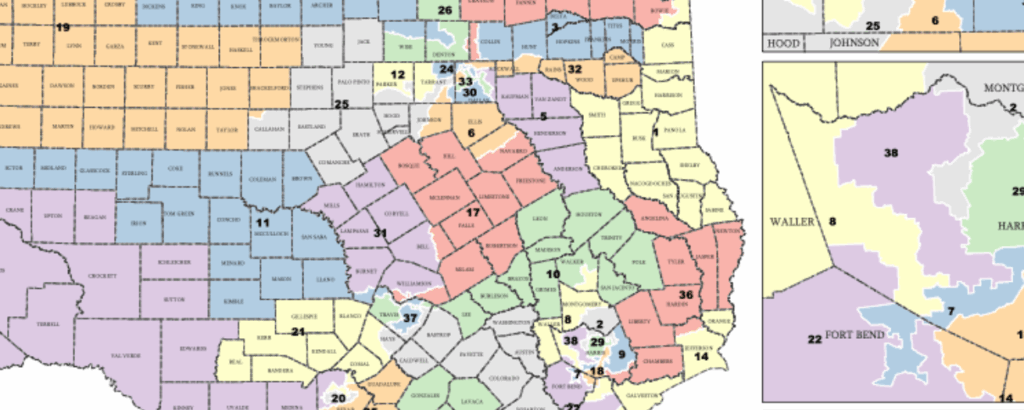
Shocker — Redistricting is political!
Acting like teenagers who’ve found out that the WWE is scripted, Texas Democratic legislators recently shrieked and ran away in fear and anger after discovering that drawing the lines and boundaries of Texas’s congressional seats is a political process. Even partisan!
Thankfully, they fled to the safe confines of Chicago, Illinois, where their congressional lines are drawn up by a committee of Buddhist monks and members of a cloistered convent of Catholic nuns, and presented on stone tablets to the citizens of Illinois by a descendant of Moses. Ahem…
The anger is all theater.
Worse, it’s another episode of Democrats engaging in both transference and gaslighting. Democrats have been far more hyper-partisan and have used power politics to gain seats in the US House, that’s why they are yelling so loudly and theatrically. They’re pretending like they’re genuinely outraged — that the GOP is doing something never done before. A “threat to democracy!”
For better or worse, redistricting is a political exercise. “Gerrymandering” has been around since Elbridge Gerry — then Governor of Massachusetts — signed a redistricting law that drew a salamander-shaped district. In 1812.
At the start of each decade, as required by Article 1, Section 2 of the US Constitution, the allocation of the US House of Representatives to the states is done following a national census — counting the residents of each state.
Thereafter, based on its state’s allocation, each state has a process for “redistricting.” That is, re-drawing the boundaries of its congressional districts, whether the state has gained or lost House members, or even if its state allocation has not changed. (This process is moot in states with only one member elected to the US House — e.g., Delaware.)
Each state used to redraw its line once a decade. Recently, some states are redrawing their congressional lines more than once a decade for a variety of reasons — including (not so shockingly to anyone being honest) partisan political politics. Rightly or wrongly, redistricting is a political process whereby one party seeks to gain control over the other party. Or other political considerations are made, including “protecting” powerful congressional committee chairmen — as has been happening in New York State where it seems like a team of geographers, mathematicians and political scientists are summoned to make sure that Democrat Jerry Nadler never loses his seat in a primary, let alone a general election, since he was elected in 1992.
The only thing more political than redistricting — is Democrats pretending to be outraged that the redistricting process is political. It’s often a blatant, overtly partisan power play.
In fact, in 2017, Obama’s former Attorney General — Eric Holder — created a SuperPAC for the sole purpose of maximizing (“gaming”) each state’s redistricting process, so that the Democrats could control the US House.
Enter Pennsylvania.
People’s exhibit number one. In Pennsylvania, our lines are (or were) drawn transparently by actual legislation. A bill is introduced, works its way through the usual committee process and is subject to amendments and debate — and even compromise. Ultimately, when the bill passes both the Pennsylvania House and Senate, it’s presented to the Governor — just like any other bill.
After the 2010 census, Pennsylvania was allocated eighteen members of the US House. Senate Bill 1249 — which passed the State House with an overwhelming 136-61 vote — became Act 131 of 2011, setting the congressional boundaries in place. (Democratic Congressman — and Philadelphia Democratic Party Chair — Bob Brady publicly approved of the legislation.)
As had been the law and custom for decades, Act Number 131 of 2011 created the districts that were used in 2012 — and 2014 and 2016. And were set to be used in 2018, until…
Taking their lead from Holder’s SuperPAC, “disgruntled voters” filed a lawsuit arguing that the lines were suddenly “unconstitutional.” Why? Too many Republicans were winning.
Shockingly, the elected, Democrat-majority Pennsylvania Supreme Court ruled that the lines were “unconstitutional.” Ultimately, through other partisan gamesmanship, the Court itself actually took the unprecedented step of drawing the lines. (Wonder who supplied them with the new lines?)
The 2018 elections were held and — to the shock of no one paying attention — the new eighteen-member delegation flipped from thirteen Republicans and five Democrats to…nine Democrats and nine Republicans. (Just like God and Thomas Jefferson would’ve wanted.)
It was political. It was overtly partisan. Just like there not being one state in New England having any GOP members in Congress, due to gerrymandering. Or, Maryland having only one out of eight. California having only nine out of 52. Or the pillar of virtue — Illinois — having only three Republicans out of seventeen.
When we elect Members of Congress in Heaven, it will be a fair, impartial and unbiased process. In America, it’s a process done by politicians — or those chosen by politicians. A citizen’s duty is to be vigilant, and to demand transparency and accountability.
Apparently, the Democrats’ duty is to use all the tools at their disposal to inflate their numbers, gerrymander seats, protect powerful incumbents, and shriek and run to Illinois and make TikToks if the GOP fights back.
It’s theater of the absurd.
Guy Ciarrocchi writes for Broad + Liberty and RealClear Pennsylvania. A Senior Fellow with the Commonwealth Foundation, you can follow Guy at @PaSuburbsGuy.
Claiming that “Democrats have been far more hyper-partisan” when it comes to drawing congressional maps is a flat-out lie. Any nonpartisan review of congressional maps shows that Republicans have been significantly more partisan when drawing congressional districts than Democrats. In fact, Republicans launched Project REDMAP, a redistricting initiative implemented in 2010, which used gerrymandering in dozens of states to secure a partisan advantage.
https://gerrymander.princeton.edu/redistricting-report-card
..and Republicans are finally starting to catch with to the Democrats. The dam will break loose with red if Newscum moves ahead with his plan.
Anything coming out of Princeton certainly will not be ‘non-partisan’.
Oh, since it’s so clear that you have zero faith in higher education or, you know, all that pesky research and data they waste their time on, maybe—just maybe—you could take a glance at these links. You know, the ones that magically say the exact same thing? That Republicans are, shockingly, even more hyper-partisan when it comes to gerrymandering than Democrats. But hey, what do facts know, right?
https://worldpopulationreview.com/state-rankings/most-gerrymandered-states
https://www.brennancenter.org/our-work/research-reports/how-gerrymandering-tilts-2024-race-house
https://ippsr.msu.edu/partisan-advantage-tracker
https://www.newsweek.com/map-shows-most-gerrymandered-states-wisconsin-1915098
Oh, come on, Guy. No Democrat is shocked that gerrymandering is political — everyone knows that. The difference in Texas is that Republicans are openly bypassing the normal census-based process, just to satisfy Donald Trump’s demand that “we are entitled to five more seats.” Those are his words. Since when is any President entitled to congressional seats? That’s not representation — that’s raw power-grabbing.
Yes, Democrats have gerrymandered in the past. But the data shows that Republicans have pushed the practice further and with fewer guardrails. As Tyrone pointed out, GOP leaders have weaponized redistricting more aggressively than Democrats. Texas already has a F grade and is trying to make things worse.
You mischaracterized Eric Holder’s and his group considering he promoted independent redistricting and even criticized Democratic gerrymanders. More recently, every national proposal for independent redistricting has been introduced by Democrats, not Republicans.
You bring up California, but that example undermines your own argument. California has an independent redistricting commission. Governor Newsom’s proposal is explicitly conditional on states like Texas breaking the rules first, would require approval through a ballot initiative (unlike in Texas), and would automatically expire at the next census.
And closer to home, you complain about Pennsylvania flipping in 2018, but you omit the context: it was a wave election for Democrats across the country, with a net gain of 41 House seats. That’s not a quirk of redistricting — that’s voters rejecting Trump’s first two years. And while you focus on the lack of Republicans in New England, you conveniently ignore states like Arkansas, Idaho, Montana, Oklahoma, Utah, and West Virginia — all of which send only Republicans to Congress. If the absence of one party in a region is proof of a rigged system, then what do we call those states?
Your article spends more time mocking outrage than examining the real problem. That selective focus makes it look like the fight is about theater, when in reality it’s about a serious abuse of power that you chose not to confront.
The trigger for this redistricting session was a 2024 en banc decision from the Fifth Circuit Court of Appeals. In Petteway v. Galveston County, the court struck down 36 years of precedent and ruled that the Voting Rights Act (VRA) does not allow “coalition” districts, where two or more minority groups combine to form a majority. That ruling overturned Campos v. City of Baytown (1988), which had long permitted Black and Hispanic voters to be treated as a single legal coalition in redistricting cases. Now, such coalitions are no longer valid in Texas, Louisiana, and Mississippi.
The court held that Section 2 of the VRA protects “a class” of citizens, not multiple distinct classes acting together. This means Texas lawmakers can no longer justify majority-minority districts built from overlapping racial and ethnic groups. The legal floor has shifted, and the Legislature must respond.
In July, the U.S. Department of Justice (DOJ) sent Governor Greg Abbott (R) a letter identifying four congressional districts, TX-9, TX-18, TX-29, and TX-33, as unconstitutional coalition districts that must be redrawn. Governor Abbott quickly added redistricting to the special session agenda, citing “constitutional concerns raised by the U.S. Department of Justice”.
The shift is rooted in a US District Court decision. The defendants could/should seek to appeal it to the US Supreme Court. Given the historical nature of the SCOTUS to punt redistricting issues back to the states, it may decline to hear the case.
So what is the rationale behind Missouri, Ohio, Indiana, and Florida considering redrawing their legislative maps?