
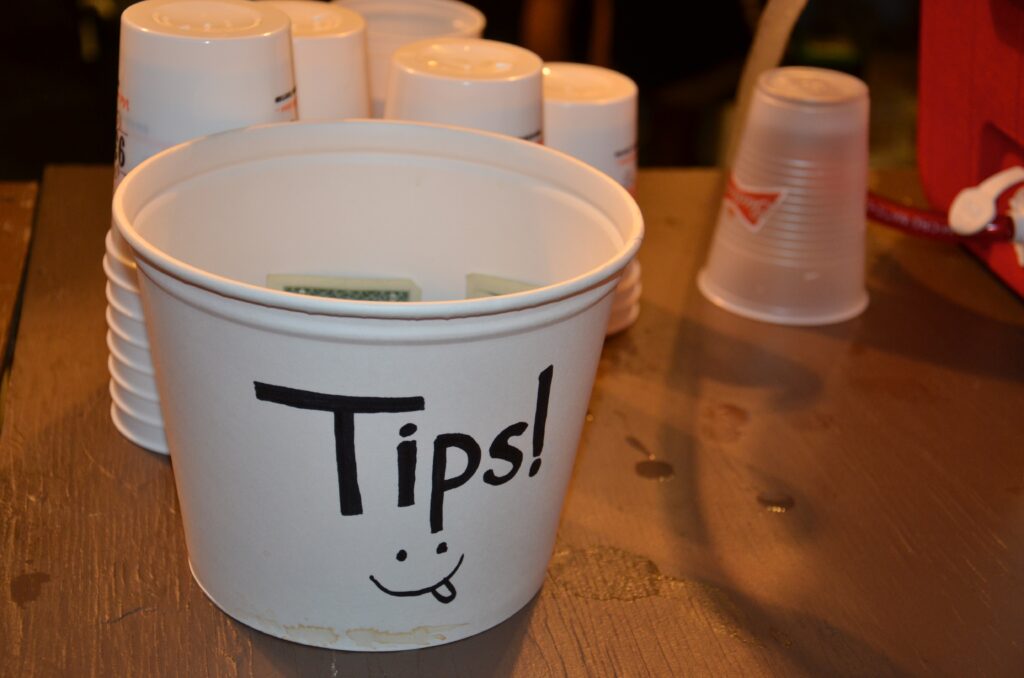
 Phot by Joe Shlabotnik via Flickr
Howard Lurie: No tax on tips? How about no tips?
I don’t like tipping, but I do tip. Usually, about 20 percent. But I would rather not.
None of the people I tip are my employees. They work for someone else. And taking my meal order and bringing the food to my table is really not worth the amount of the tip. It isn’t that I look down upon the people I would rather not tip. It’s that I don’t think they should have to rely upon tips for their wages. Frankly, I don’t see why a waiter’s income should depend upon how cheap or expensive my meal is. I think tipping is demeaning and a leftover from a years ago culture.
I don’t tip my dentist. I don’t tip bus drivers. I’ve never tipped the airline pilot. I don’t tip at McDonalds or Burger King. I don’t tip the auto mechanic who makes sure the brakes on my car are working. My auto mechanic provides a service that is far more important than how promptly my steak arrives after I order it.
If you think about it, the tip we leave for the waiter has nothing to do with the service he provides. It’s based upon the price of the meal that we order. If you and I go to the restaurant together, and you order something inexpensive, but I order a rather expensive dish, my bill will be greater than yours. The waiter brings both of our meals at the same time. We each receive exactly the same service. Yet, the 20 percent gratuity that you leave is less than the 20 percent gratuity that I leave. You are getting the same service for less than me. That fact should surely indicate that the tip is not based on the service, but on the price of the food that we ordered.
I’ve been told that some restaurants today are automatically adding a 20 percent service charge to the bill, thereby relieving the guest of the burden of voluntarily leaving a tip. Again that demonstrates that the “tip” is really not tied to the service.
The reality is that while we may appreciate good service at a restaurant, we go for the food, not the service. If the food isn’t very good, even fantastic service isn’t likely to induce a return to that restaurant. On the other hand, if the food is terrific, but service is only mediocre, we probably will go back.
So if the tip is based on the price of the food, why not just raise the price of everything by 20 percent and do away with tipping? The end result for the customer is the same. And, if the price of the food is higher, the owner can afford to pay the staff a decent wage that the staff can depend upon. Why shouldn’t the wait staff get a regular salary rather than having to depend on the generosity of diners? Surely, the accounting and the tax calculations would be simpler and less subject to manipulation.
One of Donald Trump’s campaign positions was no tax on tips. Shortly after he began urging that policy Kamala Harris also began to urge it. As a result of passing the Big Beautiful Bill, some version of no tax on tips is now law.
I still do not know the rationale for not wanting to tax tips. It strikes me as a really stupid idea. The only reason I can think of for making it law is to buy votes from those who will benefit from it. But the accounting and reporting for tax purposes will be made more difficult and costly. Furthermore, there will be an incentive to manipulate the employment relationship to gain the benefit of no tax on tips.
Also, lost in the discussion is the issue of fairness to taxpayers. I maintain that it is truly unfair to tax the $25,000 that a person earns from salary, but not tax the $25,000 that a person earns from tips. It’s the same amount of money. Why does one get taxed, but not the other? Income is income. \Why should it matter if the income is from tips or from salary?
Personally, I would like to see all tips go away. When I buy something, whether it is a product or a service, I expect it to be good. Decent service should be the norm, and the price posted should be the price. I don’t like add-ons, and tips are an add-on.
And no tax on tips should go away, too.
Howard Lurie is Emeritus Professor of Law, Charles Widger School of Law, Villanova University

Mr. Lurie: When I delivered for Campus Corner, at the time they had 8+ drivers per night, and we would jockey to see how many deliveries (and where) fate would grant us for each “run.” If you were lucky, you’d get 6-8 orders at a time going to South Campus. Rinse and Repeat. Heaven forbid if you got stuck with an unlucky Cabrini or Byrn Mawr run – 45 mins at least. No matter what, we all tried to avoid any order with grape soda. Why? Almost certainly it was a student athlete – with no tip.
You make a great point that it is “unfair to tax the $25,000 that a person earns from salary, but not tax the $25,000 that a person earns from tips.” It is called buying votes. Democracy eventually devolves to that point… followed shortly by tyranny and so here we are – e.g., student loan forgiveness or stimulus checks.
By the 1860s, tipping started appearing in American restaurants and hotels, particularly in urban areas like New York and Chicago. It was initially controversial, seen by some as un-American and undemocratic, creating a class-like distinction between patrons and servers. Critics, including labor unions and newspapers, argued it allowed employers to underpay workers, shifting the burden to customers. However, the practice grew due to social pressure and the rise of the service industry, especially in restaurants catering to the middle and upper classes.
By the early 20th century, tipping became entrenched, with 10-15% gratuities becoming standard for waitstaff. The practice was formalized further during Prohibition (1920-1933), when restaurant owners, facing financial strain, relied on tips to supplement low wages. Despite periodic resistance, including anti-tipping movements in the early 1900s, tipping solidified as a cultural norm, driven by social expectations and economic realities.
If you don’t want to tip, you don’t have to as you know. I simply offered coffee and an umbrella to the service tech looking at my outside residential HVAC unit under a Spring rain. Turns out it hasn’t been leaking (like the last 3 techs said over the past 3 years) even though my unit uses R-22… and it didn’t need a recharge. He did earn a tip.
Interesting Topic. I appreciated tips that I received while pumping gas and washing cars on weekends home from school. I follow through with tips (To Insure Performance) for waitstaff, barbers, the guy who ties my Christmas tree to my roof, the valet car guy, and basically anyone on a low pay scale who is performing a service for me that takes the time to do it right or goes the extra mile to to ‘fit me in’, get my order in, load my luggage, save me the trouble, make my experience a happy and friendly one. Maybe they’re supposed to already, but that’s getting rare these days. I tip younger workers starting out or working through school for helping me so that they learn a lesson that their attention and courtesy is recognized, appreciated and rewarded. I’m no big shot, but I appreciate working people, especially those that deal directly with the public day in and day out.