 Photo by Thom Nickels
Thom Nickels: Traveling in Romania in the shadow of the past
I almost canceled my trip to Romania several times. I wasn’t sure why I was feeling fearful. The rash of plane crashes across the globe didn’t help, but then most of those involved small, private planes. I’d be traveling on a British Airways jumbo jet.
Why Romania and not Italy, Paris or Rome? A book I am working on, “The Last Romanian Princess,” — involving the life and influence of Princess Ileana of Romania — suggested the need to touch Romanian soil and to experience the people.
And so I flew to London, and after a brief layover I took a flight to Bucharest, Romania. The second flight was a small jet and subject to mountain turbulence, and I was seated in the last row of seats, so that by the time we landed I knew every passenger’s bathroom habits.
Going through customs threw me into a tailspin. The crowds of people from arrival flights moved in a large confusing mass towards the officials. Unlike most ports of entry, this crowd was left to its own devices when it came to forming orderly lines. When a sense of decorum did eventually emerge, I found myself face-to-face with a thin, severe bureaucrat who looked at me as if trying to discern an ulterior motive for entering the country. After asking where I was from, he paused for a few seconds, looked into my eyes then raised his passport stamp high in the air and let it come crashing down with a thud.
Among the people cramming Customs were several migrant types in West African garb. I noticed some Romanians in the crowd giving them disapproving looks. I had read that many Romanians are fed up with the immigration policies advocated by the European Union. (Romania joined the EU in 2007).
My guide for a four-day road trip through the western and northern parts of the country was Constantine, an ice hockey player who dabbles in art history. He drove me to the Hotel Berholt, where we arranged to meet the following morning for the beginning of our journey.
In the hotel parking lot Constantine pointed out a couple of vehicles with Ukraine license plates. “These are Ukrainian migrants escaping the war,” he said. “They come to Romania where they stay for free at hotels and eat for free in the dining rooms. After that they are fitted for free housing.”
Constantine said the program was EU-based and discriminatory to poor Romanians, who have no such privileges.
The UN’s Help Romania Agency (UNHCR) says: “Refugees from Ukraine who enter Romania for the first time since the start of the conflict, starting from 1 July 2024, have the right to accommodation assistance in temporary and humanitarian accommodation centres. Alternatively, eligible refugees can receive a lump sum for a maximum of three consecutive months, amounting to 750 RON/month for single person and 2000 RON/month for a family.”
My first night in Bucharest was not good. I felt out of sync and wanted to return to Philadelphia. I thought a walk through Bucharest might be a good idea but once outside on city streets I couldn’t muster the enthusiasm to visit a café. Jet lag was kicking in. I was caught off guard when a girl (in her twenties) ran up to me on the sidewalk, presented me with a business card and asked if I wanted a massage. Did I look that lonely?
Constantine met me the following morning. He was dressed in a spiffy jockey-like jacket that had the word “Romania” printed in large block letters on the back. He brought snacks and drinks from a little general store he owned.
Before starting out on Route 130, Constantine pointed out a neoclassical-style building that used to serve as a headquarters for the Gestapo and for the Embassy of Germany when Hitler’s puppet dictator, Ion Antonescu, controlled the country. Nazi rule in Romania ended in 1944 when Romania’s King Michael, at the tender age of 22, successfully forced out Antonescu, saving thousands of Jews from extermination. Antonescu previously had been given a free hand by Hitler to solve the so-called “Jewish question,” and this resulted in the murder of at least 420,000 Jews early in the war.
After the war, Antonescu’s Nazi regime was followed by a harsh communist government.
Constantine talked about the Bucharest restaurant his grandparents once owned. “When the Communists took over, they came into the restaurant, smashed the liquor cabinets, drank all the alcohol, ate their meals without paying, and threatened to rape my grandmother.”
Our first road stop was an outdoor sausage stand staffed by middle-aged women in head scarves. Constantine said it was a popular “truck” stop on the way to Transylvania and beyond. The women tended to sizzling sausages of various sizes as small Gypsy children wandered the area asking for money. A boy of six or seven walked up to our table with his hand out; he was later joined by his younger sister. An old Gypsy woman, talking to unseen spirits, paced back and forth near where we were eating. Constantine inferred that the women at the grill also offered “other” services if one was interested. It was hard for me to wrap my mind around this because the women looked like good Orthodox Christians one sees bowing and crossing themselves before church icons.
We drove through the Olt River gorge and valley and stopped at the Cozia Greek Orthodox Monastery, built in 1388. To my surprise, my guide purchased a bottle of holy oil from Mount Athos in the small gift shop there and made a show of anointing my forehead, lips and hands with the oil in the middle of the church.
Romania’s political history is a study in subservience. The country fell to Ottoman suzerainty in 1541; its liberation from Ottoman rule occurred in 1871. After the Turks were driven out of the country by the Hapsburg Austrian Emperor, there was an Austrian push to convert Orthodox Christians to Catholicism.
Many Orthodox monasteries and churches were confiscated and used as horse stables. Two notable Orthodox churches, Voronet Monastery — which we would visit later — founded and erected by Stephen the Great in 1488, and the Cozia Monastery church, built in 1388 by Mircea the Elder, grandfather of Vlad Dracula, became hovels for a variety of barnyard animals. Constantine blamed the conversion of the Cozia Monastery church into a stable on the Austrian Jesuits.
Near the Cozia church an elderly Gypsy man sold us a pair of hand sculpted wooden tomahawks for two American dollars.
We entered the town of Sibiu before heading to Timisoara, where Lenten worshippers crowded the immense 300-foot tall Metropolitan Orthodox Cathedral with its mosaic-patterned roof tiles. We walked through Victory Square, the seat of the 1989 Romanian Revolution that overthrew the Communist Ceaușescu dictatorship.
Espresso and its infinite varieties dominate every gas station, rest stop, and restaurant in Romania, but Constantine asked the proprietor of one large cafe if he sold real American coffee, to which he said yes but what he presented were large cups filled with a kind of watered down espresso. The local McDonald’s seemed promising in this regard but even there watered down espresso in a large cup was presented as “American.”
Sneakers are a hot item in Romania. A large sneaker store in Victory Square was buzzing with large crowds and numerous security guards. Immediately after entering the store we were followed by a young female employee who watched as Constantine found something he liked, asked if the marked price of 50 Euros for the sneakers was correct but was told by the employee the sneakers were really 150 Euros and that the labeling was a mistake.
“This trickery happens all the time in Romania,” he said. “The list price is never the real price.”
Bram Stoker, who wrote the notes for his gothic novel Dracula in Philadelphia in 1884 (he completed the work in Scotland in 1896), never traveled to Romania but researched the country and knew its mystical traditions and folklore. These include tales of giants that protected the earth and wizards descended from Dacian (Dacia, the former name of Romania).
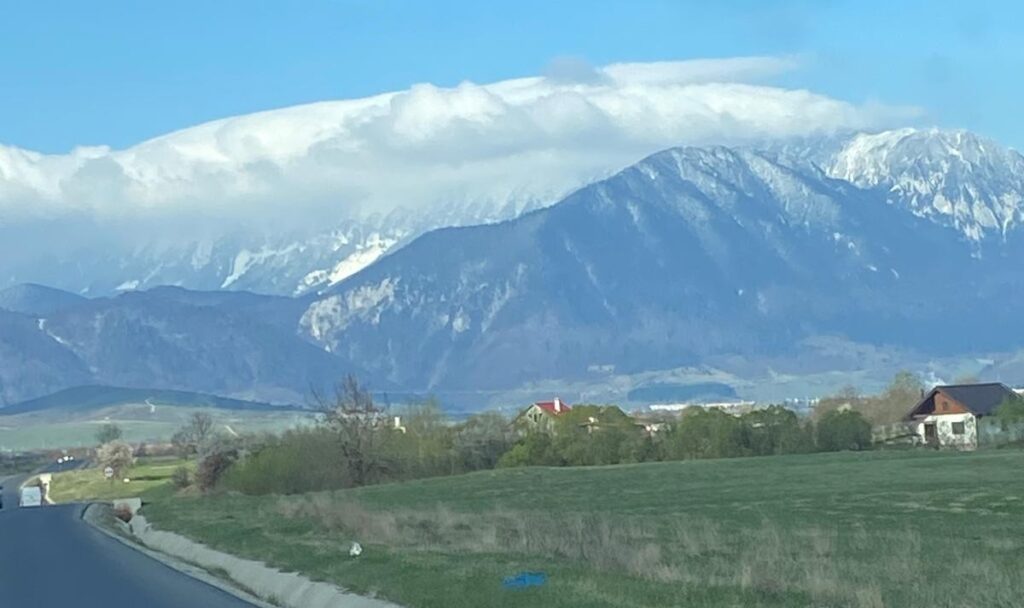
When we traveled through Transylvania, Constantine pointed out that many Romanians still observe the old custom of driving a stake through the heart of the deceased, as well as keeping the body at home for at least three days for mourning and prayers. A glass of water and a piece of bread are generally placed before the body during this period so that the spirit may partake before its journey into the afterlife. He told me he has witnessed the water in these glasses disappear slowly without being touched by human hands. Deceased relatives are sometimes buried on family property rather than in cemeteries. When we crossed the Carpathian Mountains, a mild April snow storm was in progress. He talked about the myth of the wolfmen who inhabit the forests here. What is no myth are brown bears that sometimes kill humans. When he stopped the car so he could take in a smoke he mentioned attacks by Eurasian lynx who appear suddenly from behind trees and will attack and gnaw at your ankles.
Nearly 75 percent of Romanians belong to the Romanian Orthodox Church while six percent are Protestant and four percent Roman or Greek Catholic. Along the highways and small roads Orthodox crucifix mosaic shrines are as numerous as trees. Small chapels and churches are everywhere. In a shopping mall parking lot, I noticed a very small, golden-domed chapel next to a fast food outlet. The farther north you go — at one point we were 40 minutes from the Ukraine border — the more Protestant (Lutheran) churches there are. German influence, especially Bavarian architecture, is common in towns like Brasov and Gura Humorului.
I planned my trip in December 2024 about the time Romania’s Constitutional Court cancelled the results of the presidential election in which conservative Călin Georgescu won the popular vote in the first round of voting.
Georgescu’s victory created panic among status quo pro-EU liberal politicians, causing the liberal judiciary to claim that Russia had somehow influenced the election results. The Russian interference claim was never proven, just as it was never proven — and was later disproven — when Hillary Clinton made the same claim about the 2016 election in the United States.
My Romanian guide announced that he was a Trump supporter who told me he hopes his country follows America’s lead and elects a Trump-like nationalist in the May 4 and May 18, 2025, national elections. As it turned out, he would be disappointed.
Throughout much of our journey he expounded on the current state of affairs in the country. He told me that while most Romanians dislike Russia, they have an even greater contempt for Ukraine. He called the country brutish and insensitive.
“If I were to drive us across the border into Ukraine, we wouldn’t last long. We would be ‘disappeared,’” he claimed.
Fortunately, a tour of Ukraine was not on the agenda. When we passed a car with a Ukraine license plate he remarked how Ukrainians like to escape the bleakness of their country by taking car trips into Romania’s scenic Carpathian Mountain region.
“Their country is so bleak and gray, they need Romanian beauty,” he said.
When we drove through the countryside we passed large abandoned factories built during the communist era.
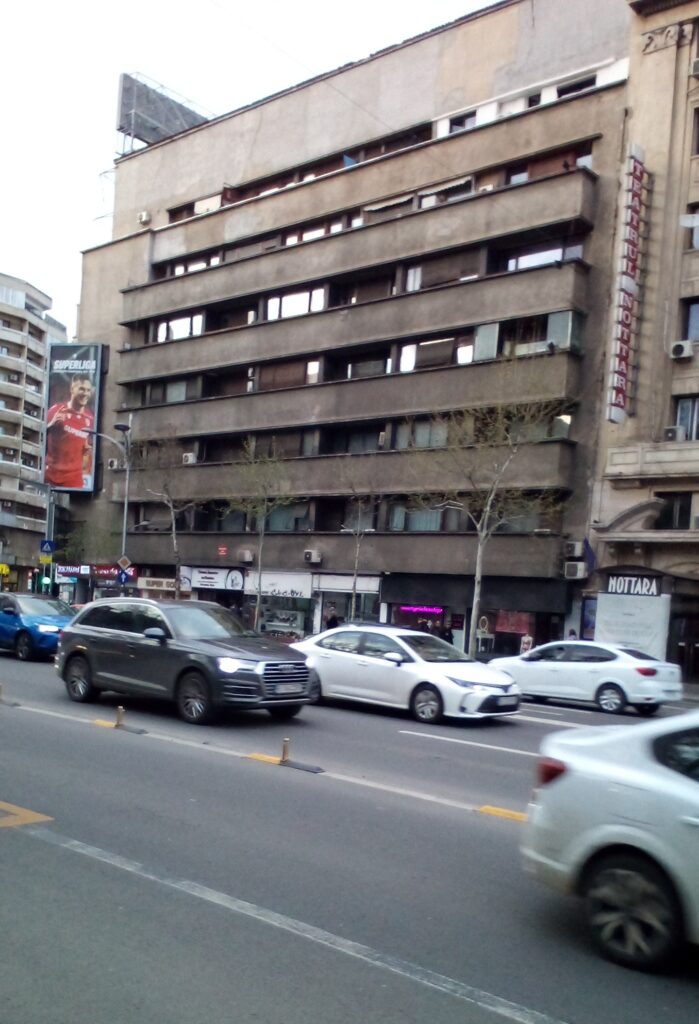
These buildings reflect the ugliness and barrenness of communism. They sit like dark monoliths in an otherwise beautiful terrain. Some of these abandoned factories are twenty stories tall with eerily small windows reminiscent of prisons. Even in Bucharest, once known as the Paris of the East, one can see many large communist buildings, some of them falling apart and rotting.
Even if one knew nothing about communist ideology and how it works, the bounty of leftover ugly communist architecture all over Romania stands as a testament as to why a country should never go communist.
Bran Castle, once owned by the Romanian royal family and cherished as a favorite family residence by Queen Marie, was robbed of most of its furniture by the Stalinist reformers who wanted to destroy all traces of royalty. A few authentic pieces of furniture managed to escape the plunder, such as Queen Marie’s breakfast table and the bed of King Ferdinand, but for the most part what visitors see are replica replacements.
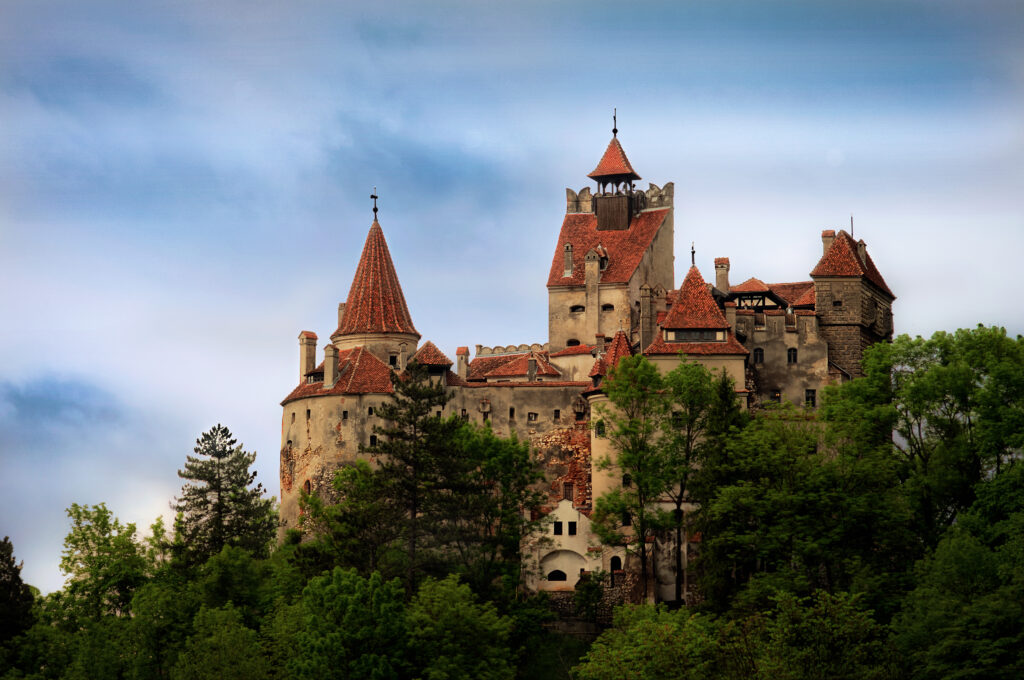
The castle is also filled with tacky Vlad Dracula paraphernalia, such as a Dracula dummy placed upside down in a coffin, installed by boardwalk commercialists in a bid to attract tourists. (For the record, Vlad Dracula never set foot in Bran Castle.)
Although Romania joined the European Union in 2007, many Romanians are now questioning that alliance. Currently, under the direction of the EU, the country is undergoing an expansive road building explosion which is causing multiple traffic detours in and out of Bucharest.
“Why the need to build new highways?” my guide asked as we drove through the Olt River Gorge. “The roads we have are fine. They just need repaving. All this construction is not necessary.” On numerous occasions we were stuck in long lines of traffic with scores of trucks, unwieldy detours that went on for miles and miles.
An even bigger issue for Romanians in the May 2025 elections is immigration.
While driving down one of Bucharest’s main thoroughfares, he pointed out Turkish and Middle Eastern immigrants hanging out in the streets in groups of five or ten. “They do nothing all day long. They gather in groups and do nothing, nothing. It gets worse all the time.”
The Middle Eastern immigrant street scene had a United Kingdom-in-the-making look.
The National Salvation Front (FSN) was the first post-communist political party established in Romania. In 1993, FSN split into two parties, the largest being the Social Democratic Party (PSD), a leftist mirror image of the Democratic Party in the United States. The current Romanian Prime Minister, Ion Marcel Ciolacu, has been the leader of the PSD since 2019, and much like his leftist cohorts in the Social Liberal Humanist Party, is likely to label anyone who challenges the EU and its policies a “right-wing extremist.”
In April 2025, Romanian polls had former PSD leftist-turned-conservative, Victor Ponta, running for president as an independent, coming in second in the first election round after conservative nationalist George Simion, who’s considered the favorite.
With two conservatives in the lead, it seemed likely that Romania would get its own Donald Trump.
Yet Romania’s top court has been quite active in barring nationalist politicians like Diana Sosoaca from this year’s and last year’s annulled presidential election. Sosoaca might be called Romania’s Marine Le Pen. Ruthless in her comments, she once said, “The EU and NATO destroy everything they touch….Europe is corrupt from the very tip.
“Serbians,” Sosoaca continued, “are the bravest people in all of Europe. Most Serbians do not wish to be part of the EU because they’ve seen what happened to Romania and to what extent Romania has been destroyed.”
Other candidates in the May 4th runoff included pro-EU Bucharest mayor Nicusor Dan, a member of the liberal USR party, and Elena Lasconi, a former journalist and the leader of the Save Romania Union Party.
The American left-wing Politico had this to say about the Romanian elections:
“The Eastern European country of 19 million people borders Ukraine and is one of NATO’s key eastern flank members, with access to the Black Sea. A victory by a far-right candidate in the presidential election threatens to bring Bucharest more in line with U.S. President Donald Trump’s MAGA movement while harming EU plans to continue aiding Ukraine in its defense against Russia’s full-scale invasion.”
That seemed to be the way things were going on May 4 when George Simion won the first round of the presidential election. George Simion came first with 40.96 percent of the vote, and went into the runoff on May 18 as the clear favourite against the liberal mayor of Bucharest.
I was hopeful this would also be the case on May 18, or Sunday Bloody Sunday, especially since Constantine never stopped talking about how most Romanians wanted change. However, Nicusor Dan, the centrist pro EU-candidate managed to squeak to victory.
EU forces celebrated Simion’s defeat — the press dubbed him the “far right Romanian MAGA candidate” — but I suspect Constantine would say Simion’s defeat carried the smells of trickery and deception we experienced in that Victory Square sneaker store.
Thom Nickels is a Philadelphia-based journalist/columnist and the 2005 recipient of the AIA Lewis Mumford Award for Architectural Journalism. He writes for City Journal, New York, and Frontpage Magazine. Thom Nickels is the author of fifteen books, including “Literary Philadelphia” and ”From Mother Divine to the Corner Swami: Religious Cults in Philadelphia.” His latest is “Death in Philadelphia: The Murder of Kimberly Ernest.” He is currently at work on “The Last Romanian Princess and Her World Legacy,” about the life of Princess Ileana of Romania.