 Photo by Raymond Clarke via Flickr
PA Senate Policy Committee discusses aggressive driving during a Northeast Philadelphia hearing
Damien Hocker was just 17 when he lost his life. He was hit by a car as he crossed McDade Boulevard in Ridley Township in April 2024.
His mother, Elizabeth Hocker, testified about the need for pedestrian safety at an April 7 state Senate Majority Policy Committee hearing on aggressive driving, held at Community College of Philadelphia Northeast Regional Center at the behest of Sen. Joe Picozzi (R-5).
Hocker, now with Families for Safe Streets Greater Philadelphia, is dedicated to preventing the deaths of other pedestrians.
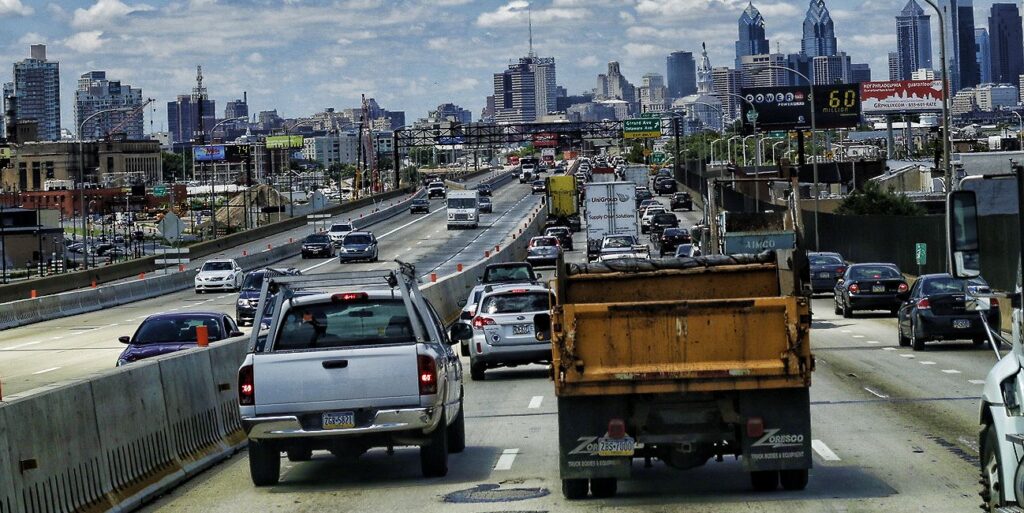
“We desperately need to expand speed cameras and red light cameras,” she said. “In recent years, there has been an increase in aggressive driving throughout our country, including running red lights and speeding. Nationally, over 11,000 people are killed annually by speeding drivers. In Philadelphia, there are over 110 traffic fatalities every year. These tragedies are not inevitable.”
“Philadelphia is preparing to welcome visitors from around the world this year for the FIFA World Cup, MLB All-Star Game, PGA Championship, and the 250th anniversary of the signing of the Declaration of Independence,” said committee Chair Sen. David Argall (R-29). “With such an influx of visitors coming to the city, Sen. Picozzi has made it a priority to ensure the safety of all — tourists and residents — who walk or drive throughout the city.”
“Across Philadelphia, aggressive driving is putting communities at risk, becoming an everyday threat to public safety,” Picozzi said. “Too many residents feel unsafe just right outside their homes.”
Police Commissioner Kevin Bethel said they’ve been curbing car “meetups” and street racing with a special enforcement unit and the use of drones.
However, since speed cameras were installed along Roosevelt Boulevard, reportable crashes have gone down from 730 in 2016 to 282 in 2025.
“We will continue to pursue data-driven approaches,” he said.
Picozzi asked what neighbors should do if they see a car meetup taking place.
“We always ask them to call 911,” Bethel said. Residents should also take pictures of what is going on.
The police have worked with car insurance companies to report teenage drivers taking part in these dangerous activities, he said.
“This behavior is well outside the scope of what an insurer would believe they are investing in,” said Bethel. “We think that’s going to be another avenue for us to get folks’ attention. Because we have cameras in our cars, we’re able to see who’s fleeing. We’re able to issue those tickets, as well.”
“We’ve been to homes where parents, particularly in the suburbs, have not realized their child was engaging in this behavior,” said Bethel. “Driving a souped-up $80,000 car, so you should know that part of it.”
Information about the meetups also spreads through social media, he said.
Deputy Police Commissioner Michael Cram said that, with people taking alternate routes to avoid Roosevelt Boulevard, Bustleton Avenue now has “speed cushions” that have slowed traffic on that street. Plus, the department has stepped up enforcement on other roads, such as Castor Avenue.
He noted that cars involved in meetups can be towed, and police may issue $2,000 tickets for reckless driving.
They have also stepped up enforcement against drivers of illegal ATVs and dirtbikes on city streets. But Philadelphia is a large area to patrol. There are 135-square miles of Philadelphia to police and 2,500 miles of roads, he said. And the Philadelphia Police have about 1,500 vacancies.
“It is a challenge,” said Cram. “We’ve taken the same focus for fighting crime to aggressive driving.”
Picozzi noted there are a lot of abandoned vehicles–even boats–on city streets. Bethel said the police collaborate with the Licenses and Inspections Department weekly to remove abandoned vehicles.
“You want safe streets. You don’t want congestion. How do you do one, without creating the other?” Argall asked.
Christopher Puchalsky, Ph.D., director of policy and strategic initiatives for the Philadelphia Office of Transportation and Infrastructure, said, “There are a lot of these safety measures that don’t have a congestion impact.” These bring down higher vehicle speeds without causing much change to the median speed.
They did a “road diet,” narrowing Chestnut Street, which slowed traffic by one or two minutes.
He said that aggressive driving, including speeding, running red lights, and randomly changing lanes, causes half of fatal crashes.
“These behaviors are particularly devastating for pedestrians,” he said. “Speeding is the number one determining factor for the severity of injuries. Philadelphia experiences more (traffic) fatalities than our peer cities,” he said. A pedestrian hit by a car going 45 mph is more likely to die, compared to someone struck by a car going 25 mph.
Richard Lazer, executive director of the Philadelphia Parking Authority, said since the cameras were installed on Roosevelt Boulevard, speeding has dropped by 95 percent. Crashes have also decreased from 500 in 2019 to 216 in 2024.
Linda Stein is an award-winning journalist who’s written for newspapers in Pennsylvania, New Jersey, and Arizona. Before joining Fideri News Network, she was the news editor for Delaware Valley Journal. She holds a master’s degree in journalism from Temple University and earned her undergraduate degree from Arcadia University. Contact her at lstein@fiderinews.com.