
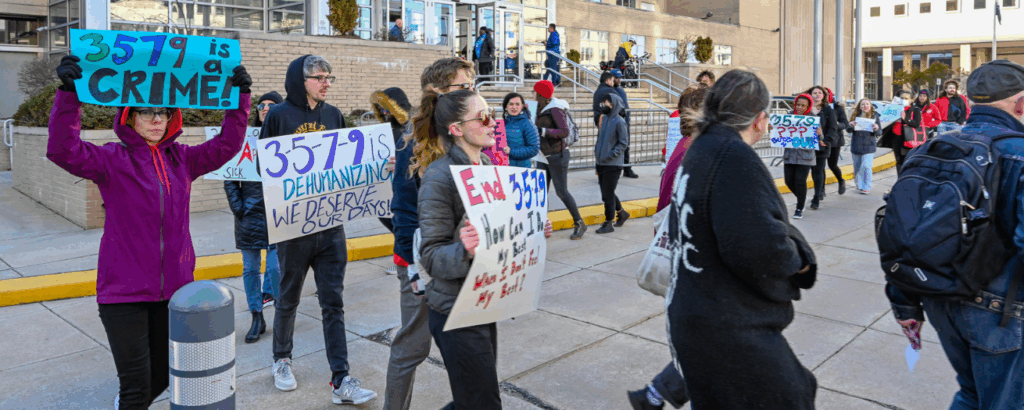
 Photo by Joe Piette via Flickr (https://www.flickr.com/photos/109799466@N06/53560873070)
John Coyne: The teachers challenging their unions’ political agenda in court
A decade apart in neighboring states, two teachers came to the same unsettling realization about their unions by opening their mail.
In 2014, Mary Trometter was stunned when her husband received a union-funded political mailer urging him to “please join Mary in voting for” a candidate for Pennsylvania governor that she didn’t support.
In 2025, campaign mailers began piling up at Ann Marie Pocklembo’s door to back her union president’s long-shot run in New Jersey’s gubernatorial primary.
The teachers’ realization? Union officials were using their members’ dues to advance a political agenda without their knowledge or consent.
Between these two events, the Covid pandemic gave the country a crash course in teachers’ unions’ political influence. Amid school shutdowns and reopening fights, teachers’ union officials collaborated with the Biden administration on its school reopening plan and recommended automatic school shutdown triggers, according to a U.S. House committee report. As Broad + Liberty recently highlighted, the academic and social effects of these closures are still visible years later.
Years Before Covid, Teachers Pushed Back
But long before Covid, teachers represented by the Fairness Center, a nonprofit law firm where I work, were already pushing back when teachers’ unions abused their power.
Williamsport culinary arts professor Mary Trometter was a member of the National Education Association (NEA) and its state affiliate, the Pennsylvania State Education Association (PSEA), when the unions used their members’ money to influence the 2014 elections. Trometter’s own dues funded the letter that invoked her name to falsely suggest she supported Democratic candidate Tom Wolf for governor.
PSEA officials later admitted that they had sent thousands of similar letters using teachers’ names to persuade their family members in the election. Represented by the Fairness Center, Trometter took legal action against the PSEA and NEA, and the Commonwealth Court ruled that the state labor board had to enforce a political spending law it had ignored for 45 years.
Because Trometter pushed back, the teachers’ union quickly apologized for the letters and pledged to stop misusing its members’ names in that way for political advocacy.
Ghost Teachers, Real Costs
Wolf won that gubernatorial election and later appointed PSEA President Jerry Oleksiak as his labor secretary. Oleksiak himself embodied another way teachers’ unions advanced their agenda in schools — through “ghost teachers.”
Typically in urban school districts, teachers’ unions arranged for certain teachers to leave the classroom and work full-time for the union. The problem? These ghost teachers stayed on district payroll, receiving a taxpayer-backed teachers’ salary, pension, and health benefits. Oleksiak, a former special education teacher, was a ghost teacher for ten years leading up to his appointment by Wolf.
But beginning in 2015, multiple legal challenges brought by clients of the Fairness Center exposed the full cost of illegal ghost teaching in Allentown, Reading, and other large districts.
Union President Puts Political Ambitions Above Members’ Interests
In the years before Covid put teachers’ unions at the center of national debates over school shutdowns, many teachers had already learned that accountability may not happen without a lawsuit. Even after the pandemic shined a light on teachers’ unions’ influence, that’s still true today.
Consider what’s happening right now in New Jersey. Pocklembo, a high school music teacher near Trenton, believed that contributing to the New Jersey Education Association’s (NJEA) political action committees was voluntary because that’s what the union told her.
Pocklembo learned otherwise during the 2025 campaign cycle, when she began receiving campaign materials promoting the union-backed candidate for governor, the NJEA’s own president, Sean Spiller.
She later discovered the NJEA had sent more than $40 million of teachers’ mandatory dues to a super PAC backing Spiller’s candidacy. Represented by the Fairness Center, Pocklembo is now suing Spiller and the NJEA. She alleges that the union violated her membership contract — which made it appear that PAC donations were optional — and breached its fiduciary duty to put members’ interests first.
Teachers’ Dues, Union Officials’ Agenda
Nationally, unions spend money on politics on a massive scale. A recent Commonwealth Foundation analysis found that four of the country’s largest public-sector unions spent $755 million on federal elections and political causes in 2023–24, mostly from dues, compared with $642 million on representing members.
While these examples of union political spending may or may not be legal, such spending is often obscured or at odds with what members are told. Many teachers think opting out of PAC contributions keeps their money out of politics. Cases like Pocklembo’s suggest their dues may just flow into union PACs through a different door.
Teachers don’t just see their union’s political agenda in their mail. They also see it at work.
In Connecticut, veteran Hartford teacher John Grande faced discipline from the school district and was threatened with firing after he criticized a union-approved, DEI-style racial and gender “Identity and Privilege” training. Grande filed a grievance against the district, but the Hartford Federation of Teachers refused to take his case to arbitration because he was not a dues-paying union member.
Represented by the Fairness Center, Grande challenged the union and won an unfair labor practice ruling that said the union engaged in “intentional discrimination” and affirmed that Connecticut law requires unions to treat fairly every employee they represent — union member or not.
In California, history teacher Isaac Newman’s union barred him from running for a seat on the union’s executive board because it had reserved the position for racial minority candidates, and he was white.
With the Fairness Center’s help, Newman sued the Elk Grove Education Association in 2024 under Title VII of the Civil Rights Act, arguing his union had discriminated against him based on race. Within months, the union ended the race-restricted seat, agreed not to discriminate based on race in other positions, and paid damages and attorneys’ fees.
From the workplace to the ballot box, union officials’ priorities can collide with the rights of the teachers they represent. A decade apart, Mary Trometter and Ann Marie Pocklembo learned that they were paying for someone else’s political agenda and decided to stand up for their rights and beliefs. The examples in between them tell the same story: accountability for union officials may come only when a teacher is willing to go to court.
John M. Coyne serves as the Senior Director of Strategic Partnerships at the Fairness Center. Contact him at jmcoyne@fairnesscenter.org to learn more.

Great topic.