
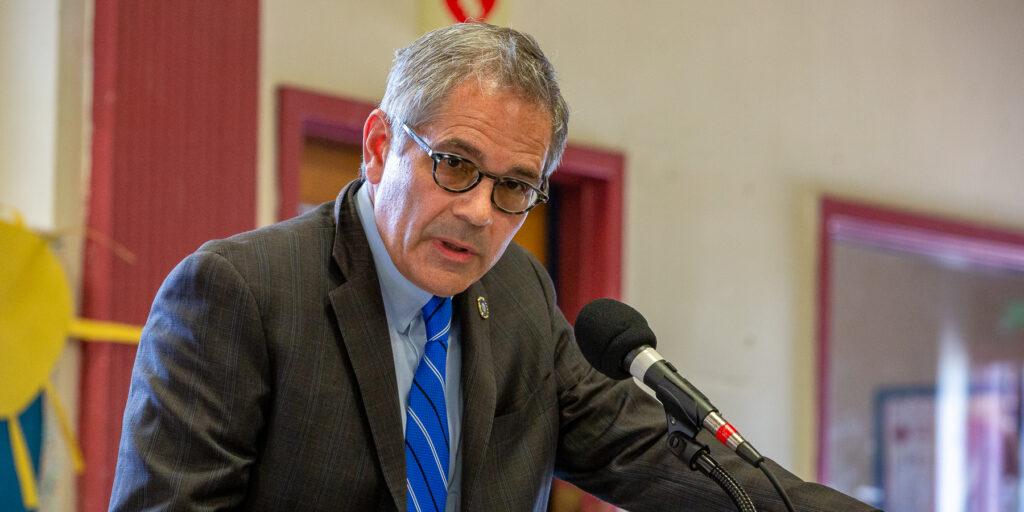
 Photo by Jared Piper | PHL Council
From the Editors: A prosecutor’s main job is to put criminals in jail, not to let them out
Philadelphia has experienced a remarkable decline in murders over the past few years, one that looks to be continuing into 2026. There’s much there to celebrate, but we should assign credit where it is due – which is not the District Attorney’s office.
We come to criticize Larry Krasner, not to praise him.
Krasner’s purposes in office seem to be running against the goals of keeping Philadelphians safe by putting criminals in jail. Nowhere is this more true than in the District Attorney’s focus on exonerations through his Conviction Integrity Unit (CIU).
Since Krasner took office in 2018, about 50 people have been exonerated in Philadelphia, many after having spent many long years in prison. To the extent these people were actually innocent, this is undeniably good, though the details of each case can lead reasonable people to disagree about the justice of this case or that.
The vast majority of these exonerations involve vacating old convictions based on recanted witness testimony, coerced confessions, Brady violations, or unreliable eyewitness identifications. But it is noteworthy that they have not involved identifying and prosecuting the actual perpetrator of those crimes.
The District Attorney’s Office’s own press release on the Keith Graves exoneration states that “in all matters where an innocent person is exonerated, the CIU and the DAO evaluate whether the true perpetrator can be identified and prosecuted.” The language is merely aspirational — it would be nice, but it’s not the main goal of the program.
It is not bad that the DA’s office wants to get innocent people out of jail; that’s traditionally the job of defense attorneys, but being willing to help in clear-cut cases of false conviction shows integrity. However, the main job of the DA and his employees is to prosecute. Yet their search for the real killers in these old cases seems about as thorough as O.J. Simpson’s was.
Look at some of the exonerations:
In one 1996 murder case, John Miller was convicted and then exonerated. Key witness David Williams later confessed multiple times to being the real shooter and even apologized to Miller’s mother. There is no indication Williams was prosecuted.
When Keith Graves was exonerated in 2024, post-conviction information pointed to James Lewis as the real perpetrator. There is no public record of Lewis being charged.
The list goes on.
Because Krasner’s exonerations are usually based on alleged police or prosecutorial misconduct, rather than on new evidence, they cause more than their share of controversy. In Krasner’s very first exoneration, Judge Anne Marie Coyle found the office unfairly accused the two original prosecutors of misconduct, called the accusations “maliciously intended,” and fined his office $120,000 for bad-faith obstruction. Krasner’s own former chief of homicide, Anthony Voci, admitted he didn’t believe the original prosecutor committed egregious misconduct — despite signing off on that claim in court documents.
It also smacks of a political agenda taking precedence over the normal legal process. As one of Krasner’s predecessors, Seth Williams, wrote in these pages back in 2022, the work of prosecutors “should not be sullied as an excuse to release a prisoner in order to fulfill some ideological agenda.” By working so diligently for the opposite side of the case, Krasner and his office risk short-circuiting the adversarial system on which the American justice system depends.
It all adds up to a lot of problems balanced against a few good outcomes. The public record suggests Krasner’s CIU has been very effective at vacating convictions but there’s remarkably little evidence of the office actually solving the underlying crimes. If the exonerated people didn’t do it, who did? If only there were some public officials charged with finding that out.

Broad and Liberty somehow forgot police exist. Or did Larry get rid of them too? Maybe the editors need to rewatch the opening of Law and Order a few times.
AB,
Excellent comment. Started to write similar stuff, and decided to not even engage it. Then you nailed it with your comment. Bravo.
What the heck has happened to these Editors? And what’s up with these ridiculous ads for usury?
US military budget 2025.. $886 bajillion.
Lockheed Martin revenue 2025… $71 Billion.
Raytheon revenue 2025… $42 Billion.
These companies don’t make money when there is peace. They make money when there is war. They fund the politicians who vote for war. The companies get contracts. The companies fund the next election. These wars continue. Iran tried to make it too expensive for the US to stay in the region. Houthi drones $2K each. Resuylt: global shipping rerouted. Every cargo ship tales two extra weeks to go around Cape of Good Hope at a cost of $1mm. Iran spent millions (of the billions of US taxpayer money Obama gave them) and then we lost another trillion(s)? These old folk need to get tossed. Larry Krasner for President?