
Patricia Rooney: Pennsylvania Republicans should pass redistricting reform while they still can
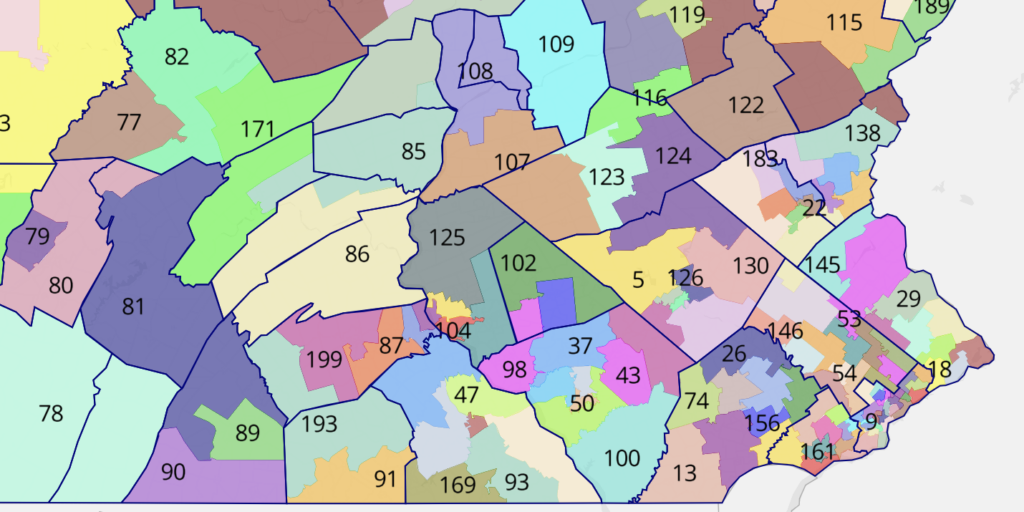
Pennsylvania’s Republican state legislators have waited until the last moment to consider two bills which would create an independent redistricting commission before the next state and congressional redistricting in 2031, bills they would be prudent to pass. House Bill 31 and Senate Bill 131 propose a constitutional amendment to allow an eleven-member commission composed of Republicans, Democrats and unaffiliated voters, none of whom have a personal stake in outcomes, to decide voting district lines.
Legislators in Pennsylvania could adopt three election reforms to lessen hyperpartisanship and steer the ship of governance for the moderate majority and pick up some independent votes. Redistricting reform, open primaries and getting money out of politics would be among the most effective reforms we could make right now. Instead, Republican legislators in Harrisburg seem unaware that if the vote goes against them in 2026 and 2028, there aren’t sufficient guardrails in law to prevent an enduring partisan gerrymander after the 2031 redistricting that could keep them out of power for a decade or more.
Similar redistricting reform bills have been proposed in the General Assembly for a decade. None of the earlier bills were as complete as HB 31 and SB 131 are now, so the delay in support may have actually improved the safeguards and tightened the language. But now we are bumping up against the deadline for passing a constitutional amendment before the next redistricting cycle.
The bills must leave the State Government committees and pass in both chambers this session, essentially before midsummer when the General Assembly goes on recess. The bills must remain unamended and pass again in the 2027-28 session before going to voters in a statewide referendum before the census.
The difficulty of getting redistricting reform passed in Pennsylvania means the decision-making around mapping can’t be overturned as easily as it was in California last year. California’s map changes are temporary changes decided by voters and their independent citizens commission will draw their maps again in 2031.
Not so easy in Pennsylvania, our country’s fifth most populous state whose constitution was, 250 years ago, a beacon of democracy and a model for other states. Now in Pennsylvania the political class is closely divided between the two major parties and has trouble accomplishing anything worthwhile while legislators on both sides are being primaried from the fringe. The ratio of bills passed to bills introduced in Pennsylvania is among the nation’s lowest, only four percent last year, as reported by FiscalNote.
So, why are independent redistricting commissions now considered the gold standard for legislative and congressional mapping? Gerrymandering can dramatically alter the partisan makeup of the legislature which, in turn, has an outsized effect on policy. Independent commissions have guardrails which constrain partisan actors; they can provide the balance necessary for a deliberative process protected from undue partisan influence. Republicans should be looking to institute the least partisan practice before the decade is out. While mapping voting districts can be seen as an inherently partisan practice, it is possible to reduce, and in fact eliminate, the influence of legislators deciding their own districts, and therefore “picking their voters.”
The bills now before the General Assembly would create transparency in the selection of commissioners and the hiring of staff. There would be concerted statewide community outreach to allow for regional diversity among commissioners, training for commissioners and staff, public access to records and data, a website and well-publicized opportunities for the public and legislators alike to engage with the process, make comments or suggestions, even to submit recommended maps. There are required voting thresholds within the commission before passage of significant decisions, requiring support from both partisan and unaffiliated commissioners. And finally, there is an elimination-vote failsafe if the commission is deadlocked that does not throw any decision to the courts. Crucially, clear, prioritized and measurable standards promote equitable representation across counties and municipalities with strict limits on deviation in population as well as compactness, contiguity and attention to geographic boundaries.
An independent commission is not a hard sell to Pennsylvania voters, two thirds of whom have indicated their support in polling conducted by Franklin & Marshall shortly before the 2021 redistricting. Many Democrats in the House and Senate have listened to constituents on this issue and have cosponsored these bills. Not, however, the House Majority Leader, Representative Matt Bradford. Before the 2021 redistricting, Rep. Bradford supported an independent commission but now he apparently looks forward to controlling the mapping process if Democrats attain a majority in both houses in 2026 and 2028.
It would behoove Pennsylvania Republicans to consider supporting redistricting reform before July this year so they don’t miss their opportunity to pass this legislation in the next session and possibly forestall a long-term shut-out going forward a decade or more.
Patricia Rooney is a Republican living in Lancaster and is Lancaster Coordinator for Fair Districts PA



Our state senators and representatives need to tell each of us why they will NOT vote or allow votes on independent redistricting in the fact of multiple polls showing 2/3rds support for it statewide and over 80% nationally. What is maddening for FDPA volunteers is hearing politicians mutter behind the scenes that they have some issues with the proposed bills. In a functioning democracy, the legislature would hold public hearings on the measures, bring in expert witnesses from both sides, get answers to their questions and then vote. Instead they tell us they have concerns behind the scenes, but NEVER get to final floor votes in either chamber and in most cases over the past decade NEVER holding any hearings or committee votes on the bills. This is NOT how democracy is supposed to work and the results are clear: underfunded schools and infrastructure, declining rural populations, a failure to increase the minimum wage while every state around us has already done so, loss of access to health care and elder care facilities, failures to address the crisis in Fire and EMS services, and a legislature so increasingly hyper-partisan that some legislators state publicly that they will NEVER vote for any bills proposed by the other party.
Enough is enough…hold hearings, vote in committees and in both chambers and pass HB 31 and SB 131. Doing so will send the measures to a statewide public referendum and (horrors) let the people decide. So legislators…tell us again why this is a bad idea when you constantly tout the idea of letting the voters decide.
In point of fact there is NO WAY for the voters to decide in PA if an issue is opposed by a handful of powerful legislative leaders who control the entire legislative agenda. We have no petition and referendum to force bills to a vote, discharge petitions have been tried for years and over the past decade, 45 of them failed.
Our Constitution says the people have the inalienable right to alter and reform their government. HOW under these circumstances.
If you care about fair redistricting and realize its importance to a functioning democracy, contact your legislators and tell them to support these bills. It’s the only way things will change. NOT a time to sit on the sidelines.d
Right on, Ms. Rooney!
Unfortunately, we’re used to legislators being blind to the public interest, ethics, and the needs of their own voters. Now, it seems, they’re even blind to their own partisan interests. If Republicans lose big in the coming elections and then get gerrymandered to death, they will have only themselves to blame.
Redistricting reform seems crucial right now. What specific changes do you think would make the biggest difference in Pennsylvania?
And if a legal challenge gets to the PA Supreme Court?
Fair districts pushed for gerrymandering reform 10+ years ago. Republicans publicly acknowledged districts had gotten out of control, but the state constitution gives the map to the legislature to decide and how to navigate new restrictions would be difficult. Despite fair districts representatives saying they were focused on PA because they trusted democrats to gerrymander- a real statement in meetings-, Republicans still worked with them. Then Dems took the state court and violated the constitution and precedent by creating a farce nonpartisan redistricting process that gave dems the upper hand. House Rs refused to negotiate and senate Rs did. Maybe Senate Rs are hesitant because Dems will cheat and lie to win and opening up legislation will be another opportunity for dems to exploit the well intentioned and misguided.
Yeah. HB 31 sucks. Dems will stack that high and we will see additional candidates because we need trans representatives and pedophile representatives. Give me a break. Its tough to argue when its simply majority/minority/independent beyond get ready for the governor and dems to collude on picking people for their corner, but when you put in “gender diversity” and “ethnic diversity” go pound sand. Ill be telling my legislators to avoid this scam. And stop calling yourself a Republican when you’re just trying to help the left.
Bahahaha— your non partisan org is still openly stating youre funded by ben and Jerry’s grant and associated with the LEAGUE OF WOMEN VOTERS! How does anyone actually think the 2 affiliations are non partisan? What a joke.
What
A
Joke
Senator Mastriano, Thanks for checking our website! As you noted, our “About” page says that we are primarily funded by individual donors, and acknowledges “The only significant out-of- state funding FDPA has received was a $25,000 grant in 2019 from the Ben and Jerry’s Employee Foundation.” That foundation grant is one of the few we’ve seen that funds “small, constituent-led grassroots organizations.”
That About page also notes that we are legally a fiscal project of the League of Women Voters of Pennsylvania. The League has been involved in civic education, voter registration and grass-roots advocacy for over a century. League positions are arrived at through a lengthy process of study, discussion and consensus, without respect to partisan priority. National positions are determined by leagues across the nation. PA positions are decided by leagues across PA. It’s an honor to be part of an organization that assesses questions respectfully, respects differences of opinion, and believes all votes should count and all voices should be heard. Those same values are foundational to our work on redistricting reform. House Bill 31 and Senate Bill 131 incorporate ideas from PA legislators in both parties across the past 40 years, and include feedback from Republican and Democratic allies and advisors in PA and other states. Gerrymandering is wrong no matter who does it, and our goal is to protect all of us, voters and legislators alike, from deviously manipulated maps.
You made quite a few of accusations in your comments. It would take a lengthy conversation to address them all. For any readers interested, the bills are explained in detail at https://www.fairdistrictspa.com/updates/introducing-house-bill-31-and-senate-bill-131 and our assessment of current PA maps is available at https://www.fairdistrictspa.com/updates/pas-maps-for-the-next-decade
As for the insistence that the PA legislature draws the maps: it does not. Five people draw the PA House and Senate map. They can, and do, use district lines to punish colleagues who offend them or step out of line. I’m curious that you would choose to support that.
Independent Commissions are a joke. New Jersey has a heavily gerrymandered Congressional map despite its commission, as did California BEFORE the recent redistricting. All Independent Commissions do is remove accountability from the people doing redistricting. They gerrymander just as much as legislative committees and they do so in the dark.
And it remains a joke that Fair Districts praised the current state house map despite that map delivering a Democratic seat majority twice in a row despite Democrats receiving hundreds of thousands fewer votes in house elections. One begin to suspect that delivering unelected Democratic majorities is the point.
Thanks for comments by Mr. Mastriano and others . . .
1. IRS thinks LWV and FDPA are non-partisan. I’m registered R, and I volunteer for FDPA – I do, too.
2. 31 House seats were won in 2024 by Rs running unopposed. 12 House seats were won in 2024 by Ds running unopposed. Doing the math, that accounts for the difference in “statewide popular vote,” IMHO. (2,258,892 D vs 2,638,894 R).
3. Per Wikipedia, 16 House races were “close” (< 10% margin); 3 were “flipped” by Ds and 2 were “flipped” by R’s
4. Other statewide races in 2024 were:
• President: 50.3 % R vs 48.6% D
• U.S. Senator: 48.8% R vs 48.6% D
• U.S. House: 3.48 million R vs 3.33 million D (10 Rs and 7 Ds elected)
• A.G.: 50.8 % R vs 46.2 % D
5. Conclusion: ”delivering a Democratic seat majority twice in a row despite Democrats receiving hundreds of thousands fewer votes in house elections” is factually correct (see 2., above). But the analysis of reasons and context is a little more complicated, as per 2., 3., and 4.
6. Presidents Reagan and Bush opposed gerrymandering. American Bar Assoc opposes it. Many other thoughtful leaders do, too – they’re no “joke.”
7. Correction: “state constitution gives the map to the legislature to decide” is correct of U.S. Congresspersons, but state House and Senate maps are drawn by just 4 caucus leaders – in that regard the U.S. is an outlier among world democracies allowing politicians to draw their own districts, and PA is an outlier-among-outliers in allowing so few politicians (4) to do so! Too much power concentrated into too few hands.
Please re-read H.B. 31/S.B. 131 – you might be surprised how it is “balanced” (not hiding partisan bias, but disclosing it), transparent (no ex-parte back-room dealing), and “accountable” to comply with a prioritized hierarchy of measurable criteria.
I have read it. It leads to partisan imbalances. The fact you are trying to encourage someone to read it when you apparently haven’t yourself is silly. As soon as DEI is pushed in a bill you should be well aware of where its coming from. Youre obtuse.