
Ben Mannes: Bilal makes Philadelphia law enforcement a global laughingstock
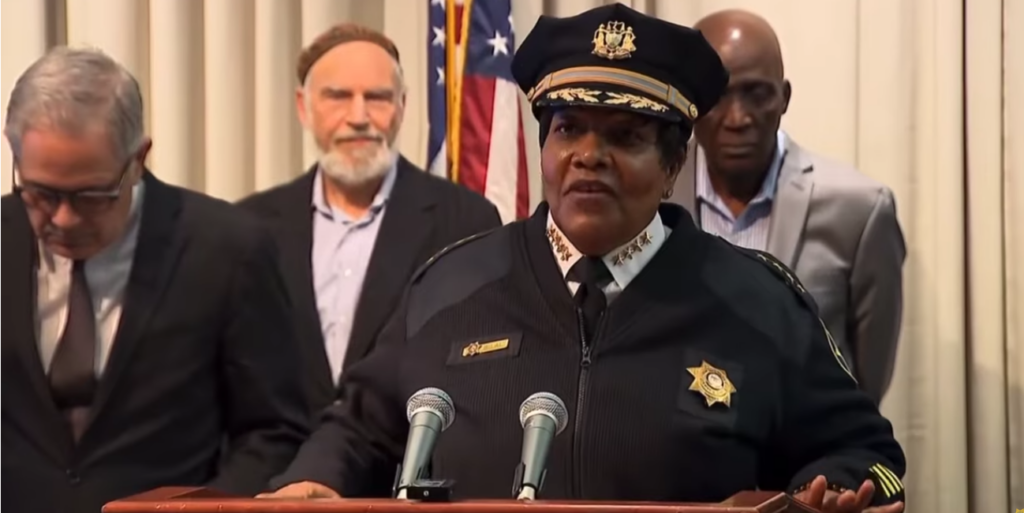
Philadelphia Sheriff Rochelle Bilal is facing intensifying backlash after an unprofessional recruitment video featuring her office’s costly mascot, “Deputy Sheriff Justice,” went viral for all the wrong reasons.
The incident compounds criticism sparked by her recent remarks labeling federal Immigration and Customs Enforcement agents “made-up, fake, wannabe law enforcement.”
The recruitment video, circulated widely on social media and in private law-enforcement forums, shows a group of female sheriff’s deputies dancing alongside the costumed mascot, Deputy Sheriff Justice, in public spaces, including near City Hall, in a lighthearted choreography meant to promote careers in the Sheriff’s Office. Viewers have mocked the tone and imagery of the ad, with posts in police and corrections groups attaching captions such as “please tell me this isn’t real” as the clip spread far beyond Philadelphia. Separate print and transit ads that surfaced at the same time feature stern‑slogan recruitment messaging paired with photos of deputies who appear older or physically out of shape, further fueling questions inside the law‑enforcement community about the office’s standards and public image.
The viral backlash came on the heels of Bilal’s appearance alongside District Attorney Larry Krasner at a press conference where she described ICE agents as “made-up, fake, wannabe law enforcement” and warned, “You don’t want this smoke,” comments that drew national attention and prompted a torrent of calls and emails into Philadelphia police headquarters.
Within a day, Police Commissioner Kevin Bethel issued a written statement clarifying that the Sheriff’s Office is a separate agency, emphasizing that Bilal’s deputies are not responsible for policing Philadelphia’s streets or investigating crimes, and stressing that her remarks did not represent the views or authority of the Police Department.
Bethel’s distancing underscored the relatively narrow role of the Sheriff’s Office, which primarily handles court security, prisoner transport and court‑ordered property sales, and has long been criticized for mismanagement and weak internal controls. This narrow authority isn’t all based on statute, as the Sheriffs can do more to handle prisoner processing for the police, enforce foreclosures, serve writs, subpoenas, and warrants, and enforce tax delinquencies in Pennsylvania, but as Bilal is the fourth scandal-ridden Sheriff in a row to head the agency, this constitutionally protected office serving the Commonwealth’s largest city is among the state’s least productive.
Bilal’s dismissal of ICE’s legitimacy has in turn invited renewed scrutiny of the federal agency’s lineage and standards: ICE traces its authority through the federal immigration and customs enforcement structure, which evolved from the U.S. Customs Service established in 1789, and its special agents attend residential basic training at federal law enforcement training centers overseen by the Department of Homeland Security and the Office of Personnel Management. ICE agents undergo national‑level background investigations and standardized training curricula comparable to those of other federal agencies that share core facilities, even as specialized entities like the FBI and DEA maintain separate academies.
In contrast, most Philadelphia sheriff’s deputies are subject to a local-only background check and sent to Penn State for a four-and-a-half-month training academy. Critics of Bilal’s comments note that this framework gives ICE a more clearly defined national mandate and oversight structure through an established Inspector General than a sheriff’s office whose authority is rooted in local statute and has been dogged by fiscal and operational scandals.
Long‑running questions about management and money
Bilal’s tenure has unfolded against a backdrop of decades of controversy in the office she leads; watchdogs have documented a pattern of poor financial controls, political patronage, and repeated investigations dating back to her predecessors. A 2023 analysis cited by the Committee of 70 found that the Sheriff’s Office had failed to complete firearm relinquishments in the vast majority of protection‑from‑abuse cases referred to it, sparking an investigation into whether the office stole the weapons, while also routing auction‑fee revenue into budgetary accounts outside normal city oversight and spending that money on DJs, catering, trading cards featuring Bilal, and over $9,000 dollars for the Deputy Sheriff Justice mascot costume. Reform groups and city officials have also criticized the office for circumventing Philadelphia’s standard procurement rules in awarding a no‑bid online auction contract that the Law Department later concluded cost the city and school district tens of millions of dollars in lost revenue.
Transparency advocates point to this backdrop in calling for deeper probes by federal and state authorities, noting that FBI scrutiny of the Sheriff’s Office has recurred over multiple administrations even when it has not produced criminal charges. Under Bilal, the office has also drawn attention for operational lapses: a 2023 report by the City Controller found that nearly 200 firearms in the Sheriff’s inventory could not be accounted for, and public reporting has detailed instances of guns lost or stolen from property rooms, reinforcing concerns about internal controls in an agency charged with safeguarding court facilities and prisoners. One such weapon was apparently stolen and illegally sold by a corrupt Sheriff’s Deputy, and was used to commit a deadly Roxborough school shooting in 2022.
Legacy of scandal and political protection
The current debate resulting from Bilal’s threats against ICE is shaped by the office’s history of corruption scandals, including the conviction of former Sheriff John Green on federal charges tied to a pay‑to‑play scheme involving a political ally, a case that helped crystallize a reform push just before Bilal took office. Commentators note that Bilal aligned herself early with the old guard by hosting a fundraiser supporting Green after his conviction, even as civic groups were calling for structural changes or abolition of the elected sheriff position entirely.
Bilal, a former Philadelphia police officer, was forced out of the department years before winning elected office amid a scandal where she was apparently working as the Director of Public Safety in Delaware County’s Colwyn Borough while simultaneously working at the same time with the Philadelphia Police Department. She also lost the Colwyn job amid theft charges raised by Colwyn Police Officers.
Many attribute Bilal’s political rise and her ability to avoid charges in part through leadership of the Guardian Civic League, an organization representing black law‑enforcement officers, which has frequently argued that systemic racism persists in local policing. That advocacy has resonated with some constituents, but critics argue it is not only a conflict of interest for her in her current role, has also helped insulate her politically even as Philadelphia’s Police Department has become one of the nation’s more racially diverse big‑city forces and recently elected a black officer to head the Fraternal Order of Police Lodge 5, the city’s primary police union. Reform‑minded Democrats and Republicans alike have struggled to recruit a well‑funded challenger with a strong law‑enforcement résumé for the next sheriff’s race, amid a broader culture in which party leaders have historically tolerated entrenched courthouse officeholders as long as scandals remain contained.
With Bilal’s recruitment video now circulating globally among law‑enforcement circles alongside her “fake law enforcement” comments about ICE, questions are mounting over whether federal or state prosecutors will move beyond audits and letters to pursue charges related to alleged waste, fraud, or mismanagement in the Sheriff’s Office.
Just as pointed are questions for Philadelphia’s political establishment: why party power brokers and city leaders have allowed one of its most controversial elected law‑enforcement officials to remain in place, even as critics say her stewardship has turned an obscure courthouse agency into a recurring embarrassment on a national stage.
Based in Philadelphia, A. Benjamin Mannes is a consultant and subject matter expert in security and criminal justice reform based on his own experiences on both sides of the criminal justice system. He is a corporate compliance executive who has served as a federal and municipal law enforcement officer, and as the former Director, Office of Investigations with the American Board of Internal Medicine. @PublicSafetySME

She must have some high grade dirt on her ‘fellow’ politicians.
It is no long necessary to have “the photo negatives” just have as your political allies, spineless politicians whose views are coloured by what “woke” screed it is necessary to support in order to remain in political favor and keep political support.
Philadelphia citizens elected her. They do not care. Its not blackmail. Its apathy and loyalty to the democratic party. Everyone has known this about the “Sheriff”, but they vote anyway because “Donald Trump is, derrrrrr, felon. Derrrrrr”. Theyve never cared about who was stealing if they framed it as some stupid underdog story. This stain on our society is a reflection of the voters as they scream about ICE while someone steals from them over and over in front of their faces. Democrats lack integrity and self respect.
I agree the bottom line is that the voters are responsible for her being the sheriff. Over the years I have hear many “voters’ remorse” stories, to which I reply, “didn’t you read who the candidate was” and get a counter reply, “I always vote a straight party ticket.” As long as voters are disengaged and apathetic, they will always get venal, self-centered, ideological despots in office. Treating politics s some king of board game like Uncle Wiggley guarantees terrible officeholders. In the 18th century, Voltaire supposedly stated that “Lotteries are a tax on the stupid,” I think we could use the same sentiment only substituting “Politicians” for “Lotteries.”
Public records and reporting show that a trust tied to Jeffrey Epstein’s Arizona Zorro Ranch collected a multidecade Powerball payout, whose lump-sum value was reported around $85 million and whose payout to the Zorro Trust—the legal entity tied to Epstein’s Zorro Ranch—was about $29.3 million after taxes, back in 2008. So… please do not peddle any conspiracies about the lottery being a tax on the stupid. Because, rest assured, official Fact Checkers have been keen to stress there is a very important legal distinction: the lottery documents list the Zorro Trust (and a trustee or financial planning firm) as the recipient of the $29.3 million rather than naming Jeffrey Epstein as the claimant. Please don’t imply that the lottery is anything but honest, nor least of all… a “tax on the stupid.”
And why are we so focused on the Sheriff in Philadelphia? The word sheriff literally starts with “she.” So let her “cook” (as the kids like to say.) Remember Attorney General Pam Bondi’s advice and remained focused on the DOW.
“Do not cite the Epstein lore to me, Goyim; I was on 4chan when it was written.”
There is some beef in that stall.