
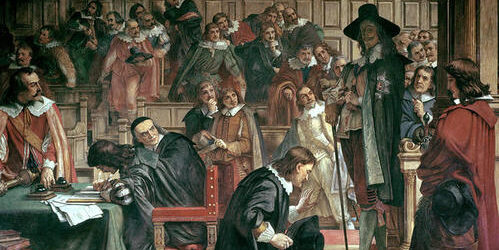
 Attempted Arrest of the Five Members by Charles West Cope
From the Editors: Separation of powers keeps us free
In 1642, King Charles I marched into the House of Commons determined to personally arrest five members of Parliament.
Accompanied by four hundred armed guards, the King demanded the surrender of five parliamentarians who had led the way in steadily decreasing royal power and — Charles believed — had committed treason by conspiring with the army of Scottish Puritans who had rebelled against the crown years earlier. Charles was unsuccessful — the members had fled the house just minutes before his arrival. “My birds have flown,” he said.
But the damage was done. The crown and parliament were at war within months, a civil war that would last seven years and end with the king’s execution.
We in the United States are blessed with a written constitution that provides courts of law for the settlement of disputes and a strict separation of powers that is, itself, a way we guarantee our liberties. Much of what the Founding Fathers put into that original Constitution was put there because of the abuses of kings like Charles I. Many of the protections in the Bill of Rights have the same origin. The Constitution was a new thing, but the Founders were deeply influenced by the history of their mother country.
With that in mind, we hardly need to imagine what they would think if they were alive today to witness the Trump administration’s attempt to prosecute six members of Congress because of a video they made reminding active duty soldiers to follow the law. Was the video inflammatory? Certainly. Was it sedition, as the President alleged? Did it interfere with the “loyalty, morale, or good order and discipline of the armed forces,” as the prosecutors claimed?
A grand jury this week held that it did not, and refused to indict the six members.
This is a sensible pushback to a gross violation of the separation of powers. Even before the First Amendment was ratified, the Constitution’s Speech and Debate clause enshrined the idea that legislators should not be punished for disagreement with the executive. Article I’s Speech and Debate Clause does not confer on members of Congress an unlimited immunity from arrest — far from it — but it shows that the Founding Fathers had learned from the abuses of the Stuart dynasty and wanted to make sure it never happened again.
Yes, both sides have abused the separation of powers — witness the Biden administration’s “Arctic Frost” investigation, which had the FBI doing surveillance on multiple Republican members of Congress. But Trump’s attempt to jail members of Congress pushes this dysfunction even further.
Conservatives have generally been more interested in the separation of powers than progressives, who see it as a hindrance to their desire to use government forcefully, quickly, and without worrying about whether the voters approve. And they’re not wrong that separation of powers slows things down and requires broad consensus to achieve anything — but that’s a good thing.
You might not care that these members are being pursued by the DOJ. You may even think that they are seditious, criminal, and out-of-line in general. But the principle is important: When Congress is cowed by an overmighty executive, we all suffer.
Justice Neil Gorsuch wrote in his 2019 book, A Republic, If You Can Keep It, that the “Constitution didn’t vest the legislative power in Congress to protect Congress. That assignment was just a means to an end, and that end is preserving the liberty of the people. When separated powers unite, it is their freedom that stands at risk.”
We are blessed with a Constitution that lets us settle these differences without resorting to civil war. The grand jury in the “seditious six” case helped us keep it, at least for a little longer.


In conservative parlance, the editors “don’t know what time it is”.
Democrats abuse power in all three branches of government (Obama, Holder, Biden, Garland, Pelosi, and every Democrat on the Supreme Court).
But Republicans must play by the Queen’s Rules.
Yeah … no.
Executive Orders that are not authorized by the Constitution or statutes are a serious threat to the separation of powers.
To the Editors:
Your complaint boils to this: the Executive Branch wanted to retaliate against the Legislative Branch, but the Judicial Branch did their job. The system worked… as designed.
Here is an actual problem: your editorial is full of extreme exaggeration and overstatement.
Pennsylvania HB 1909 was brought up on a supplemental calendar (procedural trick used to ram something through quietly.) Sheryl Delozier (R), Natalie Mihalek (R), Brenda Pugh (R), KC Tomlinson (R), and Martina White (R) voted to pass HB 1909. The bill would have failed if every Republican would have voted the bill down. HB 1909 bill makes it simpler to turn a messy breakup into a lifetime criminal disability. It hands judges way more power over your life, your home, your guns, and your record—based on a mere accusation, not a full fair trial. Our esteemed Editors must not care about balance of powers after all, it seems. These Editors are crying about the balance of powers working; yet, they don’t care a whit about HB 1909. #Goyslop #Noticing
Three branches of the US Government, all working in harmony, to get great things accomplished, moving the ball forward, for the betterment of the American taxpayer. More like, “the three walls of Government.” Biggest hoax every played on the american people, courtesy of the founding idiots. A round of hamster wheels for all my friends….