
Shapiro proposes $53.3B budget for FY27; Draws battle lines heading into 2026 elections
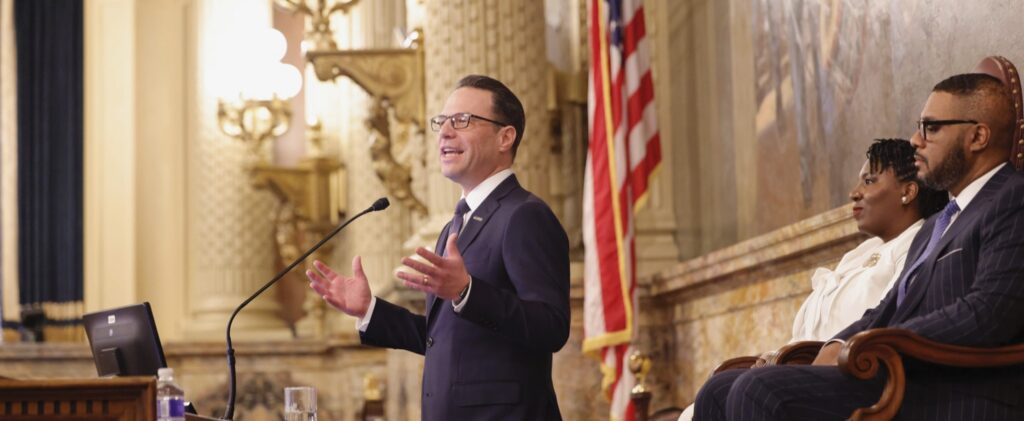
Gov. Josh Shapiro delivered his 2026-27 budget proposal in an 84-minute address before a joint session of the state House and Senate on Tuesday.
The budget calls for expenditures of $53.3 billion, while estimating the state’s revenues at only $48.68 billion with the shortfall requiring a transfer of $4.6 billion from the state’s reserves.
House Democrats were in a celebratory mood, while Senate Republicans called it a “rinse and repeat” budget that continues to ignore the structural budget deficit. While both sides outwardly said that they do not want another lengthy impasse like the one that occurred last summer and fall, it is clear that the battle lines are drawn for a contentious negotiation.
“While challenges remain — this budget puts forward commonsense solutions to protect Pennsylvanians and position our Commonwealth for long-term success,” wrote Shapiro in his budget brief. “With sound fiscal policy, we can build on the progress we’ve made, strengthen our Rainy Day Fund, and secure a brighter future for the Commonwealth.”
Shapiro once again called for the legalization of recreational cannabis and the regulation of skill games that could generate approximately $1.5 billion. He also praised his administration’s ability to deliver for Pennsylvania, touting the state’s unemployment rate that has remained below the national rate for 31 straight months; having more young farmers under the age of 35 than any other state; producing more energy than ever before; securing the largest private sector investment in the history of the Commonwealth in Luzerne and Bucks counties; and landing the biggest life sciences deal in Pennsylvania history.
“The investments we’ve made are paying off — our economy is growing and in the first seven months of this fiscal year, we’ve collected $417 million more in revenue than estimated,” said the governor. “Our bond rating has gone up not once but twice, resulting in taxpayer savings of more than $200 million.
“What we’re doing, together, is working.”
He proposed to create a Federal Response Fund seeded with $100 million to help “mitigate any future actions – or inactions – by the federal government that threaten services Pennsylvanians rely on.”
“You see, Pennsylvanians pay $158 billion in federal taxes every year — and we expect to get something for that money. And the federal government hasn’t just tried to unlawfully withhold funding for public safety — they’ve also tried to do that with dollars for plugging abandoned wells, providing health care for rural communities, improving school infrastructure, and even providing food benefits through SNAP.
“They’re breaking the compact they made with the people of Pennsylvania.”
Other initiatives included the creation of GRID – or the Governor’s Responsible Infrastructure Development standards – designed to hold data center developers accountable to strict standards if “they want our full support.
“First, developers must commit to bringing their own power generation — or paying entirely for the new generation they’ll need and not saddling homeowners and businesses with added costs because of their development. Second, developers must commit to strict transparency standards and direct community engagement. Third, these projects need to hire and train local workers. And fourth, they must commit to the highest standards of environmental protection, especially water conservation.”
Shapiro also called new restrictions on AI “companion” chatbots and for the banning of cell phones in schools.
“Students need to spend less time focused on their phones and more time focused on learning, on talking to their friends face to face, and on developing the critical skills they’ll need later in life, ” he said.
The governor also returned to one of his favorite targets, calling once again for Pennsylvania to raise its $7.25 per hour minimum wage, while noting it has been 7,150 days since the Commonwealth last passed legislation to raise the minimum wage.
While criticizing Senate Republicans for not taking up bills sent to the chamber by the Democratic-controlled House, Shapiro offered another reason for the GOP to reconsider.
Citing data that showed raising the wages of 61,000 people who currently rely on Medicaid and make less than $15/hour, he said the raise “will save this Commonwealth $300 million a year on entitlement programs like Medicaid.
“If you aren’t going to do this because it’s the right thing to do… because it would let more families put food on the table for their kids, then do it because it’s going to save us $300 million and shrink our entitlement budget by growing our workforce and putting more money back in our workers’ pockets.”
“This budget builds on real progress by staying focused on the people we serve,” said Lieutenant Governor Austin Davis. “I’ve had the privilege of meeting Pennsylvanians who are making their communities safer, teaching our youngest learners, and fighting for victims’ voices to be heard. This budget has their back — investing in afterschool programs, community organizations addressing gun violence, early childhood education and child care, and support for victims of crime. These investments will give every Pennsylvanian the tools to succeed today and build a stronger future.”
“Today’s budget address was more of the same from the Governor: more spending, the promise of new programs that have yet to help Pennsylvania families, all while sending the bill to taxpayers,” said Republican gubernatorial hopeful Stacy Garrity. “In what World does Josh Shapiro think he can fund a $53.3 billion budget when he couldn’t cover last year’s $50 billion budget? Governor Shapiro’s budget is the largest in Pennsylvania history, and it is unsustainable, irresponsible, and reckless.”
“This budget doesn’t raise taxes — in fact, it continues to cut taxes,” said Shapiro. “And it doesn’t require a broad-based tax increase today, tomorrow, or at any point in the next five years. Listen, I know some of you try to score political points by saying that it does — but saying that doesn’t make it true.”
“Governor Shapiro’s budget proposal is exactly what you’d expect given his record – reckless, unaffordable spending dedicated to partisan, special interests,” said Andrew Lewis, president and CEO of the Commonwealth Foundation.
“Rather than addressing crucial policy changes to make Pennsylvania more competitive, students more successful, and energy more affordable, Gov. Josh Shapiro has chosen instead to threaten a tax increase and raid the state’s Rainy Day Fund to pay for mass transit bailouts and bloated bureaucracies.”
“Over the past three years Democrats have delivered for Pennsylvanians by cutting taxes for families, funding our schools, strengthening public safety, and growing our economy,” said Speaker of the House Joanna McClinton (D-Delaware/Philadelphia). “The budget Governor Shapiro outlined today keeps us on course with smart and thoughtful investments in our future, while addressing some of the biggest challenges impacting our neighbors.”
“Governor Shapiro understands working people and the struggles they are facing in Pennsylvania,” said Angela Ferritto, president, Pennsylvania AFL-CIO. “From initiatives and investments in child care and public education to housing and energy affordability, this budget includes investments that help working families advance during difficult times.”
Shapiro has called together the leaders of the four caucuses to meet in his office on Wednesday to begin the budget negotiating process.
Steve Ulrich is the managing editor of Politics PA, where this piece originally appeared.

Same old crap. No evaluation of existing programs, just add new ones and pay for them with unsustainable taxes on items (skill games, cannabis) the governor thinks are popular tax targets. Skill games for example, the loss of the use of these revenues truncated by taxes means non-profit charitable organizations will have to give up or severely reduce making donations to community services, for those convenience store needing the revenue to survive, they will be just collateral damage. Interestingly, the 51% tax is just what the casino industry has been lobbying for, now they have the happy outcome of seeing competitors go out of business. Cannabis is even sketchier. It isn’t legal for recreational use, and as has been shown in other states, California, Colorado, etc. taxes add a cost burden making it cheaper when bought from your friendly street dealer, and the tax windfall expected, evaporates. I guess our governor is trying to build a contribution base for a presidential run.
School District of Philadelphia’s budget: $4.6 Billion (using 40% of its reserves to avoid immediate budget cuts.) Almost 10% of the current TOTAL budget for the ENTIRE state of Pennsylvania. Think about that.
Confidence-Artist Shapiro: Wants to borrow +/-60% of PA’s reserve fund, in one shot, to balance his proposed budget?!?! Is this guy serious?
Why does he keep calling for the legalization of recreational cannabis? Is he oblivious to how that’s worked out for Oregon and Colorado?!
COLORADO) 1. overall behavioral health spending (including mental health and SUD) averaged around $2–2.5 billion annually in recent fiscal years. 2. Tax revenue from recreational marijuana sales approximately $255.4 million.
OREGON) 1. Statewide SUD treatment/recovery funding averaged around $500–$700 million in recent years. 2. Tax revenue from recreational marijuana sales highest report was $163 million (including adjustments or partial local).
Overall, on a NET basis, by legalizing recreational marijuana it actually cost those states a lot of money. Imagine that? Getting high on drugs has consequences. And it destroys families. The legal stuff there costs more, and the illegal stuff gets laced with more addictive and damaging fillers. Nobody on Gov Shapiro’s team knows that? They know that. So, what the heck is this guy trying to do to our families?
Gov Shapiro seems hell bent on making PA taxpayers fork out more money, and seems to want your family to get high on drugs. That’s essentially his message, right? Let’s get PA residents high so we can spend more money. What’s up with this bum? What an utter scum ball.
“Our economy is growing and in the first seven months of this fiscal year.” Yep, so are the WARN notices. Another clueless Governor.. he is such an embarassment.
None of the budget addresses the unfunded liability in Public School Employee Retirement System of the State Employee Retirement Fund.