 Commonwealth Media Services
Jeff Cole: Covering Shapiro
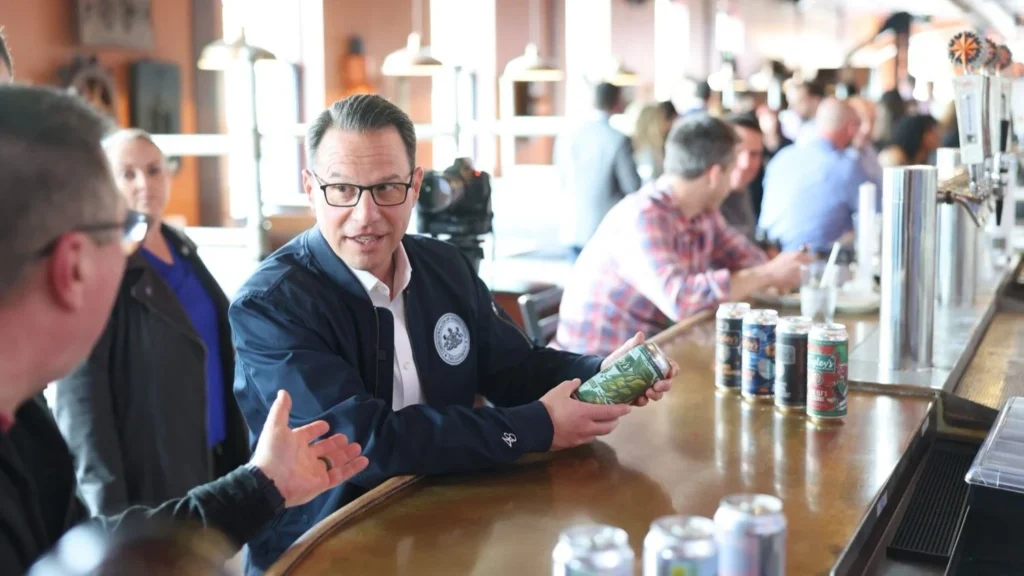
Josh Shapiro bounds across the stage at a Philadelphia community center sporting the costume of a careful, calculating politician on the move. Dark blue suit, crisp white shirt open at the collar paired with the stark white sneakers favored by younger men.
Shapiro, 52, bespectacled in dark, square frames, his hair slicked back, has come to launch his re-election as Pennsylvania’s 48th governor, flush with campaign cash and an eye to a bigger prize down the road.
“I can feel your love tonight,” he bellows to his supporters who cheer wildly as they wave signs with GSD emblazoned on them. The placards are a campaign-tell, a sure sign of Shapiro’s plan to campaign on his often-repeated phrase of, “get shit done” for the good people of Pennsylvania. “Shit” morphing into the much softer “stuff” depending on the ears of the audience.
On this evening, the second Thursday in January, Shapiro has already rallied in a union hall in Pittsburgh, hitting the same themes in both big cities of good schools, safe communities offering economic opportunities. He name-drops nurses, cops, and firefighters and speaks of the “value of hard work.” The Barack Obama cadence creeping into his voice, his speech peppered with “y’all,” Shapiro speaks of respecting citizens no matter, “what you look like, where you come from, whom you love or you pray to, or choose not to pray.”
Any reporter in the region with a pulse knew Josh Shapiro from his early days. A high-profile Montgomery County state representative who returned home to lead his county’s board of commissioners. I began covering him after he won statewide office as Pennsylvania’s Attorney General coming out of the blocks with a bombshell grand jury investigation of sexual abuse in the Catholic Church in six Pennsylvania dioceses.
Grand jurors found more than 1,000 children were sexually abused by hundreds of Roman Catholic priests while church leadership worked to hide it. According to the Associated Press, Shapiro said in an August 2018 press conference in Harrisburg, “The cover-up was sophisticated. And all the while, shockingly, church leadership kept records of the abuse and the cover-up.” The grand jury report pushed Shapiro into the national spotlight. The New York Times wrote a profile under the headline, “Meet Josh Shapiro, the Man Behind the Bombshell Investigation of Clergy Sexual Abuse.”
Crowded among a gang of reporters, peering around a bank of cameras, I covered scores of highly planned, multi-staffed, even stylized Shapiro press conferences on topics of ghost guns to nursing home abuse. When the attorney general calls a presser, reporters — especially TV reporters looking for stories they can squeeze into newscasts with looming deadlines — come running. Shapiro, standing with prosecutors and local police in uniform arrayed behind him, was disciplined at delivering soundbites: the short, pithy summary of the issue broadcast reporters are only too happy to drop into their 90 second stories. Always willing to take a few questions at the end — that’s when the fun started and I sure liked it.
Often with the loudest voice in the room and wanting to ask the first question and many more after that, Shapiro quickly noticed my style and often commented on it with humor. But the questions kept coming at every event I covered, and I sensed his reaction changed — occasionally suggesting I had talked over a colleague or had failed to give others a chance. In fact, after a scheduled sit-down interview on ghost guns, the unregistered, difficult-to-track firearms showing up at crime scenes, he told me I reminded him of a reporter who covered him as a state representative who, “tried to get him to say things he didn’t want to say.”
That’s not what I was doing. My goal was to press a statewide, high-profile leader, clearly with higher ambitions, to answer the tough questions of the day. On firearms, would he push for a controversial plan to limit legal gun purchases to one a month in a state with a politically active gun rights group? Or would he support forcing gun owners to alert law enforcement when their firearms are lost or stolen? Neither proposal is state law.
Shapiro did answer many of my questions at press conferences, but I learned when it came to some of the toughest, he was adept at slipping the punch. The final time I questioned him as governor, I repeatedly pressed if he believed the for-profit owners of a bankrupt Delaware County health system should face criminal charges. He wanted no part of it and despite my asking for his opinion, he told me to ask the attorney general.
Josh Shapiro has the pole position in his race for re-election. With a reported $30 million in his campaign coffers, he’ll flood the zone with broadcast and digital campaign ads. He’ll pair the power of incumbency with a go-everywhere campaign style and remind voters he’s the GSD guy who fixed a collapsed I-95 bridge in record time. He’ll face a tougher opponent this time in Republican State Treasurer Stacy Garrity, a proven vote-getter who’s already hammering Shapiro for looking beyond Pennsylvania to the bright lights of a run for the White House.
Will he run for president? Much can change in a few years, but the signs are all there. Where We Keep The Light: Stories From a Life of Service is expected to be in bookstores soon. He’s been the subject of recent profiles in national magazines and is a favorite on cable news shows. Newsom of California, Beshear of Kentucky, Whitmer of Michigan, Kelly of Arizona, and others may have similar plans leading to a tough Democratic primary. And then there’s JD Vance who’s accused Shapiro of doing a “bad impression of Barack Obama” while Shapiro calls Vance a “phony.”
The text came on my last day before ending 25 years of reporting on TV in Philadelphia. It read Governor Shapiro would like to speak by phone. I was not surprised he would reach out, and I wanted to speak with him.
He said while we didn’t always agree on issues he respected my work. I thanked him for the call and said I would watch as he ran for re-election and beyond. He chuckled, and knowing I was a Massachusetts native, and I was planning a return to New England, said he hoped I wouldn’t become a Boston Celtics fan. I told him it was too late.
Jeff Cole was an investigative, politics and policy reporter at Fox 29 in Philadelphia for 25 years. He is a two-time winner of the Weiss Award for Investigative Reporting, as well as the recipient of a series of Edward R. Murrow Awards and Associated Press Awards and four New England Emmy Awards for his investigative reporting.