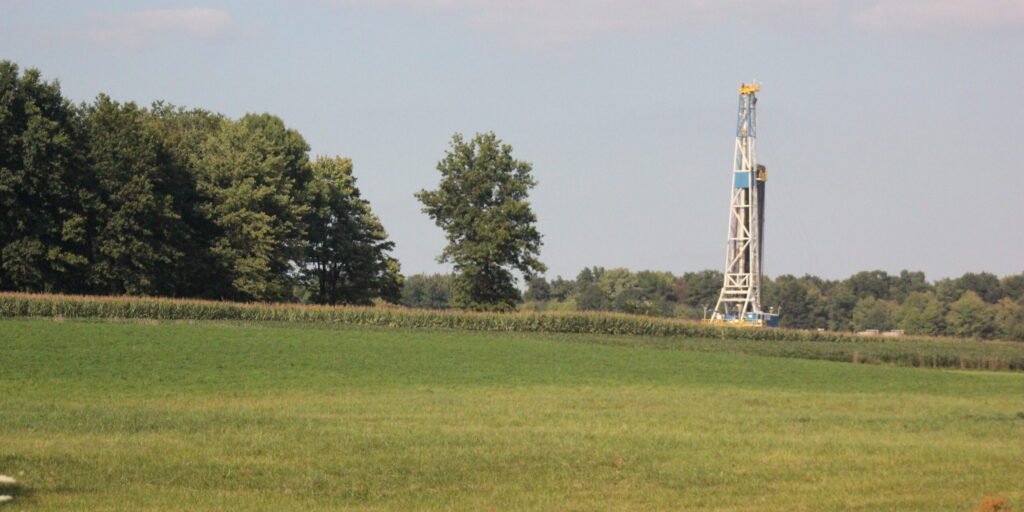
 Marcellus Shale Gas Well by WCN 24/7 via Flickr
Stephanie Catarino Wissman: Powering Pennsylvania in the ‘Demand Decade’
As America celebrates 250 years of independence, there is no better place to reflect on our nation’s future than Pennsylvania – the birthplace of American democracy and the keystone of U.S. energy leadership.
From the first commercial oil well in Titusville to today’s powerhouse natural gas production in the Marcellus shale, Pennsylvania continues to blaze trails as an energy leader and innovator. It’s here where American energy and ingenuity have helped shape our modern world.
This legacy matters now as we enter the “the demand decade”– a period of historic growth in electricity and energy demand driven by artificial intelligence, advanced manufacturing and a growing population.
The question is, will we meet this moment with realism and resilience, or allow restrictive politics and partisan gridlock to hold us back from U.S. energy dominance.
The state of American energy
At the American Petroleum Institute’s (API) 2026 State of American Energy event, which brought together industry leaders, policymakers and market analysts to examine the forces shaping America’s energy future as demand accelerates at home and abroad, API President and CEO Mike Sommers outlined the policy choices he said will determine whether the U.S. sustains its energy leadership during the demand decade, while also addressing recent geopolitical developments, including Venezuela, and their implications for global energy markets.
Nearly two decades ago, America produced just 5 million barrels of oil a day and relied heavily on imports, including from Venezuela.
Now, the U.S. producers more than 13 million barrels of oil per day – the most of any nation in the world – underpinning America’s energy security and economic strength.
Across the nation, the oil and natural gas industry supports nearly 11 million jobs and generates a staggering $2.1 trillion to the U.S. GDP, according to the PwC.
The keystone of America’s energy future
Pennsylvania is the heart of America’s energy success.
In 2006, the first exploration permit was issued in Pennsylvania, marking the first year of Marcellus shale gas production in the state.
Twenty years later, Pennsylvania is the second-largest natural gas-producing state, helping to power millions of households and businesses in the U.S. while providing critical energy to our allies overseas.
Pennsylvania holds vast underground natural gas resources, with estimates pointing to hundreds of trillions of cubic feet in reserves and boasts the most underground storage facilities in the U.S., offering about 763 billion cubic feet (Bcf) of total storage capacity for winter demand, which could power about 19 million homes for one year.
The Commonwealth is well-positioned to lead in meeting demand growth thanks to its abundant supply of natural gas, strong labor force and experience building state-of-the-art gas-fired power generation facilities.
The natural gas and oil industry is a key economic driver in Pennsylvania, supporting 400,000 jobs and $77 billion in economic impact.
Three policy imperatives
Last year ushered in numerous policy changes that will help unleash affordable, reliable and secure American energy. Electric vehicle mandates were lifted. U.S. liquefied natural gas permitting restarted. Oil and gas leasing onshore and offshore resumed.
This year, the focus must be on three critical areas: infrastructure, access and international competitiveness.
In Pennsylvania, there is an abundance of shale gas underground – and demand on the electric grid – yet the connection between the two is often blocked by red tape, delays and continuous lawsuits. Infrastructure is essential to moving energy from where it is developed to where it is needed.
The Mountain Valley Pipeline, which stretches from the Marcellus shale to the Carolinas, took an act of Congress to finish the job. This project took longer to permit and build than the entire Apollo space program.
In the Appalachia region, other pipelines projects were delayed or cancelled due to endless lawsuits and delays.
Modernizing our permitting system is vital to keep American energy moving and help meet accelerating demand.
Expanding energy access, not restricting it, can help bolster supply, and ultimately support a strained power grid. Policies that restrict production could make energy more expensive and less reliable. Our neighbors to the north know this all too well, with some of the highest home-heating costs due to limited access to abundant natural gas.
Although the U.S. is the world’s energy superpower, that status is not guaranteed. Maintaining international competitiveness is critical to America’s energy future. That is why punitive state proposals and extreme lawsuits that would retroactively penalize producers for meeting consumer demand, as well as regulatory proposals in Europe that would allow European bureaucrats to dictate rules for U.S. energy producers, are so harmful.
Across the U.S., and in Pennsylvania, energy affordability is a deepening concern. Leaders at both the state and federal levels are catching up to that reality and embracing pragmatic solutions that include permit reform and prioritizing affordability over ideology.
The same spirit of innovation and independence that defined the founding of America continues today – here in Pennsylvania and across the country. The U.S. leads the world in natural gas and oil production, and Pennsylvania plays a leading role in that success.
The decade of demand growth is upon us. Pennsylvania has the resources, the workforce and industrial might to help power America’s future – that is, if policy keeps pace.
Stephanie Catarino Wissman is the executive director of the American Petroleum Institute Pennsylvania based in Harrisburg, Pa.